Week 2 Challenge
1:Compare four different types of fuel cells and state their applications.
DIRECT METHANOL FUEL CELLS:
Most fuel cells are powered by hydrogen, which can be fed to the fuel cell system directly or can be generated within the fuel cell system by reforming hydrogen-rich fuels such as methanol, ethanol, and hydrocarbon fuels. Direct methanol fuel cells (DMFCs), however, are powered by pure methanol, which is usually mixed with water and fed directly to the fuel cell anode.
Direct methanol fuel cells do not have many of the fuel storage problems typical of some fuel cell systems because methanol has a higher energy density than hydrogen—though less than gasoline or diesel fuel. Methanol is also easier to transport and supply to the public using our current infrastructure because it is a liquid, like gasoline. DMFCs are often used to provide power for portable fuel cells applications such as cell phones or laptop computers.
POLYMER ELECTROLYTE MEMBRANE FUEL CELLS:
Polymer electrolyte membrane (PEM) fuel cells—also called proton exchange membrane fuel cells—deliver high power density and offer the advantages of low weight and volume compared with other fuel cells. PEM fuel cells use a solid polymer as an electrolyte and porous carbon electrodes containing a platinum or platinum alloy catalyst. They need only hydrogen, oxygen from the air, and water to operate. They are typically fueled with pure hydrogen supplied from storage tanks or reformers.
ALKALINE FUEL CELLS:
Alkaline fuel cells (AFCs) were one of the first fuel cell technologies developed, and they were the first type widely used in the U.S. space program to produce electrical energy and water on-board spacecraft. These fuel cells use a solution of potassium hydroxide in water as the electrolyte and can use a variety of non-precious metals as a catalyst at the anode and cathode. In recent years, novel AFCs that use a polymer membrane as the electrolyte have been developed. These fuel cells are closely related to conventional PEM fuel cells, except that they use an alkaline membrane instead of an acid membrane. The high performance of AFCs is due to the rate at which electrochemical reactions take place in the cell. They have also demonstrated efficiencies above 60% in space applications.
PHOSPHORIC ACID FUEL CELLS:
Phosphoric acid fuel cells (PAFCs) use liquid phosphoric acid as an electrolyte—the acid is contained in a Teflon-bonded silicon carbide matrix—and porous carbon electrodes containing a platinum catalyst. The electrochemical reactions that take place in the cell are shown in the diagram to the right.
The PAFC is considered the "first generation" of modern fuel cells. It is one of the most mature cell types and the first to be used commercially. This type of fuel cell is typically used for stationary power generation, but some PAFCs have been used to power large vehicles such as city buses.
MOLTEN CARBONATE FUEL CELLS:
Molten carbonate fuel cells (MCFCs) are currently being developed for natural gas and coal-based power plants for electrical utility, industrial, and military applications. MCFCs are high-temperature fuel cells that use an electrolyte composed of a molten carbonate salt mixture suspended in a porous, chemically inert ceramic lithium aluminum oxide matrix. Because they operate at high temperatures of 650°C (roughly 1,200°F), non-precious metals can be used as catalysts at the anode and cathode, reducing costs.
Improved efficiency is another reason MCFCs offer significant cost reductions over phosphoric acid fuel cells. Molten carbonate fuel cells, when coupled with a turbine, can reach efficiencies approaching 65%, considerably higher than the 37%–42% efficiencies of a phosphoric acid fuel cell plant. When the waste heat is captured and used, overall fuel efficiencies can be over 85%.
.
| CELL TYPE | COMMON ELECTROLYTE | OPERATING TEMP. | TYPICAL STACK SIZE | ELECTRICAL EFFICIENCY (LHV) | APPLICATIONS |
|---|---|---|---|---|---|
| Polymer electrolyte membrane (PEM) | Perfluorosulfonic acid | <120°C | <1 kW–100 kW | 60% direct H2; a 40% reformed fuel b |
Backup power Portable power Distributed generation Transportation Specialty vehicles |
| Alkaline (AFC) | Aqueous potassium hydroxide soaked in a porous matrix, or alkaline polymer membrane | <100°C | 1–100 kW | 60% c |
Military Space Backup power Transportation |
| Phosphoric acid (PAFC) | Phosphoric acid soaked in a porous matrix or imbibed in a polymer membrane | 150°–200°C |
5–400 kW, 100 kW module (liquid PAFC) <10 kW (polymer membrane) |
40% d | Distributed generation |
| Molten carbonate (MCFC) | Molten lithium, sodium, and/or potassium carbonates, soaked in a porous matrix | 600°–700°C | 300 kW–3 MW, 300 kW module |
50% e |
Electric utility Distributed generation |
Question 2:
Using a plot with energy density and power density on the X and Y axis, arrange various battery types like lithium ion, lead acid, Nickel Cadmium, Ultracapacitor, and fuel cell.
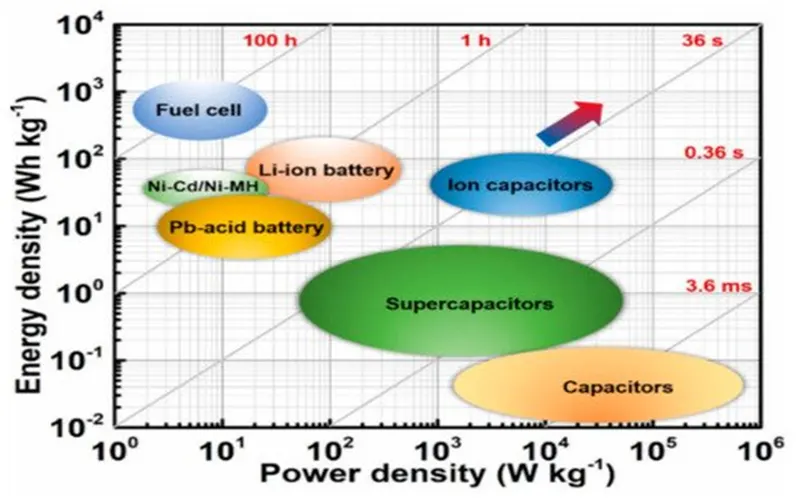
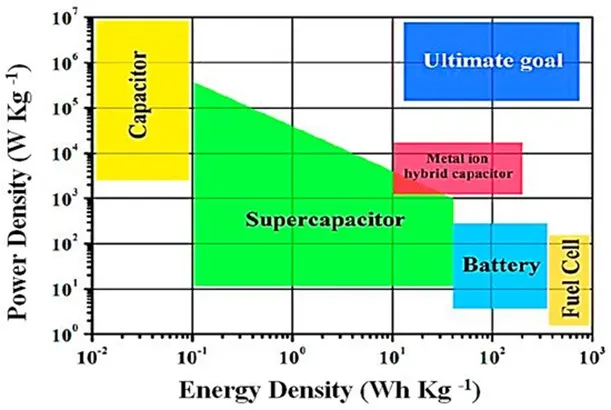
- In this figure, the power density of electrostatic capacitors is high with a low energy density
- Fuel cells have the highest energy density with a low power density
- The best option is electrochemical capacitors with better values of power and energy densities.
- The Ragone plot is very useful for estimating energy storage performance but ignores the critical features, such as cycle life, cost estimation, and safety for comparison between supercapacitors and batteries.
- For a better comparison and understanding of energy storage technology, it is important to consider safety, cost estimation, and cycle life. In supercapacitors, carbon nano-tubes, carbon nanofibers, and graphene are used.
- The main disadvantage of carbon nanotubes is the lack of solubility in aqueous media. The carbon nanofibers are toxic and graphene is bad for humans and the environment. Better electrode materials are required for the improvement of supercapacitors.
- The main difference in batteries and supercapacitors is the storage formula, energy storage amount, power restrictions, and life
- The cyclic life of a supercapacitor is 1 million to 30,000 h, i.e., extraordinarily higher than the batteries, which are 500 h, and the recharging time for the supercapacitor is remarkably low, i.e., 1–10 s vs. battery 10–60 min.
- One of the most attractive features of a supercapacitor is thermal stability, which is tuned by a wise choice of materials, including electrolytes.
- The operating temperature of the battery is between −20 and 60 °C, and that of the supercapacitor is between −40 and 100 °C.
- In supercapacitors, the potential energy is deposited in the electric field, whereas batteries store potential energy in the form of chemical energy.
- The batteries provide a higher energy density for the storage of power, while the supercapacitors have a faster charging and discharging capability, which makes them more attractive than the batteries.
- Supercapacitors are designed to provide (a) high power, (b) long stability, and (c) efficient storage because the electrodes are highly absorbable materials. However, their disadvantages, such as low energy density as well as specific capacitance, make them unfit for applications where energy is required long-term.
- The use of a scalable nano-porous graphene synthesis mechanism involves heating hydrogen; the graphene supercapacitors have a quality of energy density, better than lithium batteries.
- The supercapacitor is made up of spongy and porous material with an extraordinarily high specific area. The smaller pores of the plates increase the ESR, which finally decreases the specific power.
-
The supercapacitor fully charges within 1–10 s. The charging characteristics of a supercapacitor are similar to that of an electrochemical battery. The charging current is limited by the charger's current handling capability. The initial charging is very fast, but the topping charging takes extra time.
-
In constant current charging, a supercapacitor holds a voltage that rises linearly with time. During this constant current charging phase, the chargers typically monitor the output current, influencing the voltage across an external sensor (resistor) .
-
The lifetime of supercapacitors is more than batteries.
-
Even though the initial cost of the supercapacitors is very high, almost $2400–$6000 per kilowatt-hour for energy storage, and lithium-ion batteries are used for electric vehicles, with an initial cost $500 to $1000 per kWh; although the initial cost of supercapacitors high, in long term the supercapacitors are cheaper/comparable.