Week 2 Challenge
Q1.
Compare four different types of fuel cells and state their applications.
ANS: -
|
Fuel Cell Type |
Advantages |
Challenges |
OPERATING TEMPERATURE |
Applications |
|
1. Proton Exchange Membrane (PEM) |
· Solid Electrolyte reduces corrosion and electrolyte management systems · Low Temperature · Quick Start Up and load following |
· Expensive Catalyst · Sensible to fuel impurities |
50-100°C 122-212°F Typically, 80°C |
· Backup power · Portable Power · Distributed generation · Transportation · Specialty vehicles |
|
2. Solid Oxide Fuel Cell (SOFC) |
· High Efficiency · Fuel Flexibility · Solid Electrolyte · Suitable for power and Heating |
· High-Temperature corrosion and breakdown of cell components · Long Start-up time · A limited number of shutdowns |
700-1000°C 1202-1832°F |
· Auxiliary power · Electric utility · Distributed generation |
|
3. Alkaline (AFC) |
· Wider range of stable materials allows lower-cost components · Low temperature · Quick start-up |
· Sensitive to CO2 in fuel and air · Electrolyte Management · Electrolyte Conductivity |
90-100°C 194-212°F |
· Military · Space |
|
4. Direct methanol fuel cell (DMFC) |
· Ease of fuel delivery and storage · Low cost of Methanol · Operation at low temperatures and pressure |
· Still emits CO2 · Sluggish kinetics of methanol oxidation is much slower than that of hydrogen · Methanol crossover reduces cell voltage |
50 to 120 °C 122 to 248 °F |
· Store a high energy content in a small space, producing a small amount of power over a long period of time. · Military applications of DMFCs are an emerging application since they have low noise and thermal signatures and no toxic effluent · Portable Power Pack, Forklift, Golf Cart, Telecommunication Backup Power |
Q2
Using a plot with energy density and power density on the X and Y axis, arrange various battery types like lithium-ion, lead acid, Nickel Cadmium, Ultracapacitor, fuel cell.
ANS: -
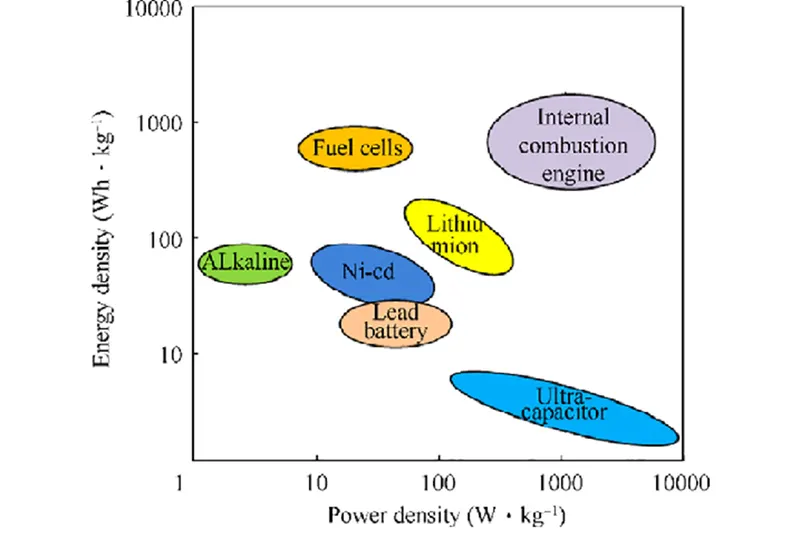
Fuel Cell (PEMFC) is the most popular fuel cell in EVs with high efficiency, long life, and low operating temperature relatively. Accumulators such as the lithium-ion battery, Ni-Cd battery, and Lead-acid battery cannot only store surplus power but also act as the emergency power source with enough capacity, and Lithium-ion battery is a better choice for EVs due to their high efficiency and lightweight. Ultra-capacitor is another typical bidirectional power source, in which power density and cycle life are much greater than batteries, and it is especially applicable to compensate peak power demanding from the load.