Week 2 Challenge
Question 1:
Compare four different types of fuel cells and state their applications.
Answer:-
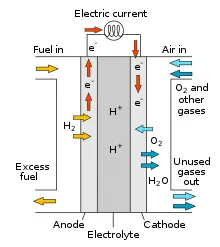
Fuel Cell
Fuel Cells
Fuel Cell was invented in 1838 but was used commercially much later by NASA. Typically, they used it in their satellites and other devices for their research to supply power. Today, you will find these being used in commercial and residential premises and industries. It can be used both as a primary or as a secondary source of power.
A fuel cell is a tiny device that has two electrodes namely, a cathode and an anode. These electrodes result in an electrochemical reaction inside the cell.
However, a fuel cell needs to have two important components to perform this reaction. These are:
- An oxidizing agent and
- Supply of fuel or an electrolyte.
When these two are cut off, the cell will stop generating electric power. The electrolyte is very important because it supports the movements of ions, to and from the electrodes.
Working Process of Fuel Cells
A fuel cell generates electricity via a chemical reaction by simply completing an electric circuit. The entire process is completed in a few steps which are as follows:
- At the anode, Hydrogen atoms are introduced. These atoms are known to carry a positive electric charge. However, these atoms are stripped of their electrons at this stage. These negatively charged electrons move and create a current through the wires.
- At the cathode, Oxygen atoms are introduced. These atoms combine with the leftover electrons of the hydrogen atoms. It can combine with it after it passes through the anode or at this stage itself. It all depends on the type of cell.
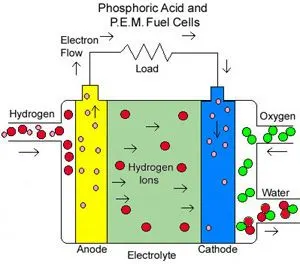
Working Process of Fuel Cells
The different reactions that take place involve:
- At Cathode: O2 + 2H2O + 4e- → 4OH-
- At Anode: 2H2 + 4OH- → 4H2O + 4e-
The net result of these two reactions is 2 H2 + O2 → 2H2O.
Sometimes, however, the reaction can be too slow and in such a situation a catalyst is used. Usually, platinum or palladium is used to expedite the reaction.
Types of Fuel Cells
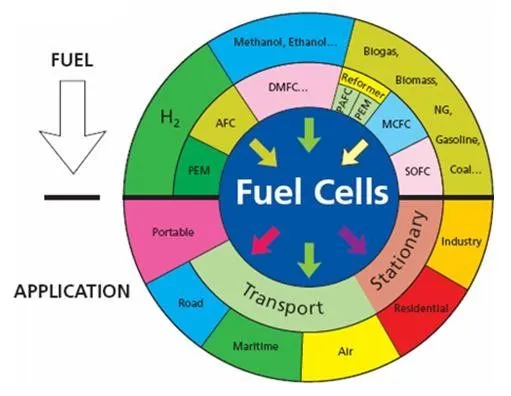
There are different types of fuel cells available in the market, though the working process is pretty similar in all. The various types of the fuel cell are:
- PEM or Polymer Electrolyte Membrane Fuel Cells, which are also known as Proton Exchange Membrane Fuel Cells, have an operating temperature of 50 to 100 degrees Centigrade while conducting protons. These cells consist of electrodes, bipolar plates, a polymer membrane, and a catalyst.
- Phosphoric Acid Fuel Cells contain phosphoric acid as their electrolyte. The operating temperature of these fuel cells is typically between 150 to 200 degrees Centigrade while they carry the positively charged Hydrogen ions. It is the non-conductive nature of this electrolyte that forces the electrons to pass through the cathode by completing an external circuit. However, the acidic nature corrodes the electrodes and oxidizes during the process.
- Solid Acid Fuel Cells work on either Cesium Hydrogen Sulfate, CsHSO4, or Cesium Dihydrogen Phosphate, CsH2PO4. The molecular structure of the solid acid material works in a specific order at a lower temperature. However, at a high temperature, conductivity can increase significantly due to the phase transition.
- Alkaline Fuel Cells use an aqueous alkaline solution. This solution helps to saturate the permeable milieu and helps in separating the electrodes. These cells operate at a temperature of 90 degrees Centigrade and are very efficient in producing heat and water apart from electric power.
- Solid Oxide Fuel Cells come with a solid oxide or a ceramic electrolyte like the Yttria-stabilized Zirconia. These low-cost cells are also very efficient. However, it operates at a very high temperature. The standard operating temperature of these cells can be 600°C and 1000°C at the two extremes of the temperature scale.
- Molten Carbonate Fuel Cells are powered by natural gas or biogas and use Lithium Potassium Carbonate salt as its electrolyte. It turns liquid at high temperatures to help the carbonate ions move. These cells also have a very high operating temperature of more than 650°C. However, the electrolyte corrodes the anode and cathode of the cells for its high operating temperature.
Applications
Fuel cell technology is very useful and has a wide and varied range of applications. A few of them include but are not limited to:
- Electric and eco-friendly vehicles
- Spaceships and space expeditions
- Electronic devices and
- Military applications.
The byproducts of the fuel cells, in the form of heat and water, are also very useful. Also, in remote areas, fuel cells are used as a primary electrical source or as a backup. It can also be used to power up cell phones, other appliances, and even households.
Advantages
There are lots of different advantages of using fuel cells. A few of them are:
- These are more efficient in comparison to any regular combustion engine since they do not undergo a double conversion process.
- These cells save wasteful emissions of greenhouse gases. It not only conserves energy but creates heat and water as its byproducts.
- These cells are consistent and more stable, reliable, and convenient to use because the parts in them or around them need minimal or no movement.
- The working process involves atom separation and is very clean, ergonomic, and is very useful for preserving natural resources.
- These cells are very easy to combine with other technologies such as solar panels and turbines.
- Most importantly, the fuel cells are considered to be extremely scalable in comparison to a traditional cell. Depending on the need, these cells can generate electric power from a few watts to several megawatts.
- Fuel cells are the most energy efficient devices for extracting power from fuels.
- Capable of running on a variety of fuels, including hydrogen, natural gas, and biogas, fuel cells can provide clean power for applications ranging from less than a watt to multiple megawatts.
- Fuel cell properties:
- High ionic conductivity (which results in high efficiency)
- Impermeability to gases
- Negligible electronic conductivity
- Chemical stability under a wide range of conditions
- Good mechanical integrity
- Fuel cells are composed of an anode, cathode, and an electrolyte membrane.
- Fuel cells work by passing hydrogen through the anode of a fuel cell and oxygen through the cathode.
Each fuel cell technology has advantages and challenges.
| FUEL CELL TYPE | COMMON ELECTROLYTE | OPERATING TEMPERATURE | TYPICAL STACK SIZE | ELECTRICAL EFFICIENCY (LHV) | APPLICATIONS | ADVANTAGES | CHALLENGES |
|---|---|---|---|---|---|---|---|
| Polymer electrolyte membrane (PEM) | Perfluorosulfonic acid | <120°C | <1 kW–100 kW | 60% direct H2; a 40% reformed fuel b |
Backup power Portable power Distributed generation Transportation Specialty vehicles |
Solid electrolyte reduces corrosion and electrolyte management problems Low temperature Quick start-up and load following |
Expensive catalysts Sensitive to fuel impurities |
| Alkaline (AFC) | Aqueous potassium hydroxide soaked in a porous matrix, or alkaline polymer membrane | <100°C | 1–100 kW | 60% c |
Military Space Backup power Transportation |
Wider range of stable materials allows lower cost components Low temperature Quick start-up |
Sensitive to CO2 in fuel and air Electrolyte management (aqueous) Electrolyte conductivity (polymer) |
| Phosphoric acid (PAFC) | Phosphoric acid soaked in a porous matrix or imbibed in a polymer membrane | 150°–200°C |
5–400 kW, 100 kW module (liquid PAFC) <10 kW (polymer membrane) |
40% d | Distributed generation |
Suitable for CHP Increased tolerance to fuel impurities |
Expensive catalysts Long start-up time Sulfur sensitivity |
| Molten carbonate (MCFC) | Molten lithium, sodium, and/or potassium carbonates, soaked in a porous matrix | 600°–700°C | 300 kW–3 MW, 300 kW module |
50% e |
Electric utility Distributed generation |
High efficiency Fuel flexibility Suitable for CHP Hybrid/gas turbine cycle |
High temperature corrosion and breakdown of cell components Long start-up time Low power density |
| Solid oxide (SOFC) | Yttria stabilized zirconia | 500°–1,000°C | 1 kW–2 MW | 60% f |
Auxiliary power Electric utility Distributed generation |
High efficiency Fuel flexibility Solid electrolyte Suitable for CHP Hybrid/gas turbine cycle |
High temperature corrosion and breakdown of cell components Long start-up time Limited number of shutdowns |
Question 2:
Using a plot with energy density and power density on the X and Y axis, arrange various battery types like lithium ion, lead acid, Nickel Cadmium, Ultracapacitor, fuel cell.
Answer:-
Why Does Battery Energy Density Matter?
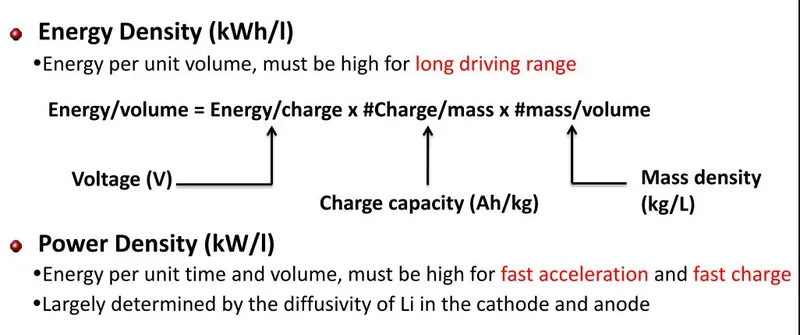
Battery energy density is crucial because the higher the energy density, the longer the battery can emit a charge in relation to its size. That being said, high energy density batteries can be useful when there isn’t much room for a battery but you need a lot of energy output. Smartphones and other handheld devices are great examples of this.
Let’s pose the benefits of energy density as a question: Would you rather have a small, lightweight battery that emits power for long periods or a heavy battery that takes up a lot of space and only provides a small amount of energy?
Almost everyone would say the former. This is why high energy density is vital in our world.
Energy Density vs. Power Density in Batteries
It’s easy to confuse energy density and power density because they’re similar in certain ways. They both measure an electrical characteristic of a battery in comparison to its weight.
Nevertheless, energy density and power density differ in one important way: while battery energy density measures the watt hours (wh) per kilogram (kg), power density measures the watt output per kilogram.
This is where power vs. energy comes into play. Power density measures how fast energy can be delivered, while energy density measures how much energy a battery holds.
What Are the Benefits of Using Batteries with High Energy Density?
Batteries with high energy density have transformed the mobile world. With more energy, we can fit useful batteries in smaller spaces. This enables long-lasting phones, laptops, earbuds, or medical devices.
They’re also very lightweight compared to past alternatives. Could you imagine carrying around a 5 lb iPhone? Or a 10 lb tablet?
More energy density also means we can pack a lot of energy into larger mobile devices like cars, planes, construction equipment, and robots.
What Are the Risks of High Energy Density?
When a battery packs more energy in it, it has more energy to release if something goes wrong.
The liquid electrolytes found in lithium-ion batteries are highly volatile and can lead to combustion, presenting a fire hazard. Because of this, there are safety features built into these batteries, limiting how lightweight and compact they can be.
Therefore, the higher the energy density of a battery, the more dangerous it can be, which poses limitations (and risks) to further advancement.
What Battery Currently Has the Highest Energy Density?
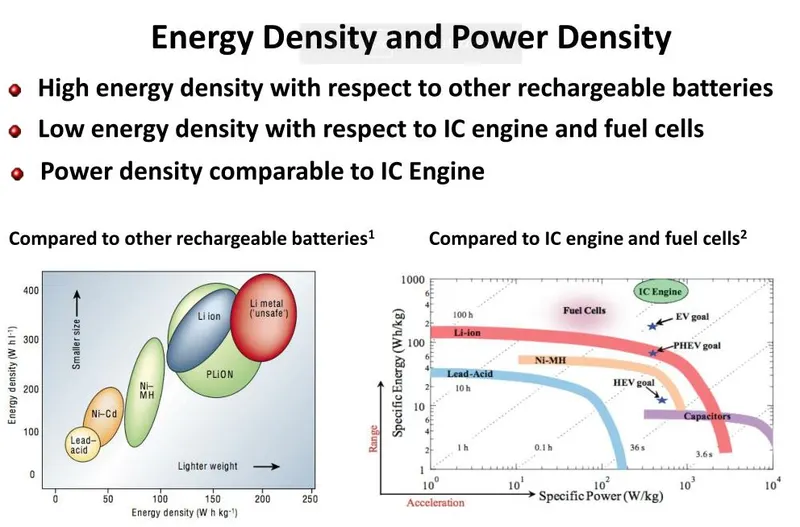
Hands down, lithium-ion batteries take the cake when it comes to high energy density. They’ve transformed our world with advancements in energy consumption and portability. In fact, lithium-ion batteries’ energy density ranges between 260-270 wh/kg, while lead-acid batteries range from 50-100 wh/kg.
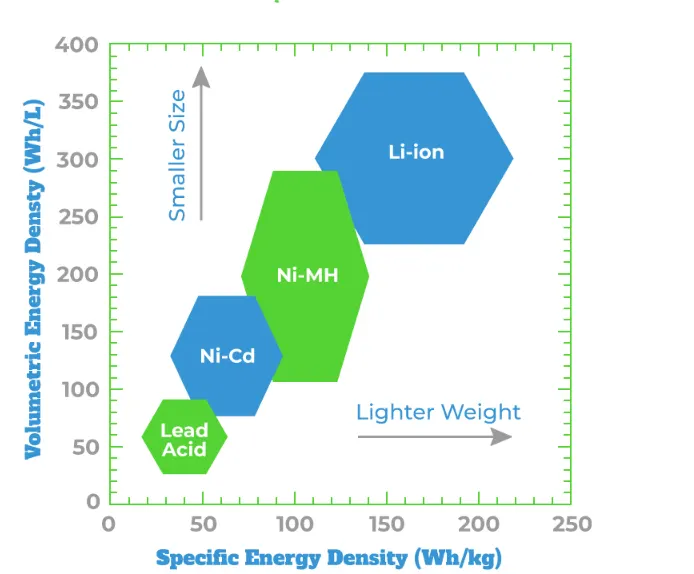
There have been many advancements in lithium-ion batteries over the last decade, specifically involving their chemistry. By using different materials for the anode and cathodes, engineers can experiment with electrochemistry and alter the energy density, power density, and more.
The lithium-ion battery with the highest energy density is the lithium cobalt-oxide battery. It uses cobalt oxide as the cathode and graphite carbon as the anode. Because of its high energy density, it’s popular for smartphones, laptops, watches, cars, and any compact device that needs to emit power over long periods.
In Li-Ion Batteries:-
Comparing EV battery and fuel cell energy density
By Jody Muelaner |
Battery electric vehicles (BEV) and fuel cell electric vehicles (FCEV) are two “zero-emissions” vehicles. Although none achieve zero emissions, as discussed below. The amount of energy stored in a battery or hydrogen tank for a FCEV can be measured in two ways:
- Energy Density: Energy per unit volume, also known as volumetric energy density
- Specific energy: Energy per unit mass, also known as gravimetric energy density. When referring to a fuel itself, specific energy is typically used. The term gravimetric energy density is typically used to refer to the combined energy per unit mass of a fuel tank and the fuel it contains.
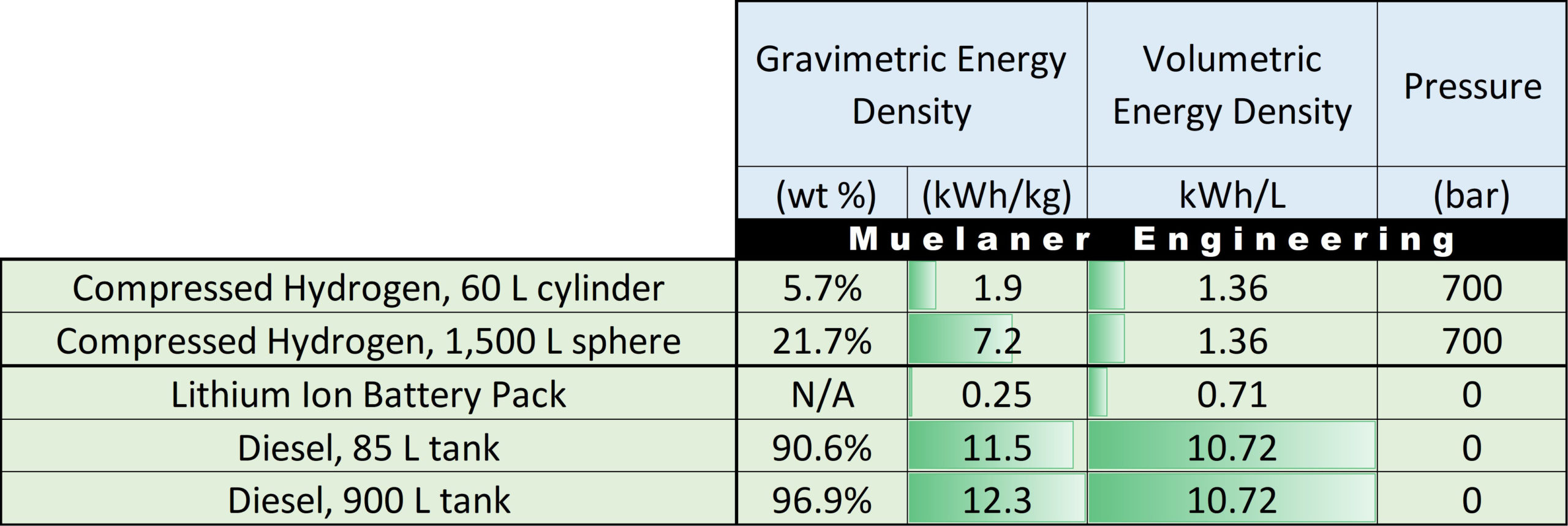
Batteries are a highly energy-efficient way to store electricity. Unfortunately, compared to liquid petroleum-based fuels, batteries store far less energy – both by volume and mass. Although the gravimetric energy density of a lithium-ion battery pack can be as much as 50 times less than a diesel tank, an internal combustion engine and gearbox are much heavier than an electric motor. The combined mass of the powertrain for a BEV is only about 30 percent heavier than a fossil-fuelled vehicle.
When it comes to hydrogen, the picture is even more confusing. Hydrogen itself is very light, giving it specific energy greater than liquid fuels. However, uncompressed hydrogen is extremely bulky and couldn’t fit into any practical vehicle. Compressing or liquifying hydrogen requires very high-pressure tanks, weighing far more than the hydrogen they contain. For example, the Toyota Mirai stores 5 kg of hydrogen compressed to 700 bar in composite tanks weighing 83 kg – a gravimetric density of 5.3%. The gravimetric energy density of a hydrogen tank in a car or truck is much lower than a tank containing liquid petroleum fuel.
The gravimetric energy density of a fuel tank depends on the tank’s size; bigger tanks have a higher energy density. This is because the volume increases by the cube of its dimensions, while the material used to construct the tanks depends on its surface area, which increased by the square of its dimensions. Imagine a cube, one meter in each dimension, with walls made from a material weighing 1 kg/m2. This would store one cubic meter of fuel and have an external surface area of six square meters, giving a weight of 6 kg/m3. If the dimensions are increased to two meters, the volume becomes eight cubic meters, and the surface area is 24 m2 giving a weight of 3 kg/m3. This is a linear relationship, assuming constant wall thickness, increasing the dimensions of a tank by x will divide its mass per unit volume by x. This means that the larger the vehicle, the more practical hydrogen becomes.
For passenger cars, hydrogen offers very little energy storage advantage over a battery once the additional mass of the fuel cell and the auxiliary battery is accounted for. This is demonstrated by the fact that state-of-the-art BEVs and FCEVs have a comparable range and electrical energy consumption at the motor. The actual energy efficiency of the FCEV is far lower than the BEV because of much more significant energy losses when producing hydrogen, transporting it, and then using it to generate electricity in the fuel cell.
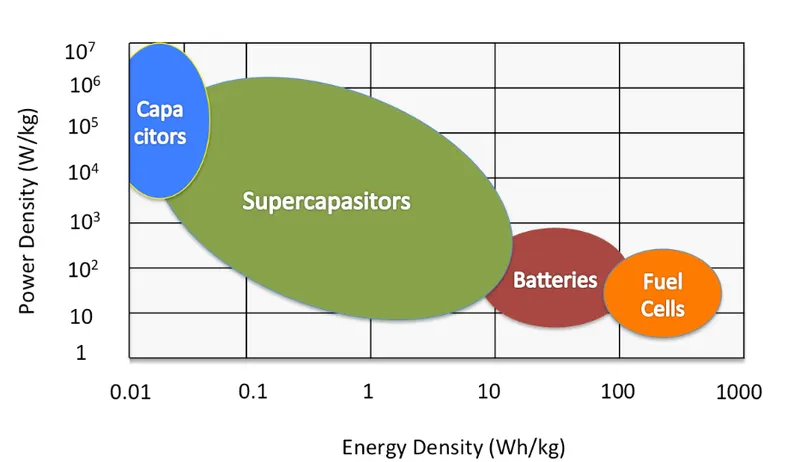
Electrochemical double layer capacitors, also known as supercapacitors or ultracapacitors, are energy storage elements with high energy density compared to conventional capacitors and high power density compared to batteries. Unlike conventional capacitors, where no chemical reactions is used and small amount of energy is stored by physically storing electric charges between two conductive plates upon application of an electric field, these electrochemical storage devices cross the boundary into battery technology by using special electrodes and electrolyte, and have capacitance values as high as 3500 Farads in a single standard case size with long cycle life (>100 000 cycles).
Supercapacitors are the preferred choice in applications requiring a large amount of energy to be stored and delivered in bursts repeatedly. Batteries have high internal resistances (ESR) that are too large to continue to consistently deliver high-power pulses without increasing the risk of performance failures. Supercapacitors ultra-rapid charging and delivery of high current make them an ideal candidate to balance loads on power grids, standby/backup power supplies, or peak-load enhancer for hybrid vehicles. In these applications, supercapacitors will supply power to the system when there are surges or energy bursts, while the batteries can supply the bulk energy since they can store and deliver larger amount energy over a longer slower period of time.