Week-11 Challenge: Braking
1)For a defined driving cycle, calculate the energy required for braking.
Answer:-
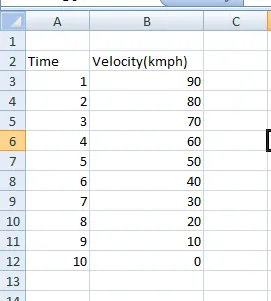
Defining the drive cycle in matlab:
Importing and running the simulation:-
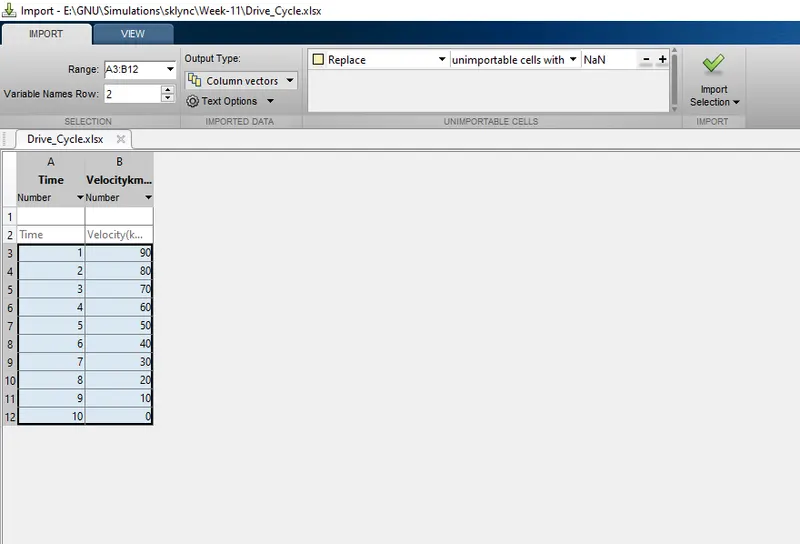
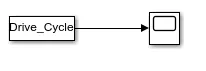
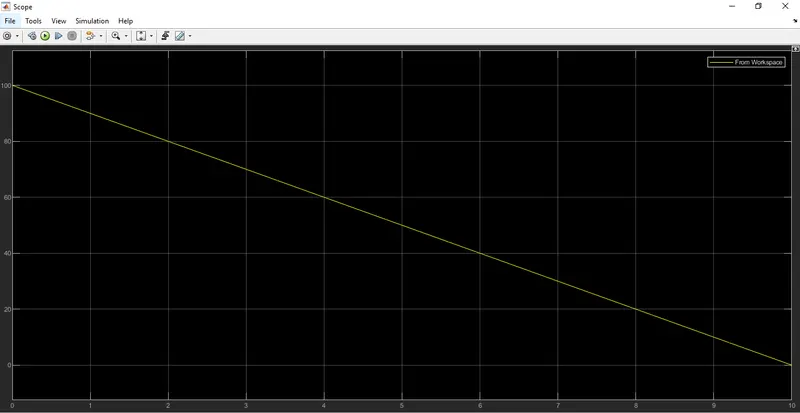
Now we can see the braking is happning from 100kmph to 0 kmph.
Kinetic energy can be given as=(1/2)*m*v^2
now mass of the vehicle m=500kg
Velocity Vi=100 kmph
Velocity Vf=0 kmph
time t=100 sec;
Energy=(1/2)*500*10^3*(100-0) =>As braking hence the 100kmph is initial speed and 0kmph final speed).
=25000000J
=25000KJ
2). Why electric motor can’t develop braking torque at high speed similar to starting? How electric and mechanical brakes are coordinated?
Answer:-
Torque Slip Characteristics of Three Phase Induction Motor
The torque slip curve for an induction motor gives us the information about the variation of torque with the slip. The slip is defined as the ratio of difference of synchronous speed and actual rotor speed to the synchronous speed of the machine. The variation of slip can be obtained with the variation of speed that is when speed varies the slip will also vary and the torque corresponding to that speed will also vary.
The curve can be described in three modes of operation-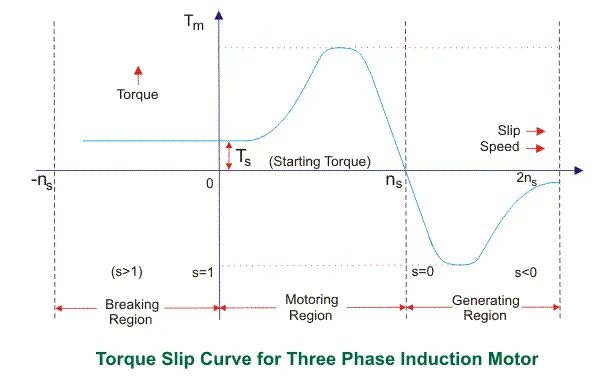
Braking Mode
In the Braking mode, the two leads or the polarity of the supply voltage is changed so that the motor starts to rotate in the reverse direction and as a result the motor stops. This method of braking is known as plugging. This method is used when it is required to stop the motor within a very short period of time. The kinetic energy stored in the revolving load is dissipated as heat. Also, motor is still receiving power from the stator which is also dissipated as heat. So as a result of which motor develops enormous heat energy. For this stator is disconnected from the supply before motor enters the braking mode.
If load which the motor drives accelerates the motor in the same direction as the motor is rotating, the speed of the motor may increase more than synchronous speed. In this case, it acts as an induction generator which supplies electrical energy to the mains which tends to slow down the motor to its synchronous speed, in this case the motor stops. This type of breaking principle is called dynamic or regenerative breaking.
Torque Slip Characteristics of Single Phase Induction Motor
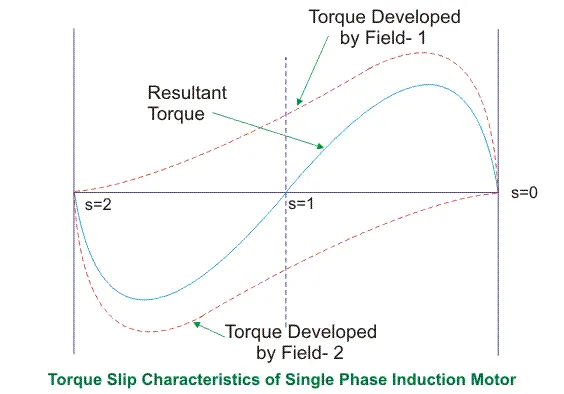
From the figure, we see that at a slip of unity, both forward and backward field develops equal torque but the direction of which are opposite to each other so the net torque produced is zero hence the motor fails to start. From here we can say that these motors are not self starting unlike the case of three phase induction motor. There must be some means to provide the starting torque. If by some means, we can increase the forward speed of the machine due to which the forward slip decreases the forward torque will increase and the reverse torque will decrease as a result of which motor will start.
From here we can conclude that for starting of single phase induction motor, there should be a production of difference of torque between the forward and backward field. If the forward field torque is larger than the backward field than the motor rotates in forward or anti clockwise direction. If the torque due to backward field is larger compared to other, then the motor rotates in backward or clockwise direction.
Types of Braking System:
[1] Electrical Braking
- Plugging
- Dynamic (or) Rheostatic braking
- Regenerative braking
[2] Mechanical Braking
- Compressed air brake (Pneumatic brake)
- Magnetic brake
- Vacuum brake
Various Types of Electrical Braking System:
Plugging:
- This is the simplest type electric braking.
- In this method, the torque of the motor is reversed.
- It makes the motor and the driven machine to standstill condition.
- A special device is required to cut off the supply as soon as the motor comes to rest.
- The Plugging braking method can be applied to AC and DC motors.
Dynamic braking:
- In this method of braking, the motor is disconnected from the supply
- Then operated as a generator driven by the kinetic energy of the rotor and the load.
- Thus the kinetic energy of rotation is converted into electrical energy
- This electrical energy is dissipated in the external resistance connected across the motor at the braking instant.
- The advantage of dynamic braking is that no energy is required from the supply to brake the motor.
- The Dynamic braking method can be applied to brake DC motors, induction motors and synchronous motors.
Regenerative braking:
- In the Regenerative braking method the motor is not disconnected from the supply.
- It remains connected to it and feeds back the braking energy or it kinetic energy to the system.
- As no energy is wasted in this method and it is supplied back to the system, thus overall energy is saved.
- Thus the regenerative braking is better than Plugging and Dynamic braking.
- This type of braking is used in traction whenever the train runs on down.
- The regenerative braking is applied to DC shunt motor, series motor and 3-phase induction motors.
At the starting time of motor, when we want to run the motor from standstill, the torque required is the maximum torque. At this time speed is less and torque is more for accelerating the motor. Now when deceleration happens at that time motor is running at higher speed, and to slow down or to stop the motor. This torque is not more then the accelerating toque because the motor is in flux weekning region, where it is having lesser torque.
The other reasons that electric motor is not generating same amount of braking torque is the charging rate of battries. The discharging rate of batteries lower than the peak discharging rate. Also the power converters should be bidirectional type to fed back the regenrative power.
Series Brking:-
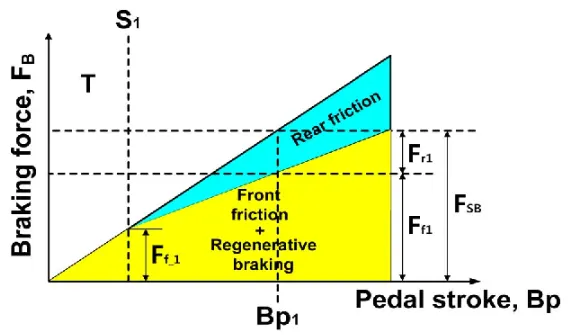
In this the brakes are applied one after the other. First the electric brake is applied and after that the mechanical brake is applied. Suppose we are riding vehicle and we can see the at some distance there is a traffic signal, then we wiil remove our leg from the accelerator paddle, hence vehicle will slow down and regenrative braking occurs, after that to stop the vehicle at traffic signal we are applying the mechanical brake. This is how the series braking works.
Parallel Braking:-
Bothe electrical and mechanical braking are applying at the same time.When the brake paddle is pressed the brake fluid will reach the brake piston and cause will retard the motion of wheels, there will be same kinetic energy lost. That kinetic energy lost will be reused at the same time by regerative braking to change the power using bi directional motor/generator so in this way both electric and mechanical brake will work at the same time.
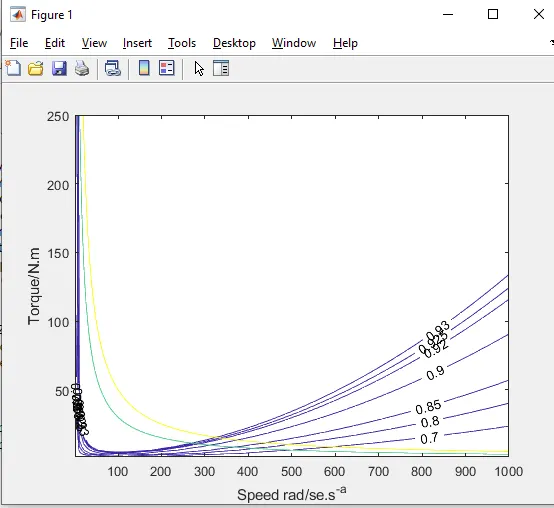
3)Make a MATLAB program which plots contour of given motor speed, torque and efficiency values. Attach the code as a .m file attach a screenshot of all the plots.
Answe
Matlab Code:-
clc
clear all
close all
x=linspace(1,1000);%motor speed in rad/sec
y=linspace(1,250);%motor torque in N-m
kc=0.2;%Cu losses
ki=0.008;%iron losses
kw=0.00001;%windage losses
Const_loss=20;%contstant motor losses
[X,Y]=meshgrid(x,y);%creating 3D array
Outputpower=(X.*Y);%power equation
B=(Y.*2)*kc;%Cu loss equation
C=X*ki;%iron loss equation
D=(X.^3)*kw;%windage loss equation
Inputpower=Outputpower+B+C+D+Const_loss;
Z=Outputpower./Inputpower;%efficiency
V=[0.70,0.80,0.85,0.90,0.92,0.925,0.93];
box off
grid off
[C,h]=contour(X,Y,Z,V);
clabel(C,h,'labelspacing',300);
xlabel('Speed rad/se.s^-^a')
ylabel('Torque/N.m');
hold on
V=[3000,5000];
contour(X,Y,Outputpower,V);
contour(X,Y,Outputpower,V);
Result:-