Project-1: Powertrain for aircraft in runways
Part A:-
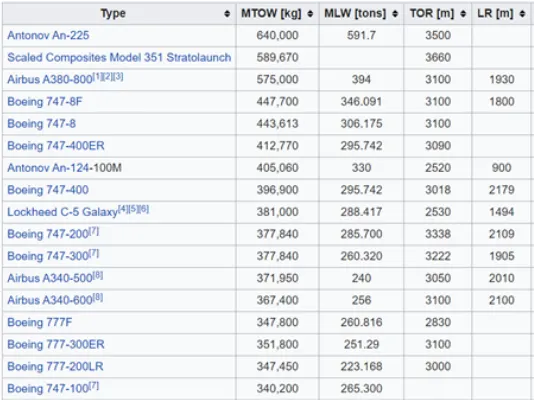
1)Search and list out the total weight of various types of aircrafts.
Answer:-
What Is The Aircraft?
Any vehicle that is manufactured and made to fly in the air is called an aircraft. While the aeroplane is the most known, familiar, and popular kind of aircraft we know, other vessels that fly through the air also come in this category. All of them have propellers and wings or machinery to run through the air; however, they may vary according to sizes, types, usage, and more.
Classifications Of Aircraft:
Before we get into knowing and studying different types of aircrafts, let us understand how are these aircrafts classified. In most common terms, there are two types of classifications for aircrafts. One is lighter than air aircrafts, known as aerostats, and the other is heavier than air aircrafts, called aerodynes.
Aerostats (Lighter Than Air): Aerostats or lighter than air aircrafts are very more lightweight in weight. These types of light aircraft generally use buoyancy like ships, which helps them float in the air. Low-density gas such as hydrogen, helium, or hot air balloons is used to fill in the aircraft. This low-density gas is lighter than air, hence the name. The most common types of aerostats known to us are hot air balloons and sky lanterns.
Aerodynes (Heavier Than Air): Alternatively, the other aircraft, heavier than air or aerodynes, as we understand, is much higher in weight and size. They push the gas or air downwards, which reaction helps to make aircraft upwards. Since these are dynamic through movements in the air, they are called aerodynes. This dynamic lift through the air can be caused mostly through mechanisms, as you must have already known.
- One is the fixed-wing classification, just like planes. In this category of fixed-wing aircraft, the entire mechanism is relied upon forwarding speed to create airflow all over the wings.
- Another mechanism is rotorcraft, which uses spinning rotors that are like wings. The helicopter is the most commonly known aircraft under this classification.
Types of Aircrafts:-
1. Amphibious:
Amphibious aircraft, otherwise also popularly known as an amphibian, is a multipurpose aircraft which can work, take off and land both water and ground. They are used as both seaplanes or flying boats, or also airplanes. In this aircraft, the engine is either placed in front or even above the wing, that is most commonly found in floatplanes. On the other hand, modern and other amphibious aircraft have engine and propeller placed above the wings. The size of amphibians differs as per the purpose; there are military amphibians, leisure purpose seaplanes, and civil amphibious aircraft.
2. Helicopters:
Helicopter aircraft, also known as a chopper, is commonly known to most of us and belongs to rotorcrafts. Horizontally spinning rotors help and aid the helicopter to lift and thrust. These aircraft have the advantage of taking vertically, horizontally, and fly both backward and forward or laterally. Unlike the other fixed-wing aircraft, these benefit from taking off and land at several places and flying even in congested areas. The engine depends on the size, purpose, and function of the chopper. Today, the helicopter is mostly used for military purposes, cargo, construction, rescue, tourism, aerial observation, and the government. The size of the chopper hence mostly depends on the usage.
3. Multi-Engine Piston:
As the name suggests, Multiple or Multi-engine piston aircraft has more than one single engine, unlike the other categories and types of aircraft. These multi-engine pistons are known to have a second power source, which is greatly helpful during another engine’s failure. Due to this multiple power and engine facility, the aircraft quality, capacity, speed, and climb rate is much higher than the usual air crafts. In most cases, this kind of aircraft is used by air services for their services and duties.
4. Biplanes:
Biplanes come under the category of fixed-wing aircraft. In this category, two wings come one above each other on both sides. This kind of plane is among the first aircraft to discover fixed-wing planes. The biplanes have lower weight but with excellent stiffness and efficiency. The biplanes are fitted with reciprocating engines. Only two adults, in most cases, can do these. In most cases, biplanes are spotted and used for army and military purposes of specific countries. These aircraft were among the most commonly used ones during world war times.
5. Balloons:
The balloon-type aircraft are standard aircrafts most of us are aware of and are mostly spotted during tourist activities. It comes under a kind of aircraft that floats in the sky and is much different from other airships and aircraft categories. While most confuse them with airships, the balloons are distinct in that they do not possess any engine and cannot change their direction, except for up and down. The balloon’s top is called an envelope, and the bottom part is a basket where people can sit. The most common ones in the category of balloons are hot air balloons.
6. Gliders:
Gliders come again under the category of fixed-wing aircraft. The types of gliders aircraft are used through air reaction against lifting surfaces and mostly do not use any engine. Although small engines may be used as required (in cases like a motor glider), most glider aircraft are efficient for self-take without engines. A wheeled undercarriage helps in take-off or landing. In the past, gliders are used for military purposes and wars; however, nowadays, we even see them in tourist activities and entertainment or leisure. The most common types in this category include hand gliders and paragliders. Most gliders are small in size and can fit a maximum of two people.
7. Gyroplanes:
Gyroplanes, also known as autogyro or gyrocopter, is a rotorcraft aircraft category that uses rotor machines to lift. They are similar to helicopters in appearance, although a bit narrow, and have an engine-driven propeller. The air flows help the gyroplanes lift upwards, and the rotor self-propels as per the way air flows through it. While gyroplanes or autogyros are mostly used for military and war purposes during the 20th century, nowadays, they are spotted in the Olympics and police departments at some states.
8. Parachutes:
Parachutes are the most common types we often hear and see. They are slow-moving air flowing craft that helps move through, creating drag to land. They are made through lightweight yet stable and fitting fabric such as nylon or silk. Most parachutes may be in the shapes of round, dome, or inverted dome. Although most parachutes are spotted during leisure activities and entertainment, they are also used and deployed by state and operations during expeditions to ice areas such as polar ends. Only one or two maximum can fit in one parachute.
9. Single Engine Piston Aircraft:
Like the multi-engine piston plane we have seen earlier. This aircraft uses only one engine. These aircraft are used for shorter distance works and not for heavy works. They can access smaller runways, takes less space, and has lesser climb and speed. Most single-engine pistons can fit only four to six people, depending on the plane and size.
10. Tricycle Gear Aircraft:
The tricycle gear aircraft is a kind of plane that has tricycle fashion fixed landing gear. The arrangement has a nose wheel in the front and two more in the main wheels. These are lightweight and are known to have better visibility of the ground, and is very easy to take off and land. The aircraft also has significantly less drag and allows the application of a full brake. They are used for lighter and quick uses, given the advantages of easy runs.
11. Business Jets:
Business or private jet aircraft are known to be among the luxurious or unique aircraft to transport and fly a small group of people, even individuals. While they are costly due to their design, plush appearance, and very sophisticated looks, the business jets are used by different classes of people – from government officials to armed forces for special operations to companies and private ownership. While the speed, engine, and other manufacturing are similar to airplanes, the size differs from lightweight or small jets to mid-sized ones to long business jets. The heavy and long jets can accommodate 16 to 18 people, whereas the mid-size (depending on the capacity) can accommodate up to 12 or 10 people. The smaller types of business aircraft are only for four to six individuals.
12. Taildraggers:
Taildraggers, also known as tail-wheel type gear draggers, consists of two main wheels at the forward size and a small-sized wheel to skid near the tail area. These are the conventional aircraft variety which uses such gear draggers instead of the modern tricycle propeller aircraft. These are the much lighter size and weight aircraft and can even be operated in skis. However, they have very poor visibility on the ground and are difficult during heavy wind conditions.
13. Tiltrotors:
Tiltrotors use powered rotors for propulsion and to generate lift. These powered rotors, also called proprotors, are added to rotating shafts of a fixed-wing. These use transverse rotor design and combines the vertical lift capability of a helicopter. The rotors, similar to the chopper, helps lift this aircraft. However, the propulsion is much more efficient and can avoid retreating blade stall, commonly seen in choppers. The speed and range are heavier and higher than a normal helicopter and almost near a fixed-wing aircraft. The altitude capability of tiltrotors is higher than helicopters.
14. Light-Sport Aircraft:
The light-sport aircraft, also known as LSA, differs from country to country. However, they are into the new category of small and very lightweight aircraft. These are super simpler to fly. Although they may be a bit heavier than ultralight aircraft, they are sophisticated and looks grand. These are two-seater versions and are much more affordable too.
15. Turboprops:
As the name suggests, turboprops or turboprop aircraft have gas turbine engines connected to the gears to turn the propeller to move them through and around the air. They burn much lesser fuels and have lesser operating costs too. These types of turboprops are larger than piston aircraft and can carry more passengers. These also fly high and can go to an altitude of 35000 feet. However, they are slower in speed than jet planes. The turboprop size varies according to the need and can fit a small set of people or up to eight or ten at maximum.
16. Floatplanes:
The floatplanes are similar to seaplanes, which floats on water through the floats mounted under the fuselage. These mounts are added instead of the undercarriage, where wheels are placed in other planes. These do not have landing gear, which makes it possible to land, in which case it becomes similar to amphibious aircraft (as seen earlier). Seaplanes or floatplanes are heavily used during world war times for military operations; however, they now are witnessed as more of a pleasure flight in many countries.
Various Weights on Aircraft:-
Manufacture's empty weight(MEW)
Also called Manufacturer's Weight Empty (MWE) or Licensed Empty Weight
It is the weight of the aircraft "as built" and includes the weight of the structure, power plant, furnishings, installations, systems and other equipment that are considered an integral part of an aircraft.
This excludes any baggage, passengers, or usable fuel2.
Zero Fuel Weight(ZFW)
This is the total weight of the airplane and all its contents (including unusable fuel), but excluding the total weight of the usable fuel on board.
As a flight progresses and fuel is consumed, the total weight of the airplane reduces, but the ZFW remains constant.
Maximum zero fuel weight (MZFW) is the maximum weight allowed before usable fuel and other specified usable agents (engine injection fluid, and other consumable propulsion agents) are loaded.
Operating empty weight(OEW) (Roughly equivalent to basic empty weight on light aircraft)
It is the basic weight of an aircraft including the crew, all fluids necessary for operation such as engine oil, engine coolant, water, unusable fuel and all operator items and equipment required for flight but excluding usable fuel and the payload.
Payload
It is the carrying capacity of an aircraft. It includes cargo, people, extra fuel. In the case of a commercial airliner, it may refer only to revenue-generating cargo or paying passengers.
Maximum takeoff weight(MTOW)
This is the maximum weight at which the pilot of the aircraft is allowed to attempt to take off3.
Regulated Takeoff weight (RTOW)
Depending on different factors (e.g. flap setting, altitude, air temperature, length of runway), RTOW or maximum permissible takeoff weight varies for each takeoff. It can never be higher than MTOW.
Maximum Landing Weight (MLW)
This maximum weight at which an aircraft is permitted to land3.
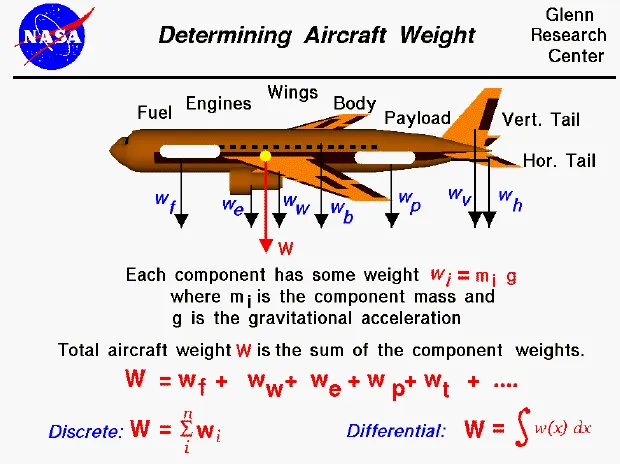
The following image depicts takeoff weight components.
Maximum ramp weight(MRW)
also called maximum taxi weight (MTW)
It is the maximum weight authorized for maneuvering (taxiing or towing) an aircraft on the ground.
Aircraft Gross weight
It is the total aircraft weight at any moment during the flight or ground operation. This decreases during flight due to fuel and oil consumption.
2)Is there any difference between ground speed and air speed?
Answer:-
Ground Speed:- It is the airplan's speed relative to earth's surace. One thing that should be noted here is that it's horizontal rather that vertical speed-an aircraft climbing completely vertcally would have a ground speed zero.
Air Speed:-
It is airplane's speed relative to the air it is flying in. Air speed is what determines whether there is enough airflow around an aircraft to make it fly.
true airspeed is simply the speed at which an aircraft is moving relative to the air it is flying in. As such, it’s also the speed at which the air is flowing around the aircraft’s wings.
Ground speed, on the other hand, is the aircraft’s speed relative to the ground. One thing that should be noted here is that it’s its horizontal rather than vertical speed – an aircraft climbing completely vertically would have a ground speed of zero.
In other words, while airspeed is what determines whether there is enough airflow around an aircraft to make it fly, ground speed is what determines how fast an aircraft will get to its destination.
3)Why is it not recommended to use aircraft engine power to move it on the ground at Airport?
Answer:-
It is used to describe the operation of the all engines, whilist on the ground for purposes of functionality checkingoperation. Either engines or aircraft systems.
It is usually take prior release the service of an aircraft from the maintenance. Ground running may be during rectificaton of the defect schedule work on engine or aircraft systems, when this requires engine to be operated in order to asses its function although aircrft may need to be towed to appear to ground running position under clearance from ATC. Most of the donot required for the pilots on board because aircraft technicians can be tired and approved for thoseduties.
The risks which may arise from engine ground running relate to the potential for loss of control of the aircraft by those persons occupying the pilot seats in the flight deck. In most cases, such persons will be maintenance personnel holding specific company-issued approval for the required tasks. The consequences of loss of control during taxi or towing are the same as apply to these operations generally and this article is concerned only with the risks arising from the static running of one or more aircraft engines. Unwanted consequences from such static running are mainly related to those arising from the unintended movement of the aircraft during engine running - effectively a loss of control - especially during high power engine running. Damage can occur to the aircraft itself, other aircraft nearby or to airside structures. In addition, there is a risk of injury to ground support personnel who may be in relatively close proximity to the aircraft.
4)How an aircraft is pushed to runway when its ready to take off?
Answer:-
- The pilot parks the aircraft in exactly the right place. Usually with the help of an automatic system, but occasionally guided by a marshaller waving two paddles or wands. Dozens of handling personnel are already standing by to perform a whole range of tasks simultaneously.
- As soon as the aircraft is stationary and the engines are switched off, the first priority is to disembark the passengers as quickly as possible. The apron handler places chocks in front of the wheels and connects the ground power. Meanwhile, the passenger bridge manoeuvres up to the door and a belt loader rolls up to the cargo hold. Luggage is unloaded and transferred to the terminal on baggage carts.
- Refuelling begins, usually from a hydrant at the stand. A hose is attached to this from a special vehicle called a dispenser, with the other side connected to the fuel tank in the wing.
- Now it is time to service the aircraft. The caterer loads new meals and takes away the food waste and used cutlery and crockery. Other activities include draining the lavatories, replacing the headrest covers, removing rubbish and distributing fresh blankets and in-flight magazine.
- A specialist team – or sometimes the crew themselves – cleans the cabin so that the new passengers board a pristine aircraft.
- Meanwhile, specialists from the airline conduct a technical check to make sure that the engines, wings, control surfaces, landing gear, instruments, doors and other equipment are in full working order.
- The aircraft is now ready for baggage to be loaded for the next flight. This is a quick process, on average taking only 10-15 minutes. A little later the passengers start boarding. As soon as they are all in their seats, the door is closed and the pilot informs air-traffic control that the flight is ready for departure.
- The apron handler removes the chocks. A so-called pushback truck reverses the aircraft into taxiing position, pushing it with a towbar attached to the nose-wheel strut. Or, in the most modern versions, by actually lifting the wheel. That speeds up coupling and decoupling.
- The aircraft taxis to the runway to depart at the agreed time.
- The pilot waits for permission to take off from air-traffic control. This is possible once the departure route is clear. As soon as the go-ahead is received, the plane takes to the air at full power.
5)Learn about take off power, tyre design, rolling resistance, tyre pressure, brake forces when landing.
Answer:-
Take off power:-
The stating power of aircraft is an important for each aircraft type parameter based on aircraft weight be related before every knownneed. It discribes the flight performance of the aircraft in the takeoff phase and should not be confused wit the pure engine performance.
The starting performance depends on many factors. These are the dead weight at take off, the take off speed the selected engine power,enviroment factor such as height of aircraft above MSL, the prevaling temperature, air pressure as well as wind direction and wind speed.
Tyre Design:-
Why are tyres important in Aircraft?
When it comes to safety, tyres are one of the most important components of aircraft. They help to absorb the shock of landing and provide cushioning. It also provides the necessary traction for braking and stopping of an aircraft.
An aircraft tyre is designed to withstand extremely heavy loads while landing, take off, taxing, and parking. The number of wheels required for aircraft increases with the weight of the aircraft, as the weight of the aeroplane needs to be distributed more evenly.
A Boeing 737NG & 737MAX uses 6 wheels, Boeing 787 uses 10 wheels, Boeing 777 uses 14 wheels and Airbus A380 uses 22 wheels. Aircraft tyres work under extreme conditions, carrying up to 340 tons and accelerating at over 250 km/hour at takeoff, in addition to enduring varied environmental stress when in flight and taxiing.
Design and Construction of Aircraft tyre
Carcass plies are used to form the tire. They are sometimes called casing plies. An aircraft tyre is constructed for the purpose it serves.
- They support the weight of an aircraft while it is on the ground.
- It also provides the necessary traction for braking and stopping of an aeroplane.
- Tyre also helps to absorb the shock of landing and provide cushioning the roughness of takeoff, roll-out, and taxi operations.
Unlike an automobile or truck tyre, it does not have to carry a load for a long period of continuous operation. However, an aircraft tyre absorbs the high impact loads of landing, and also it’s operating at high speeds for a short time when required.
Retreading – Retreading is methods of restoring a worn tyre by renewing the tread area or by renewing the tread area plus one or both sidewalls. Repairs are included in the tyre retreading process.
Load Rating – Load rating is the maximum permissible load at a specified inflation pressure.
Ply Rating – Ply Rating is used to identify the maximum recommended load rating and inflation pressure for a specified tyre. It is an index of tyre strength.
Speed Rating – The speed rating is the maximum takeoff speed to which the tyre has been tested.
Skid Depth – Skid depth is the distance between the tread surface and the deepest groove as measured in the mould.
Aircraft tyres must have an approved speed and load rating and have sufficient clearance when retracted through landing gear to allow for tyre growth. Tyre growth is the increase in the size of the tyre due to centrifugal forces at high speed.
Aircraft tyres may be Tube-type or Tubeless
Tubeless tyres are more advantageous over tube-type. There is no longer the use of tube-type tyre in recent aviation. Nowadays all airliners are using tubeless tyres. Tubeless that are meant to be used without a tube has the word TUBELESS on the sidewall of the tyre.
Aircraft tyres may be Radial or Bias
Almost all airliners are using Radial tyre. Bias is an older design, and it’s mainly used for road vehicles. Radial tyres have the word RADIAL on the sidewall. Radial tires are more expensive than bias-ply tyres. Radial tires are in demand because of their lower life cycle cost and long term value.
Tyres are conductive. Aircraft tyres are manufactured with tread rubber with conducting compounds to permit earthing of static charges. In early days when tyres were not sufficiently conductive, aircraft used to have a conductive strip hanging down from the axle of the landing gear. Upon landing, this strip would be the first part of the aircraft to touch the earth. This discharges any static electricity accumulated on the outer surfaces of the aircraft. Now you don’t see them anymore.
What is the purpose of Chines in aviation tyre
Chines are also called deflectors. Chine tyre used on the nose wheel of aircraft, specially fuselage-mounted jet engines. It diverts runway water away from the engine inlets.
Chines are circumferential protrusions that are moulded into the sidewall of nose tyres that deflect water sideways to help reduce excess water ingestion into the engines. Tyres may have chines on one or both sides, depending on the number of nose tyres on the aircraft.
Aircraft Tyre Standards
Each tyre manufacturer produces their own designs of the tyre with different tread patterns, wear patterns, wear limits etc, and in some cases, different names for the same part of the tyre. But all tyres must meet the approved standards before being accepted by the FAA or CAA.
All commercial aircraft tyres approved under FAA Requirement Technical Standard Order (TSO) C62. A TSO is a minimum performance standard for specified materials, parts, and appliances used on civil aircraft.
Rolling Resistance:-
For the most part, the rolling resistance of a tyre is on an average of 25%. The other major contributor to energy loss is aerodynamic drag. Chain rubbing and bearings are only 10% responsible for hindering faster driving. After about 40kmph, aerodynamic drag is the biggest factor working to stop you from reaching your top speeds.
In essence, no tyre has zero rolling resistance. However, theoretically speaking, if a tyre didn’t have internal friction and didn’t heat up, the force on the front and back section of the contact with the road would be the same. It means that there would be zero rolling resistance.
Lower rolling resistance means there is no energy loss due to the compression of the tyre with the road. The main reason for rolling resistance is that the force pushing the tyre backwards is much higher than the force pushing it forwards. You can say that any kind of rolling resistance is bad, but you cannot get rid of it.
High rolling resistance means a poor performing tyre. It will slow down your automobile, require more energy as the tyre will heat up more, and lead to using more engine power as well. It also increases fuel consumption, which eventually contributes to the high-levels of CO2 in the environment. So from a greener point of view, rolling resistance is a curse than anything else.
Factors That Impact Rolling Resistance
There are multiple key factors that affect rolling resistance. Let’s have a detailed look at them –
- Aerodynamic resistance
Around 15% of the total resistance comes from aerodynamic resistance. It is also known as the resistance of the surrounding air. As you increase the speed of the car, the aerodynamic resistance also increases. It is an important factor as decreasing will maximize your car speed without any problem.
- Weight
Another key factor is the weight of the vehicle with the tyres. A low-weight vehicle generally has less rolling resistance because it takes less energy to move it forward. It means that there is a less downward force that stops the vehicle from moving. Low-profile and narrow tyres are lighter than high-profile tyres. It is also impacted by the height of the tyre.
- Construction type
Believe it or not, the tread pattern and grooves on the tyre can reduce the rolling resistance by up to 60%. It is a crucial factor that ensures the tyre doesn’t require more energy to move the vehicle. The rubber compound and optimized tread pattern allow swift driving with low rolling resistance.
- Micro-skidding
It only contributes to about 5% of the rolling resistance. It is the loss of grip that happens due to the deformation of the tyres when it touches the road. It’s value increases when there is sudden braking or acceleration. Generally, on straight roads, it’s not more than 5%.
- Tyre pressure
Another significant contributor to high rolling resistance is tyre pressure. When the tyre pressure is low, it takes more energy for the tyre to drive the vehicle. Abnormal tyre pressure increases the tyre contact with the road surface. It generates more heat and leads to a high loss of energy. Insufficient tyre pressure can cause about 30% of the rolling resistance.
Tyre Pressure:-
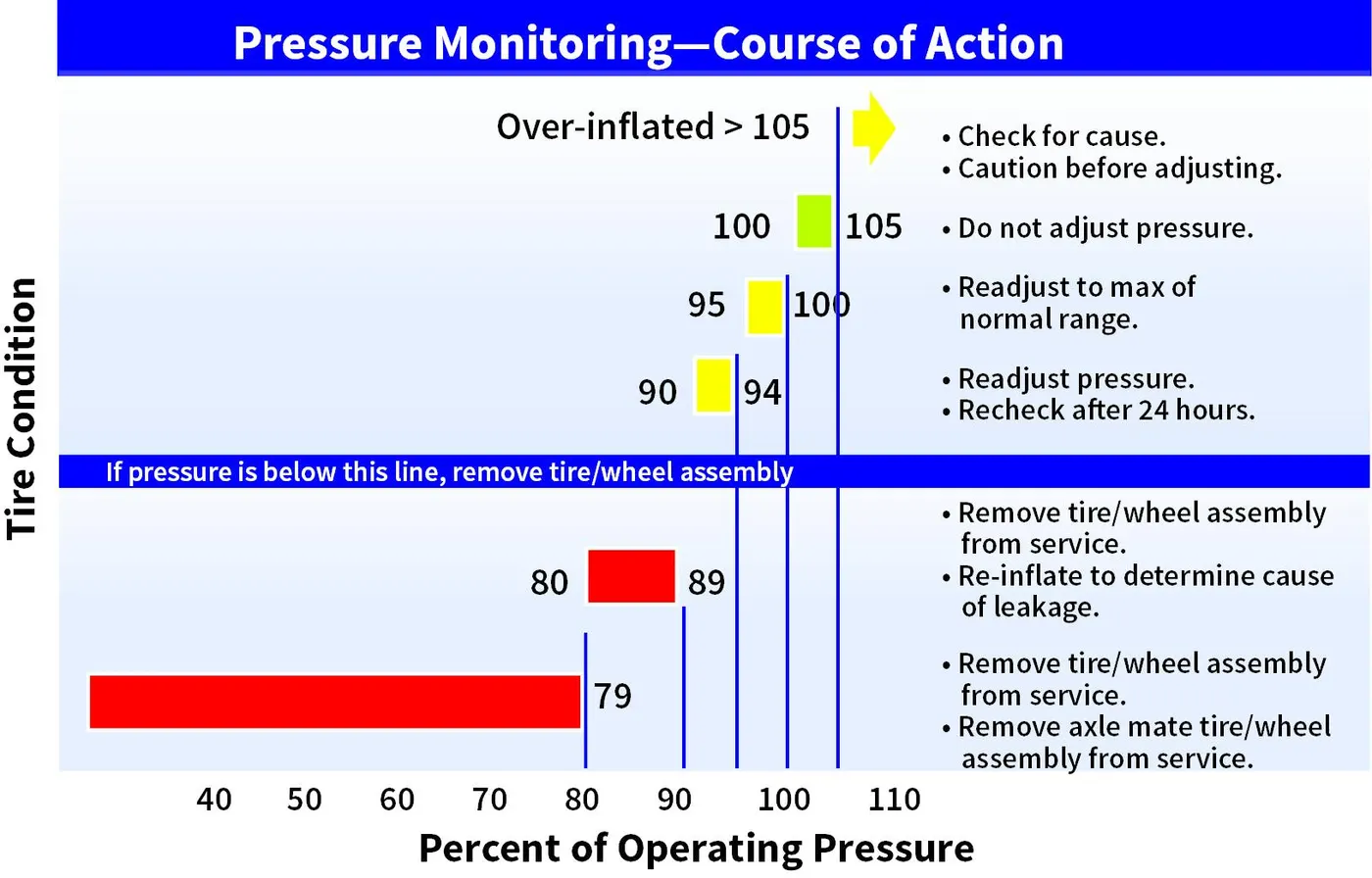
With good reason, aircraft safety concerns are paramount in maintenance operations. No one wants to see loss of life, injuries, or serious property damage as a result of poor aircraft maintenance. Aircraft maintenance manuals have very detailed, step-by-step procedures, tool, and parts lists. Certified inspectors must sign off on work cards, validating that the mechanic completed the job and completed it correctly. These procedures and checks and balances are all designed to insure the aircraft remains safe to operate. Making sure that the aircraft tires are properly inflated is a crucial part of preflight and routine service checks which can go a long way to maximizing tire utilization and minimizing risks to safe operations. At Michelin, we are committed to aircraft safety and we are proud to share our expertise with pilots, A&P mechanics, and the FAA.
Aircraft tires are not the same as passenger car or truck tires. As a result, their care and service requirements differ. Figure 1 below compares key parameters between a passenger car tire and two aircraft tires of about the same dimensions:
Car Tire Aircraft Tire Aircraft Tire
(Typical) (737 NLG) (F-16 Blk 40 MLG)
Size P205/75 R15 27x7.75 R15 27.75x8.75R14.5
Outside Diameter 27.2 inch 27 inch 27.75 inch
Selection Width 8.1 inch 7.75 inch 8.75 inch
Max Inflation 35 psi 200 psi 320 psi
Max Load 1,598 lbs. 9,650 lbs. 21,500 lbs.
Speed Rating 106 mph 225 mph 259 mph
Brake forces:-
How aircraft brakes work
The most common type of brake used on aircraft is the disc brake. Disc brake function by exploiting friction between rotating and stationary discs inside the brake.
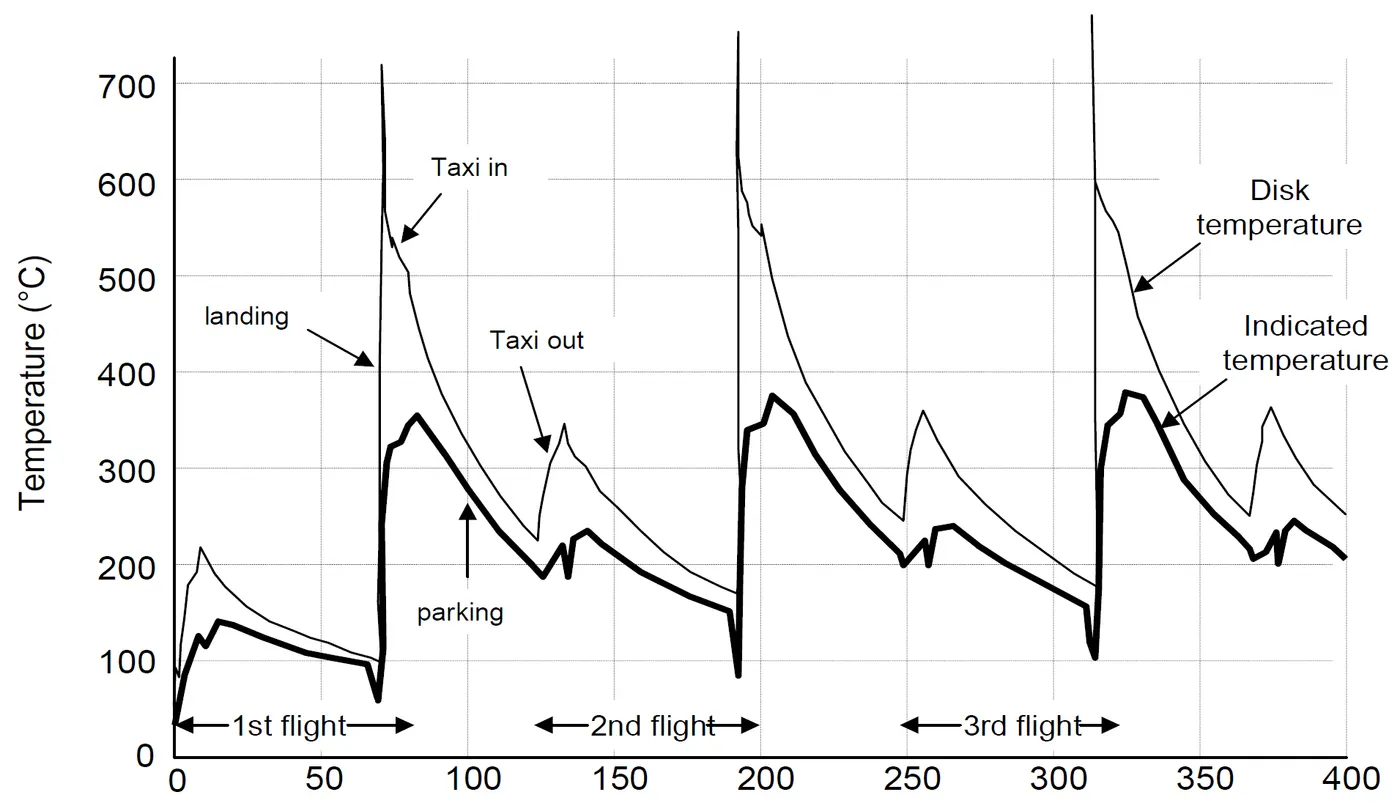
Upon receiving a command signal to brake — from the pilot depressing a foot pedal or from the autobrake system — actuators in the brake move a piston to squeeze the discs together, generating a frictional force that slows the rotation of the wheel. The friction between the discs generates heat as the aircraft’s kinetic energy is converted to heat energy. In this function, the brakes act as a heat sink, absorbing tremendous amounts of heat as the aircraft sheds kinetic energy. During RTO stops, the temperature of carbon disc brakes can exceed 1,800° C.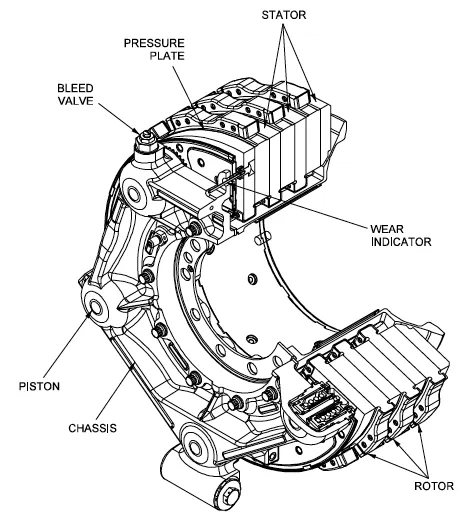 Gulfstream G450 main landing gear brake assembly. Source: G450 Maintenance Manual via Code 7700
The discs are mounted on a carrier assembly consisting of a torque tube, which resists and transmits brake torque to the landing gear structure. Sandwiched together between the carrier assembly housing and a backing plate, the discs are arranged in an alternating pattern of rotors and stators. Notch and groove geometry around the circumference of each rotor fits into corresponding geometry in the wheel, keying the rotors to the wheel so that they rotate with it. The stators are keyed to the torque tube and are thus held stationary since the torque tube is connected to the axle and landing gear structure.
Cylindrical spaces within the carrier assembly hold actuator piston. Braking occurs as piston force squeezes the discs together.
During each application of the brakes, disc material is worn away by frictional forces. A wear indicator in the form of a pin that protrudes out of the carrier assembly indicates the thickness of the stack of discs. Over hundreds of brake applications, material wears away and discs become thinner, requiring replacement following periodic maintenance intervals.
Brake design
The primary design considerations for aircraft brakes include the number of discs, the diameter of the discs and the material of the discs.
A major design point around which aircraft brakes are designed is the worst-case scenario of rejected takeoff (RTO) at the maximum rolling speed V1, known as the decision speed. Above V1, a takeoff could not be safely aborted without serious risk of the airplane failing to stop before the end of the runway. In this situation, the brakes need to absorb more energy than any other scenario.
Autobrakes and skid control
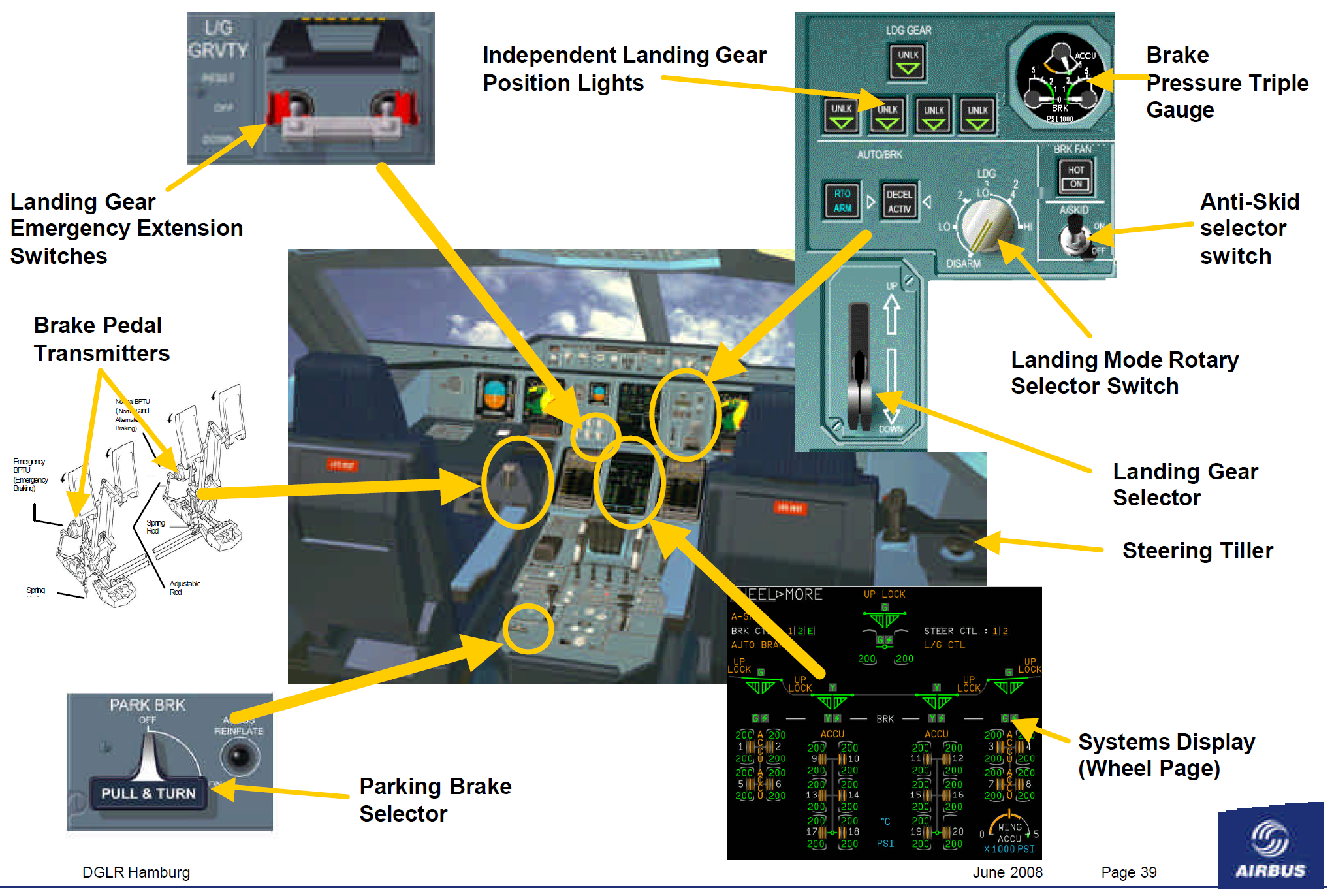
Modern commercial aircraft are equipped with an autobrake system that controls the deceleration of the aircraft by automatically optimizing the application of brake force independent of pilot operation of the brake pedals to minimize stopping distance, reduce pilot workload and smooth braking action.
Another common feature of aircraft brake systems is a skid control function. Similar to anti-lock brakes on an automobile, skid control systems prevent wheel lockup. They minimize stopping distance and prevent the negative effects of skidding on tires such as unnecessary tire wear and blowout. Skid control is accomplished by applying an optimal brake force that maximizes the coefficient of friction and remains just below the amount of force that would cause skidding. In one implementation, the proper force is arrived at by continuously sensing wheel speed and comparing it to a calculated aircraft velocity. The difference between the two values represents wheel slip and brake force is reduced if it rises above a specified value.
Part B:
6. A. With necessary assumptions, calculate the force and power required to push / pull an aircraft by a towing vehicle.
B. Develop the model for the calculated force and power using Simulink.
Answer:-
A)
Rolling resistance=coefficient*mass*gravity
Airdrag force=0.5*airdensity*frontal area*drag coefficient*speed
Now for aircraft:-
mass=170000kg
height=16m
width=45m
frontal area=height*width=16*45=720m^2
drag coefficient=0.0265
air density=1.225kg/m^3
speed=35kmph=9.27m/s
rolling resistance coefficient=0.02
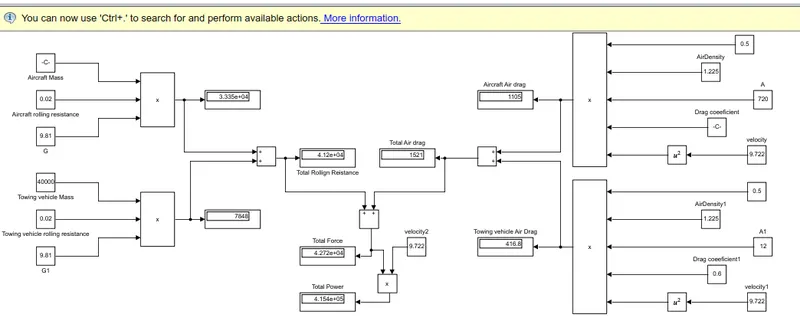
rolling resistance=0.02*170000*9.81=33354N
Airdrag Force=0.5*1.225*720*0.0265*9.777^2=1104.576N
Now for towing vehicle:-
mass=40000kg
height=3m
width=4m
frontal area=3*4=12m^2
tyre size=0.5588m
drag coefficient=0.6
air density=1.225kg/m^3
speed=35kmph=9.722m/s
rolling resistance coefficient=0.02
rolling resistance=0.02*40000*9.81=7848N
Airdrag force=0.5*1.225*12*0.6*9.722^2=416.851N
Total rolling resistance=Aircraft rolling resistance+towing vehicle rolling resistance=33354+7848=41202N
TOtal airdrag force=Aircraft airdrag force+towing vehicle airdrag force=1104.576+416.821=1521.397N
Hence total forces=41202+1521.397=42723.397N
and total power=F*v=42723.39*9.722=415356.8656W=415.356kW
B) Develop the model for the calculated force and power using Simulink.
Answer:-
Matlab Model
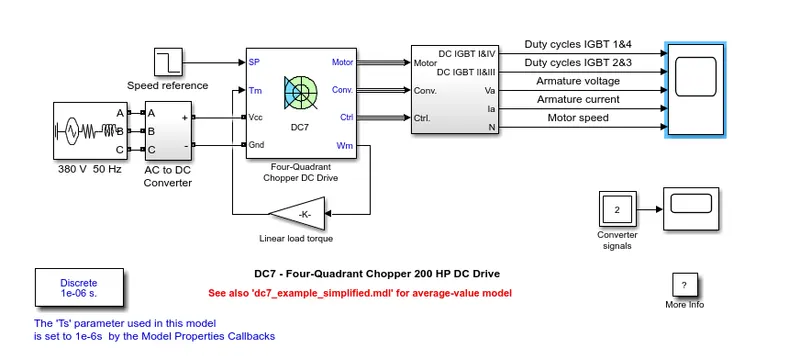
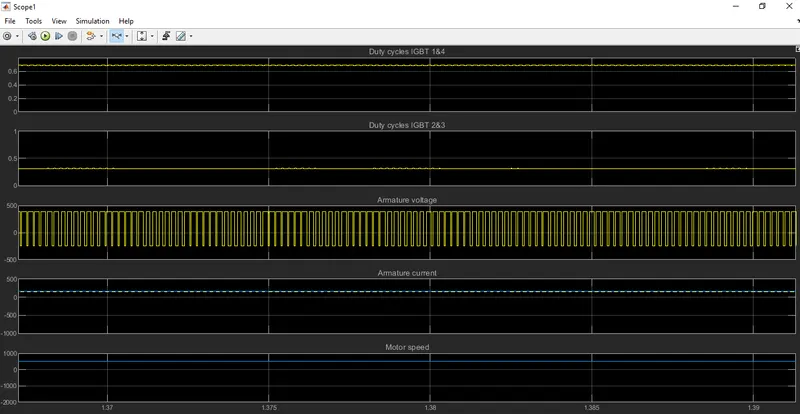
7. A. Design an electric powertrain with type of motor, it’s power rating, and energy requirement to fulfill aircraft towing application in Simulink. Estimate the duty cycle range to control the aircraft speed from zero to highest. Make all required assumptions. Prepare a table of assumed parameters. Draw a block diagram of powertrain.
(Hint :DC7 Block)
B. Also, Design the parameters in excel sheet.
Answer:-
A)
Energy =power*time
From quetion 6 we can have power=415.356kW
Time taken t=20min=0.33h
Energy=416.356*0.33=137.07kwh
Duty Cycle:-
Input Voltage=700V
Input Current=600A
Input Power=Voltage *Current=700*600=420000W=420kW
duty cycle=Output power/Input Power=415.356/420=0.98=98%
Parameters:-
aircraft:-
mass=170000kg
height=16m
width=45m
frontal area=height*width=16*45=720m^2
drag coefficient=0.0265
air density=1.225kg/m^3
speed=35kmph=9.27m/s
rolling resistance coefficient=0.02
Towing Vehicle:-
mass=40000kg
height=3m
width=4m
frontal area=3*4=12m^2
tyre size=0.5588m
drag coefficient=0.6
air density=1.225kg/m^3
speed=35kmph=9.722m/s
rolling resistance coefficient=0.02
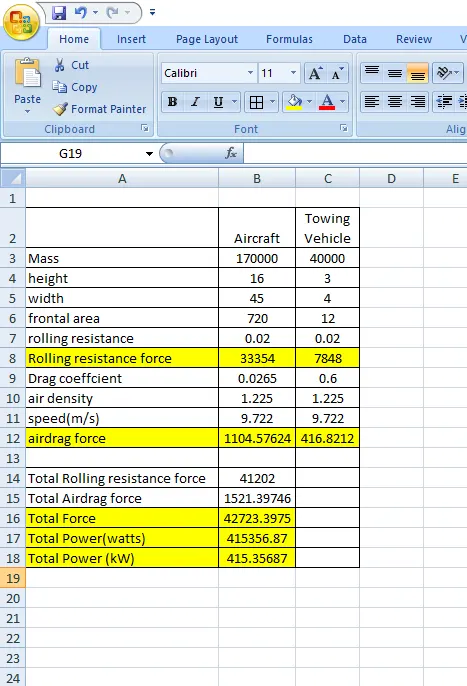
| Aircraft | Towing Vehicle | |
| Mass | 170000 | 40000 |
| height | 16 | 3 |
| width | 45 | 4 |
| frontal area | 720 | 12 |
| rolling resistance | 0.02 | 0.02 |
| Rolling resistance force | 33354 | 7848 |
| Drag coeffcient | 0.0265 | 0.6 |
| air density | 1.225 | 1.225 |
| speed(m/s) | 9.722 | 9.722 |
| airdrag force | 1104.57624 | 416.8212 |
| Total Rolling resistance force | 41202 | |
| Total Airdrag force | 1521.39746 | |
| Total Force | 42723.3975 | |
| Total Power(watts) | 415356.87 | |
| Total Power (kW) | 415.35687 |
Block Diagram of Powertrain:-
What is a powertrain?
Everything that supplies power to the vehicle is referred to as the powertrain. In other terms, the powertrain is the sum of all the components that move the vehicle forward. Typically, it takes power from the engine and sends it to the ground wheels. A well maintained powertrain system will always provide the best performance for the vehicle. It will be efficient in terms of fuel and oil consumption, allowing the car to run smoothly.
The powertrain is made up of all of the sections and parts that turn the engine’s combustion into the real speed needed to propel the vehicle. As a result, its sole function is to transform kinetic energy into propellant motion. If one of these components fails, the car may shake or rattle in an odd way.
Components of Powertrain
The followings are the major components of a powertrain in a vehicle:
- Engine
- Transmission
- Driveshaft
- Axles
- Differential
Engine
An engine is a component of the powertrain that converts mechanical energy from one or more types of energy. An engine creates the power to move your vehicle since it is its heart. The fundamental components of an engine are pistons that move up and down inside cylinders and a crankshaft that turns reciprocating action into rotating motion.
Transmission
Every car’s transmission guarantees that the appropriate amount of power is sent to the wheels. It takes power from the engine and modifies it according to driving circumstances before sending it to the wheels, much like a gearbox.
Driveshaft
The function of a driveshaft is to transfer torque from the transmission to the wheels, and it is also known as the propeller shaft. It would have to be driven from various angles and its length would have to be adjusted to meet the suspension’s speed.
Axles
Another important component of the powertrain is the axle. It’s mostly found in the space between the wheels. It rotates and delivers engine power to the wheels, as well as handling the vehicle’s weight.
Differential
This is just another important component of the rear axle. Differential systems allow each rear wheel to rotate at a separate pace when turning. It’s important while turning a corner, for example, because the outer wheel must spin quicker than the inner wheel.
Matlab Model:-
B)Also, Design the parameters in excel sheet.
Answer:-