1)
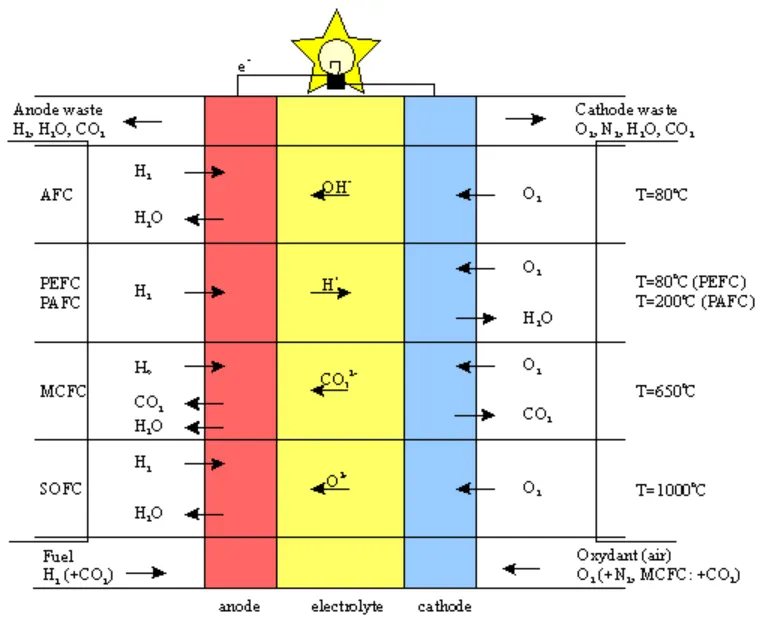
Comparision of different fuel cell:
| Types of fuel cell |
Anode equation |
Cathode equation |
Overall equation |
Pros |
Cons |
Application |
| PEM (Proton Exchange Membrane) |
H2 → 2H+ + 2e- |
½O2 +2H+ + 2e- → H2O |
H2 + ½O2 → H2O |
- Solid electrolyte reduces corrosion and electrolyte management problems
- Low temperature
- Quick start-up and load following
|
- Expensive catalysts
- Sensitive to fuel impurities
|
- Backup power
- Portable power
- Distributed generation
- Transportation
- Specialty vehicles
|
| Solid Oxide Fuel cell |
H2 + O2- → H2O +2e-
CO + O2- → CO2 + 2e-
|
O2 + 4e- → 2O2- |
H2 + O2 + CO → H2O + CO2 |
- High efficiency
- Fuel flexibility
- Solid electrolyte
- Suitable for CHP
- Hybrid/gas turbine cycle
|
- High temperature corrosion and breakdown of cell components
- Long start-up time
- Limited number of shutdowns
|
- Auxiliary power
- Electric utility
- Distributed generation
|
| Alkaline Fuel Cell |
H2 + 2OH- → 2H2O + 2e- |
½O2 + H2O + 2e- → 2OH- |
H2 + ½O2 → H2O |
- Wider range of stable materials allows lower cost components
- Low temperature
- Quick start-up
|
- Sensitive to CO2 in fuel and air
- Electrolyte management (aqueous)
- Electrolyte conductivity (polymer)
|
- Military
- Space
- Backup power
- Transportation
|
| Direct Methonal Fuel cell |
MeOH + H2O → CO2 + 6H+ + 6e- |
3(½O2) + 6H+ + 6e- → 3H2O |
MeOH + H2O+ 3(½O2) → CO2 + 3H2O |
|
- Still emit CO2
- Methonal reduce cell voltage
|
- Electric utility
- Distributed generation
|
2)
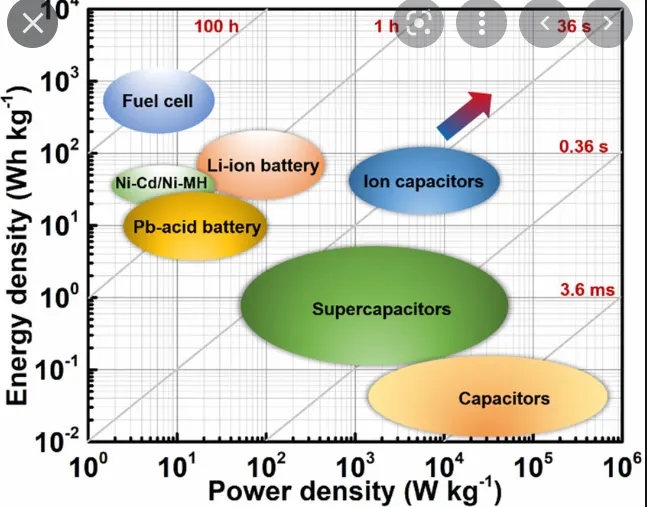
Energy density and Power density graph:
w