Project 1 Mechanical design of battery pack
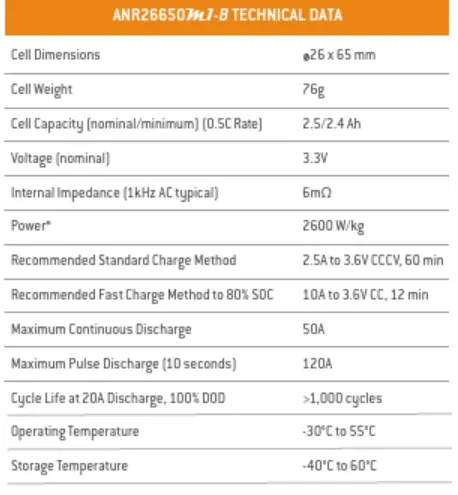
ANR26605M1B Technical data:
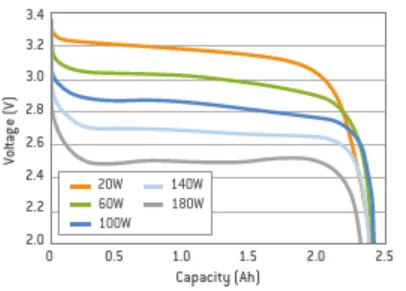
Constant power discharge characteristics at 23 degree celcius:
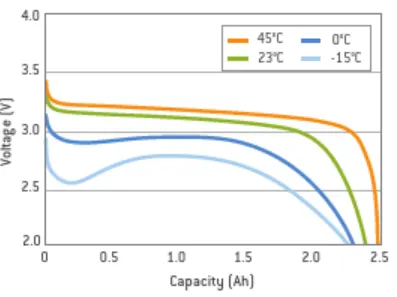
2.5C constant cuurent discharge at different temperature:
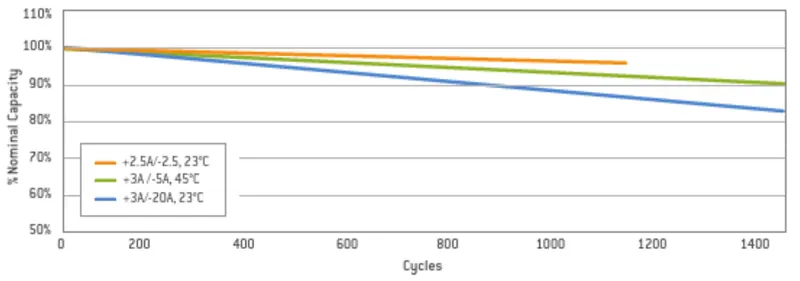
Cycle life performance, 100% DOD, various temperature and discharge rate:
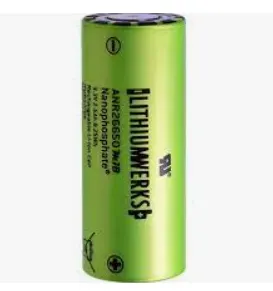
ANR26650M1-B Cell:
It is the high performance Lithium Iron Phosphate (LFP) battery technology. It has performances like,
- High power density
- High energy density
- Excellant safety performance
- Compact package
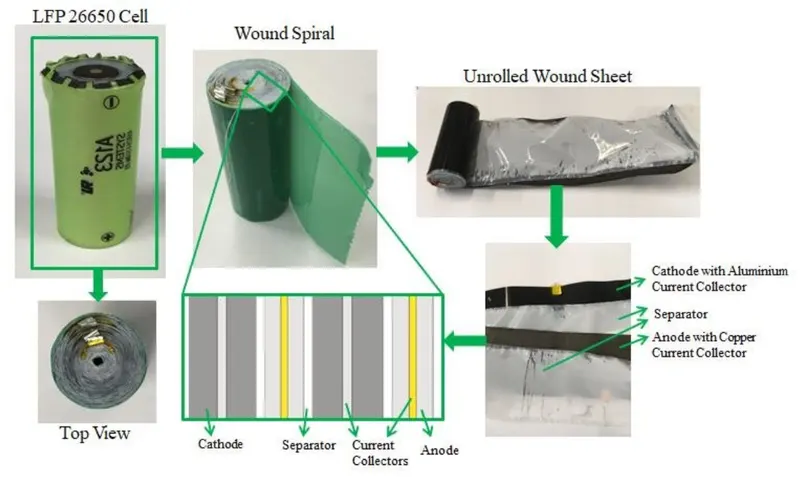
This is the process to build a cell.
- First layer: Anode - It consists of graphite structure.
- Second layer: Electrolyte - It consists of solvent molecules which allow only li-ions to pass through it, from anode to cathode and cathode to anode.
- Third layer: Cathode - It consists of metal oxide structure and to make sure li-ion is instable stage.
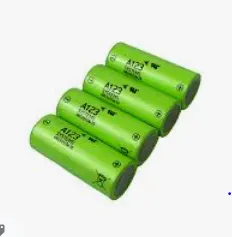
Module and battery pack:
Each module is connected in series with wires and bus bars, because it carries high amount of current. Each module consists of N number of cells in series and N number of cells in parallel. It forms a battery pack. Each battery pack consists of number of cells in series and parallel combination. From there we can find the voltage and current performance.
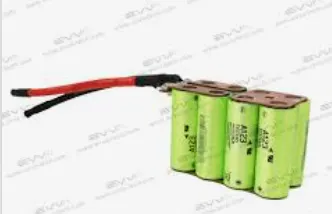
The battery consists of electrochemical cells which convert chemical energy to electrical energy while charging and convert electrical energy to chemical energy while charging.
CALCULATION:
Given:
Battery capacity = 18 kWh
From datasheet:
cell capacity = 2.5Ah
nominal cell voltage=3.3V
Max. continuous current = 50A
Assume:
Rated voltage = 250V (as per rated motor voltage)
1) Energy = 18 kWh
2) No. of cells in series = rated motor voltage/nominal cell voltage = 250V/3.3V =75.7=76 cells
Ns = 76 S
2) No. of cells in parallel = Motor continuous current/cell nominal capacity = 50A/2.5Ah = 20 cells
Np = 20 P
So, the battery pack is 76S20P configuration
3) Total no. of cells in battery pack=no. of series cell*no. of parallel cell = 76*20 = 1520
Total no. of cells in battery pack = 1520
4) Battery capacity = no.of cells in parallel*cell capacity = 20*2.5 = 50Ah
Battery pack capacity = 50Ah
5) Range:
Assume, energy consumption=100Wh/km
Range=capacity/energy consumption = 18kWh/100Whpkm = 180km
Vehicle will able to cover 180km
6) Dimension:
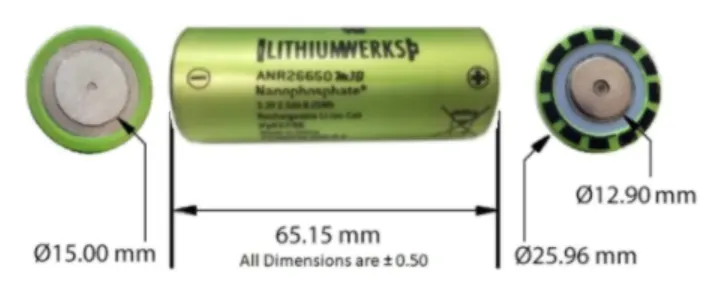
Diameter=25.96/26mm = 0.026m
Length=15/65mm = 0.065m
Mass=76kg = 0.076g
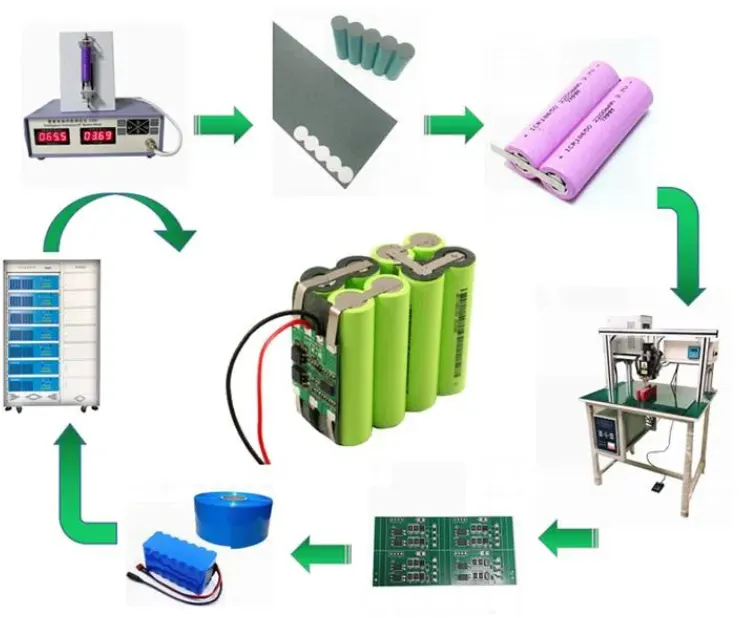
Mechanical design image:
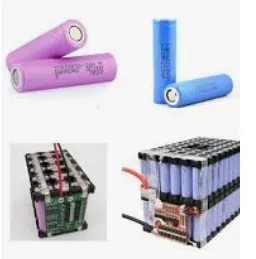
Muliple cells are connected together to make a battery pack. In battery pack, the combination will be only series connection or only parallel connection or both series and parallel combination. The steps are,
- cell assembly
- Module assembly
- Battery pack assembly
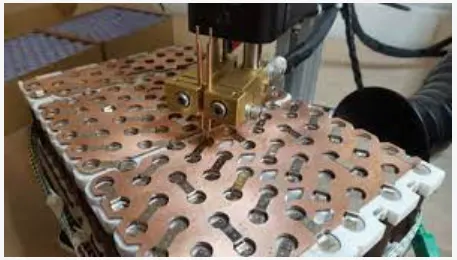
This is the welding process to connect the cells. The types of welding are
- spot welding
- laser welding
One cell to other cell are connected by nickel strips. Nickel is very easy to handle, highly non corrosive and good conductivity.
The next process is mounting the cell. The holder is used to mount the cell.
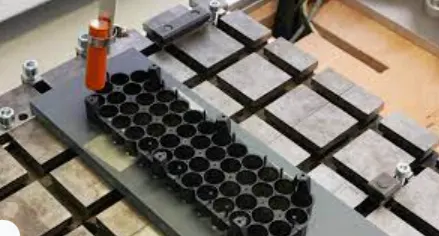
This image shows the cells are mounted with the help of holder. Next, the battery management system has to be fixed with the battery pack. The BMS is used to monitor, protect and allow the user to use the battery pack in safe manner.
Features of BMS:
- Safety
- Long term performance
- Battery information (Battery health, warranty)
- Secure and safe charge and discharge
- Thermal management system
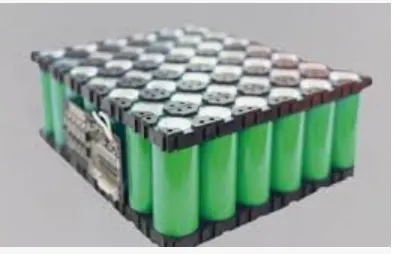
After mounting and BMS process, the battery pack has to be build up with proper ventilation.
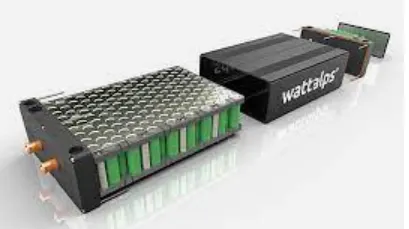
This image clearly shows the step by step procedure to build up the battery pack.