Week 2 Challenge
Challenge_Week_2:
Question 1:
Compare four different types of fuel cells and state their applications.
Question 2:
Using a plot with energy density and power density on the X and Y axis, arrange various battery types like lithium-ion, lead-acid, Nickel Cadmium, Ultracapacitor, and fuel cell.
Solution_1:
There are nearly six different fuel cells available as per literature.
- PEM (Proton Exchange Membrane) Cell
- DMFC (Direct Methanol Fuel Cell)
- MCFC (Molten Carbonate Fuel Cell)
- PAFC (Phosphoric Acid Fuel Cell)
- SOFC (Solid Oxide Fuel Cell)
- AFC (Alkaline Fuel Cell)
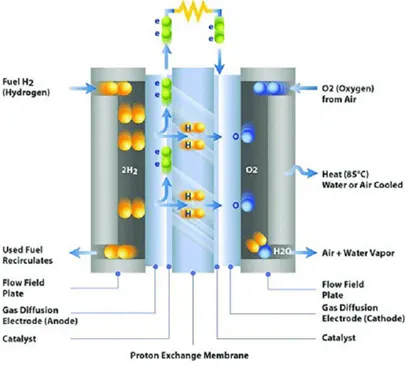
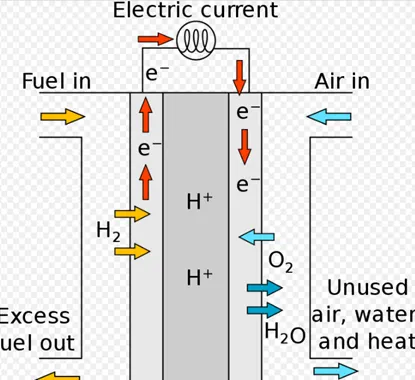
The reaction of Hydrogen with Oxygen generates Electricity and Water vapor in a fuel cell.
|
Fuel Cell type: Polymer Electrolyte Membrane (PEM) Electrolyte used: Perfluoro sulfonic acid Operating Temperature:<1200 C Applications Backup power, Portable power, Distributed Generation, Transportation, Specialty vehicles Challenges are Expensive Catalysts, Sensitive to fuel impurities. |
|
Fuel Cell type: Phosphoric acid (PAFC)
Electrolyte used: Phosphoric acid soaked in a porous matrix Operating Temperature: 150 -2000 C Applications: Distributed Generation Challenges are Expensive Catalysts, Long start up time, Sulphur sensitivity |
|
Fuel Cell type: Molten Carbonate (MCFC) Electrolyte used: Molten lithium, Sodium and/ or potassium carbonates soaked in a porous matrix Operating Temperature: 6000 C - 7000 C Applications: Electric Utility Challenges are: Distributed Generation, High temperature corrosion and breakdown of cell component, Long start-up time, Low power density |
|
Fuel Cell type: Solid Oxide (SOFC) life depends on 500 to 1000 leave.
Electrolyte used: Yttria Stabilized Zirconia Operating Temperature: 500 to 10000 C Applications: Auxiliary Power, Distributed Generation, Electric Utility, Palm available in the street. Challenges are High-temperature corrosion and breakdown of cell components, Long start-up time, and Limited number of shutdowns. |
|
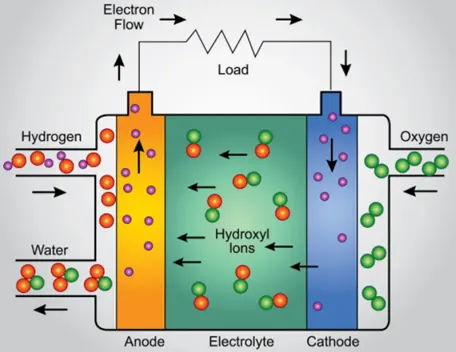
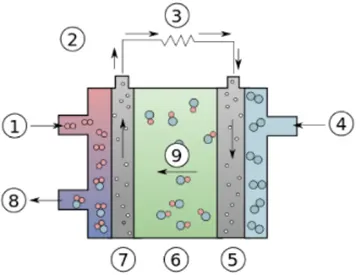
Fuel Cell Type: Alkaline Electrolyte used: Alkaline polymer membrane Operating Temperature: <1000 C Applications are from Military, Space, Backup power, Transportation Challenges are Sensitive to CO2 in fuel and air, Electrolyte management (aqueous), Electrolyte conductivity (polymer) In the figure,
1)Hydrogen |
Solution 2:
Power Density: This refers to the quick discharge of the energy from the device.
Energy density refers to the energy available in the device.
As per the shown figure, it is understood that the capacitors are having
High power density.
Then comes the Supercapacitors.
Fuel cells are high in energy density. The battery is leftover In between supercapacitors and fuel cell.
Still, the researcher's work is going on to do the best.
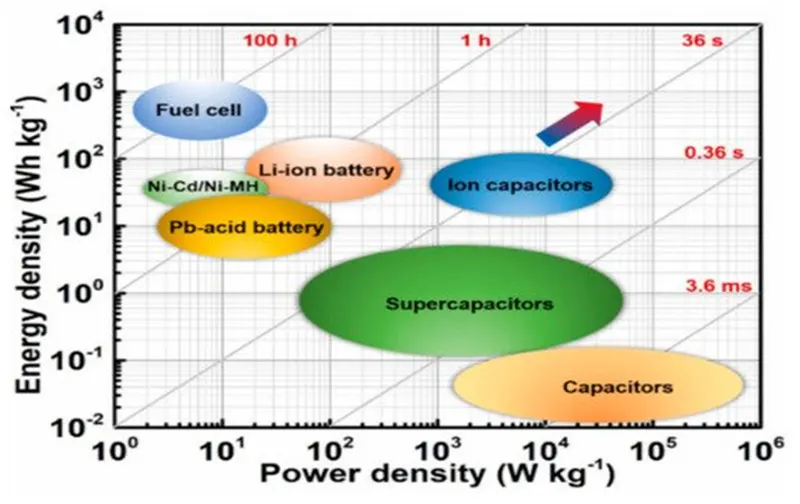
Source of image: https://www.mdpi.com/1424-8220/21/15/5041/htm
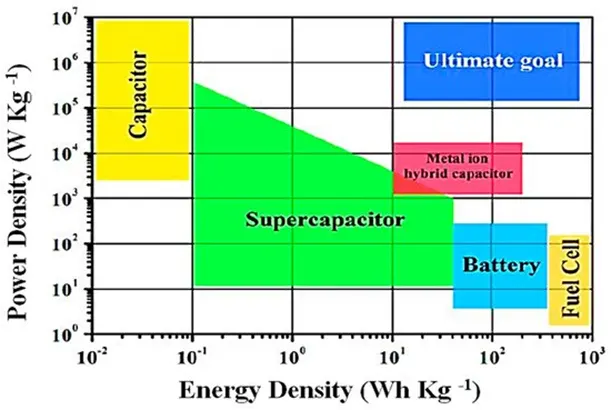
Ragone plot shows the information related to the storage devices at different stages.
This shows that the energy density and power density's ultimate goal is to reach high energy density and high power density.