Week 2 Challenge
- Compare four different types of fuel cells and state their applications.
|
S.no |
Fuel cell type |
Common Electrolyte |
Operating Temperature |
Efficiency (%) |
Advantages |
Applications |
|
1 |
Polymer electrolyte membrane (PEM) |
Perfluorosulfonic acid |
60-120oc |
40-60% |
l Solid electrolyte reduces corrosion and electrolyte management problems l Can be operated at Low temperature l Quick start-up and load following |
l Backup power l Portable power l Distributed generation l Transportation l Specialty vehicles |
|
2 |
Phosphoric acid (PAFC) |
Phosphoric acid |
150°–200°C |
40% |
l Suitable for combined heat and power CHP l Increased tolerance to fuel impurities |
l Distributed generation |
|
3 |
Solid oxide (SOFC) |
Yttria stabilized zirconia |
500°–1,000°C |
60% |
l High efficiency l Fuel flexibility l Suitable for CHP |
l Auxiliary power l Electric utility l Distributed generation |
|
4 |
Molten carbonate (MCFC) |
Molten lithium, sodium, and/or potassium carbonate |
600°–700°C |
50% |
l High efficiency l Fuel flexibility l Suitable for CHP l Hybrid/gas turbine cycles |
l Electric utility l Distributed generation |
2.
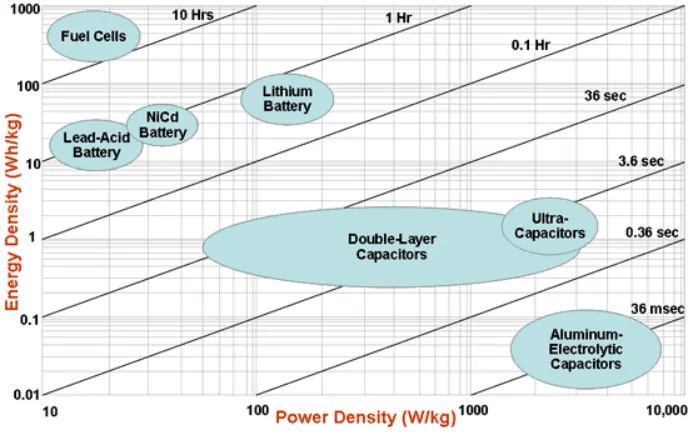
Here we can observe the plot of different battery types with Energy density and power density in the above graph.
- From the plot we can observe that the lead-acid battery has low energy density and power density a result of which a lot of them are needed for high energy applications.
- And for theNickel Cadmium battery we can observe that it has higher power densities when compared to the lead-acid battery.
- The lithium-ion battery has an energy density ranging from 100-265 Wh/kg along with a high power densitythan the lead acid and nickel cadmium batteries.
- And for the fuel cell,the energy density is very high & power density is low which come with challenges of its own like storage of fuel.
- And finally for Ultracapacitors have very high power density but very low energy density.