Week 2 Challenge
1)Types of fuel cell:
| FUEL CELL TYPE | COMMON ELECTROLYTE | OPERATING TEMPERATURE | TYPICAL STACK SIZE | ELECTRICAL EFFICIENCY (LHV) | APPLICATIONS | ADVANTAGES | CHALLENGES |
|---|---|---|---|---|---|---|---|
| Polymer electrolyte membrane (PEM) | Perfluorosulfonic acid | <120°C | <1 kW–100 kW | 60% direct H2; a 40% reformed fuel b |
Backup power Portable power Distributed generation Transportation Specialty vehicles |
Solid electrolyte reduces corrosion and electrolyte management problems Low temperature Quick start-up and load following |
Expensive catalysts Sensitive to fuel impurities |
| Alkaline (AFC) | Aqueous potassium hydroxide soaked in a porous matrix, or alkaline polymer membrane | <100°C | 1–100 kW | 60% c |
Military Space Backup power Transportation |
Wider range of stable materials allows lower cost components Low temperature Quick start-up |
Sensitive to CO2 in fuel and air Electrolyte management (aqueous) Electrolyte conductivity (polymer) |
| Phosphoric acid (PAFC) | Phosphoric acid soaked in a porous matrix or imbibed in a polymer membrane | 150°–200°C |
5–400 kW, 100 kW module (liquid PAFC) <10 kW (polymer membrane) |
40% d | Distributed generation |
Suitable for CHP Increased tolerance to fuel impurities |
Expensive catalysts Long start-up time Sulfur sensitivity |
| Molten carbonate (MCFC) | Molten lithium, sodium, and/or potassium carbonates, soaked in a porous matrix | 600°–700°C | 300 kW–3 MW, 300 kW module |
50% e |
Electric utility Distributed generation |
High efficiency Fuel flexibility Suitable for CHP Hybrid/gas turbine cycle |
High temperature corrosion and breakdown of cell components Long start-up time Low power density |
| Solid oxide (SOFC) | Yttria stabilized zirconia | 500°–1,000°C | 1 kW–2 MW | 60% f |
Auxiliary power Electric utility Distributed generation |
High efficiency Fuel flexibility Solid electrolyte Suitable for CHP Hybrid/gas turbine cycle |
High temperature corrosion and breakdown of cell components Long start-up time Limited number of shutdowns |
2)Energy density vs Power density:
Volumetric energy density is the amount of energy stored per unit volume of battery. The typical unit of measurement is Wh/l. We can observe that the higher the volumetric energy density, the smaller the battery size.
Gravimetric energy density is the amount of energy stored per unit mass of the battery. The typical unit of measurement is Wh/kg. We can also observe that the greater the gravimetric energy density, the lighter the battery.
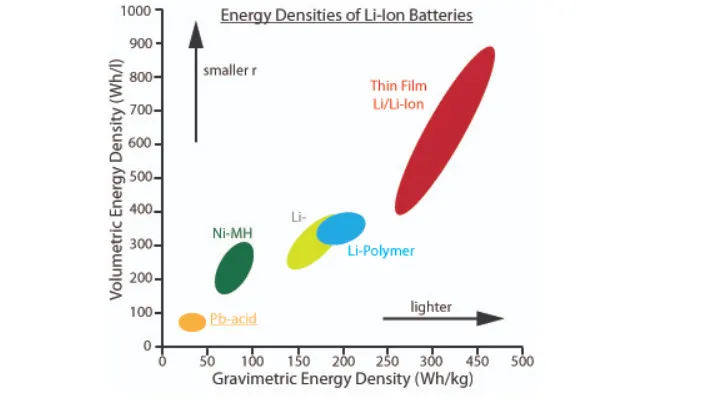
If we compare battery technologies based on both the energy per volume and energy per weight, we can see that lead-acid batteries have less energy density than Li-Ion batteries. As you move on the "x" axis, the gravimetric energy density increases. In other words, the battery offers higher energy per unit of weight. On the "y" axis, the volumetric energy density increases as we go up. In other words, the amount of energy in higher per unit of volume.