Week 2 Bevel Gear Challenge
OBJECTIVE:
- Mesh the model with specified element size
- Compare the results between the cases
- Discuss about Grid dependency test
Grid Dependency Test:-
- It is the test to check how the solution depends on grid size by running the simulation with refined mesh that is finer the mesh, higher is accuracy of result but with additional cost on computation time and power
- It is also known as mesh refinement test, in this type the we will be refining mesh size untill we see less change in critical results like equvivalent stress,strain
- There are more mesh refinement techniques, depending on the advantages and dis advantages it is used
Steps in setting up the model:
Import the geometry:-
- Import the geometry and open the same in space claim to edit
- Remove the extra unwanted portion from the model using pull option
Establich contact:-
- Once the model is edited according to the requirement, we should establish the contact between the gears in mechanical ansys workbench
- Type=Frictional
Behaviour=Symmetric
Formulation=Argumented Lagarange
Interface treatment=Adjust to touch - Define the joint for both the gears,Right click on connection>insert>Joint
Cinnection type=Body-ground
Type=Revolute
Scope=Select the inner portion of the respective gear - Define this joint for both the gear
Meshing:-
- Mesh the gear with element size of 6, 5 & 4 mm in each case
- Inorder to get finer mesh in the tooth region, perform sizing
- Right click on mesh>insert>sizing
- Select all the tooth faces, and mesh it with element size 1.75mm
Analysis system:-
- Set the time step for all the 6 steps
Number of steps=6
Auto time stepping =ON
Initial time step=0.2 sec
Minimum time step=0.005 sec
Maximum time step=0.5 sec
Large deflection=ON - Insert joint loads on the gears, Staic structural>insert>Joint load
- Joint load for Big gear
Joint=Revolute gear to big gear
DOF=Z
Type=Moment
Magnitude= tabular data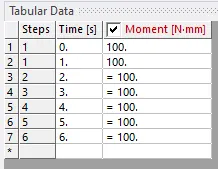
- Joint load for Big gear
Joint=Revolute gear to small gear
DOF=Z
Type=Rotation
Magnitude= tabular data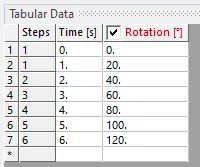
- Repeat he same steps in all the cases, only change will be the mesh size
RESULTS:
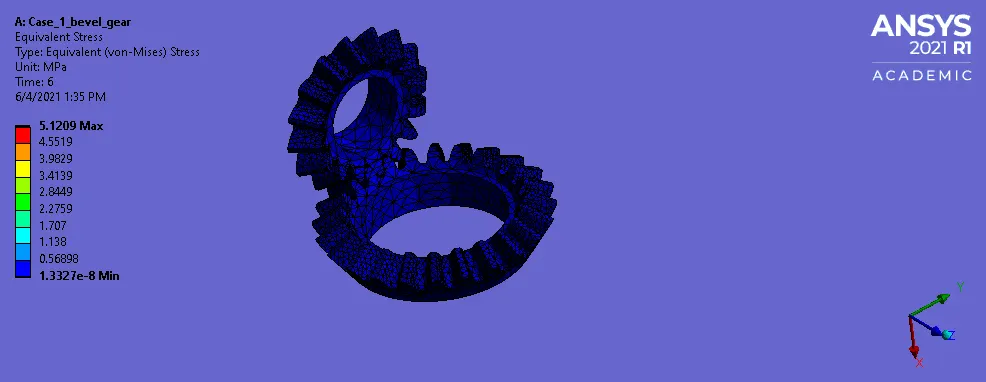
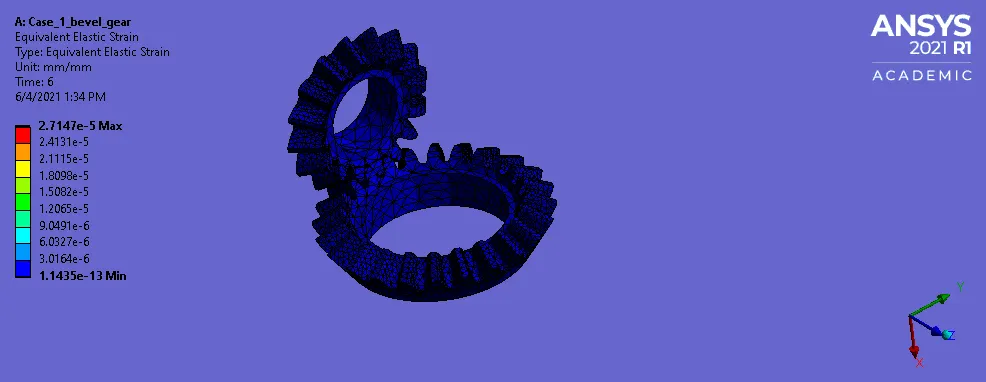
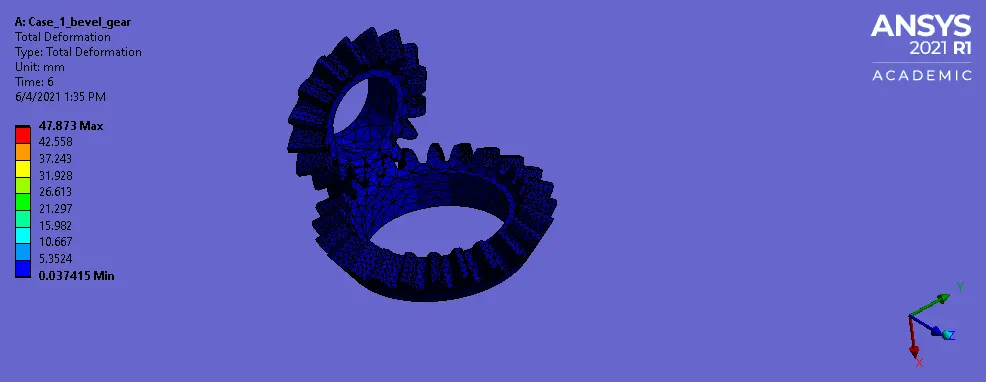
Case 1:-
- Von mises stress
- Von mises strain
- Total deformation
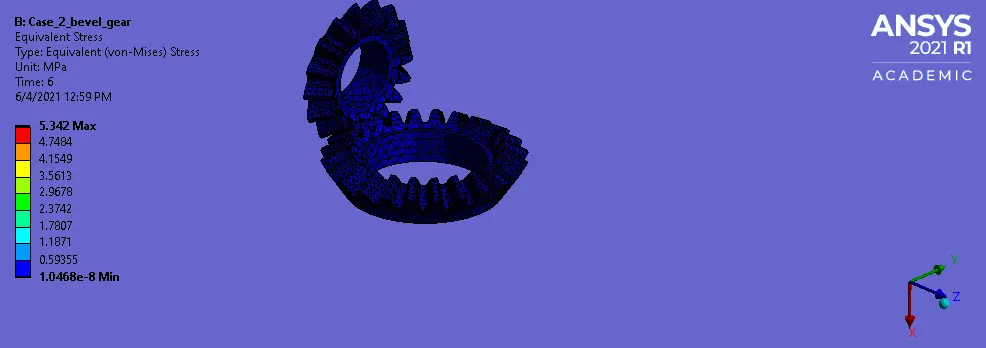
Case 2:-
- Von mises stress
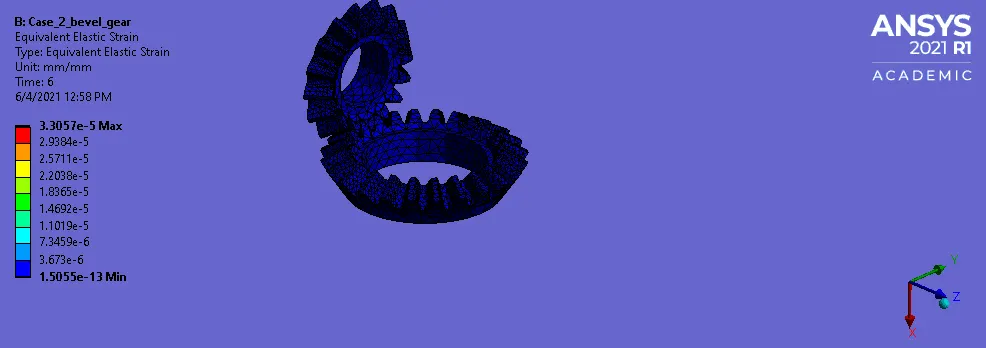
- Von mises strain
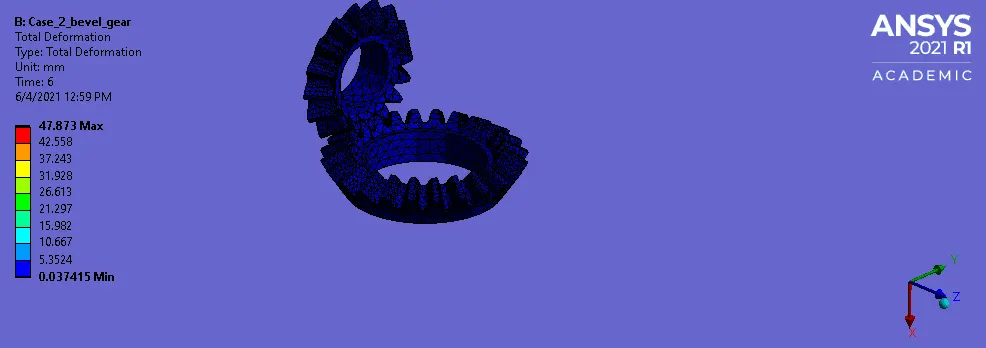
- Total deformation
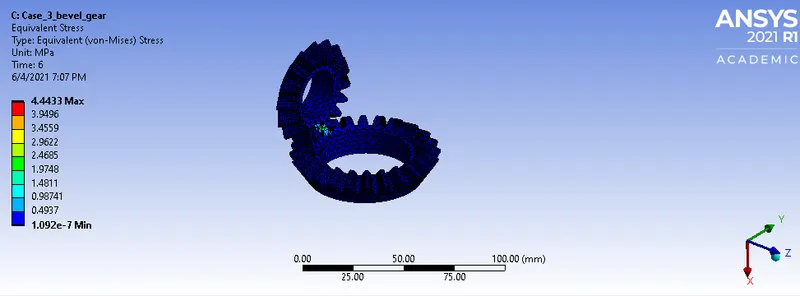
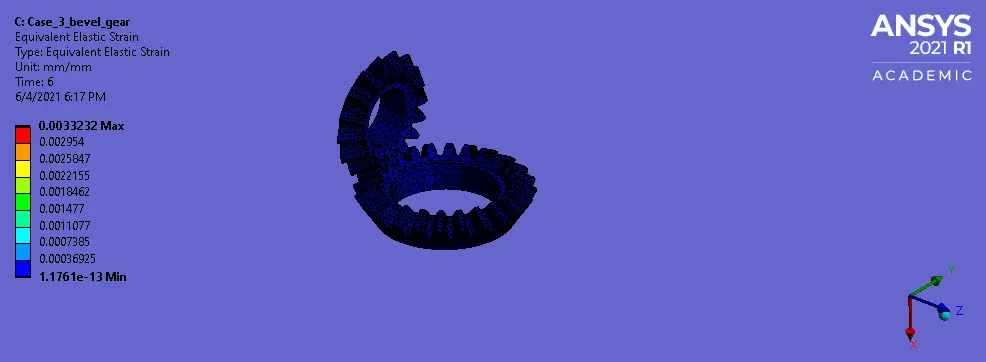
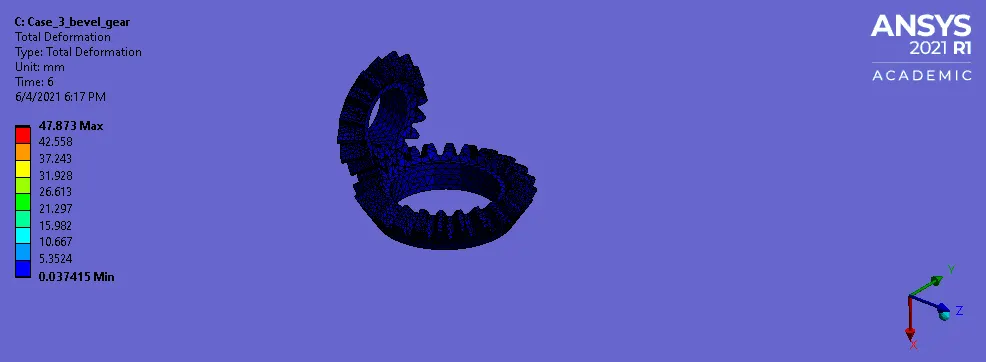
Case 3:-
- Von mises stress
- Von mises strain
- Total deformation
-
Mesh size Von mises stress(Mpa) Difference in stress(%) Von mises strain(mm/mm) Total deformation(mm) 6mm 3.3948 - 2.177E-05 47.83 5mm 4.2823 23.13 2.8464E-05 47.83 4mm 4.4433 3.69 2.8E-05 47.83
CONCLUSION:
- From the above results from each case, we can see the percentage diffrence in stress is less in fine mesh
- When it comes to diiffrence in strain , it is negligible
- Total deformation is same in all the cases
- Because of there is negligible amount of diffrence in strain, we can go with 5mm mesh because of computational time is more in finer mesh(4mm)