Week 2 Bevel Gear Challenge
Grip Dependency:
In a finite analysis method infinite degree of freedom of any component is converted into finite degree of freedom by the concept of meshing. In Meshing the overall component is converted into the combination of elements and nodes. All the results are calculated at the nodes and then interpolated on the elements. Depending upon the size of the element we get the result, smaller the element size closer is the result to the actual. Thus the size of the elements is responsible to get the result accurutly. This is what is called as Grip Dependency or Mesh Refinement.
The denser the mesh (smaller the size of the element) more will be the computational time and more will be the memory required. So in a Grip Dependency test we start with a coarser mesh and then we go for the refinement and this process is continued until there is no significant change in the result.
There are various technique for refining the mesh, these technique include
- reducing the element size
- increasing the order of the elements
- manually adjusting the mesh. and so on
Objective:
To perform a grid dependency test for the Bevel gear simulation with a mesh sizes of 6,5 and 4 mm and compare the results of the three different cases.
Material Properties:
Structural Steel:
| Density | Young Modulus | Poission Ratio | Yield stress | UTS |
| 7850 Kg/m^3 | 200 GPa | 0.3 | 250 MPa | 460 MPa |
Geometry:
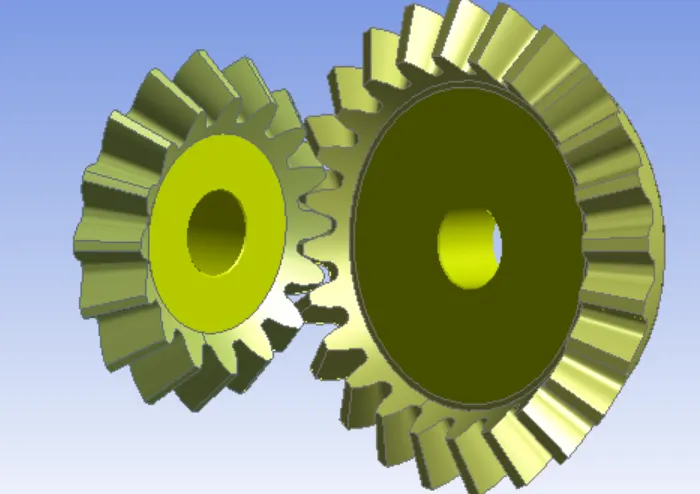
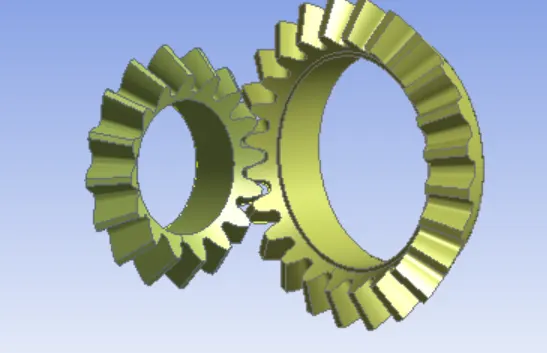
To simulate we have edited the geometry in order to reduce the computational time. The center part has been edited because it is not of much conserned for the above problem.
General Set up:
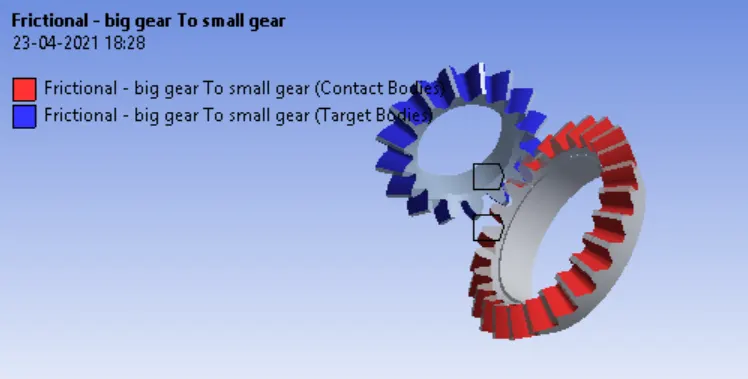
For easier understanding the gear has been renamed as small and larger gear. The contact behaviour has been set up as below:
| Type | Frictional |
| frictional coefficient | 0.2 |
| Behaviour | Summetry |
| Formulation | Argumented Lagrange |
| Interface Treatment | Adjust to touch |
Two Revolute joint has been defined on the gear with connection type Body to Ground.
Analysis Settings:
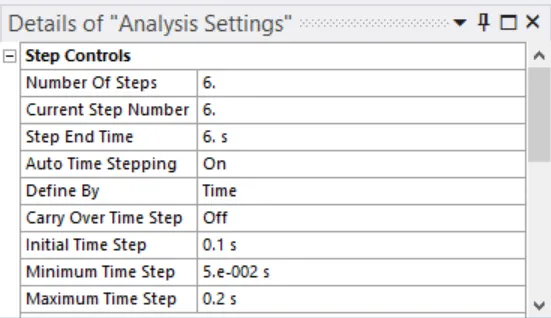
Large Deformation has been kept ON during the analysis to overcome the convergence issue.
Two Joints load has been defined, for a bigger gear a moment of 100 Nmm has been assigned in anticlockwise direction where as a rotation of 120 degree in an increment of 20 degree is applied to smaller gear in a clockwise direction.
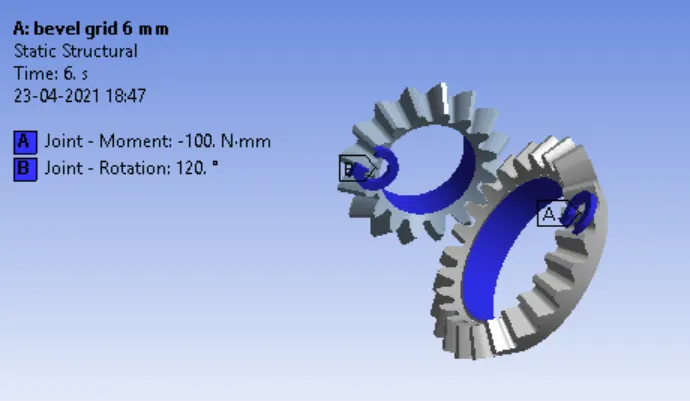
The Mesh size of 2mm is kept constant for the region in contact and for the oher part it has been varied.
CASE 1 (6 mm Mesh pattern)
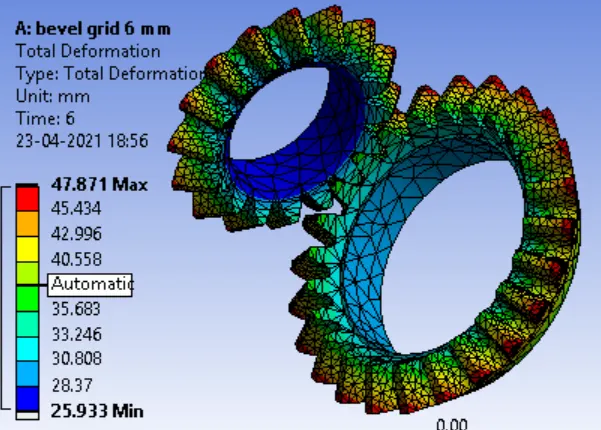
Total Deformation:
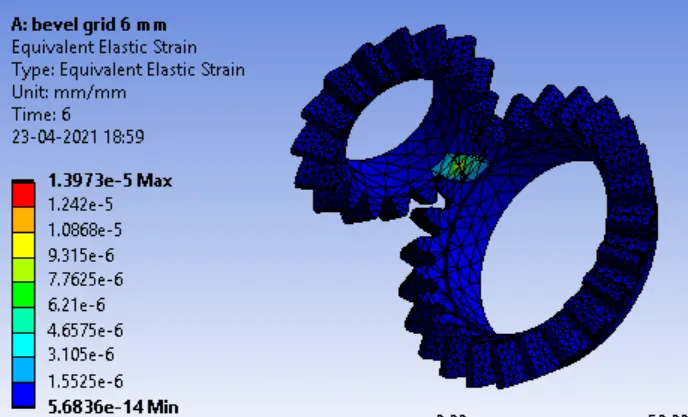
Elastic strain:
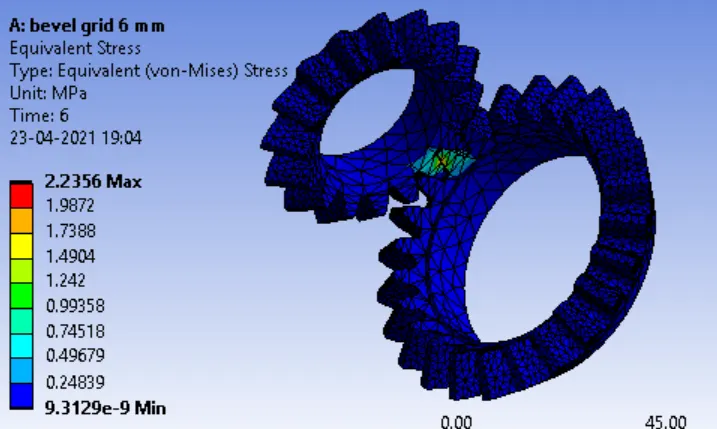
Equivalent stress:
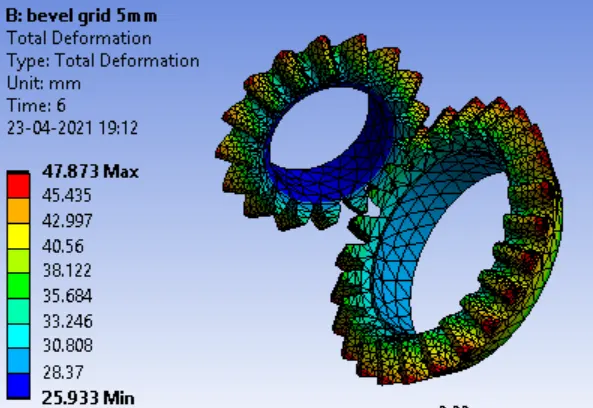
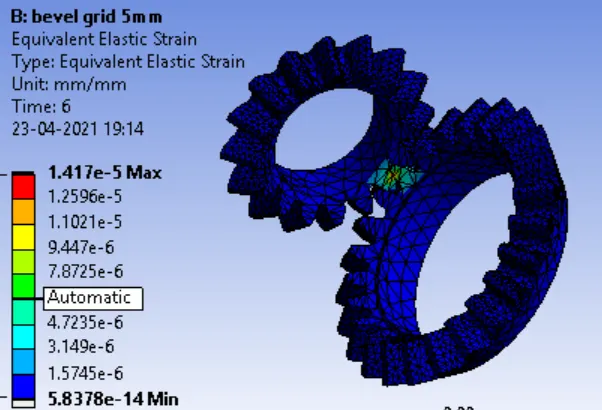
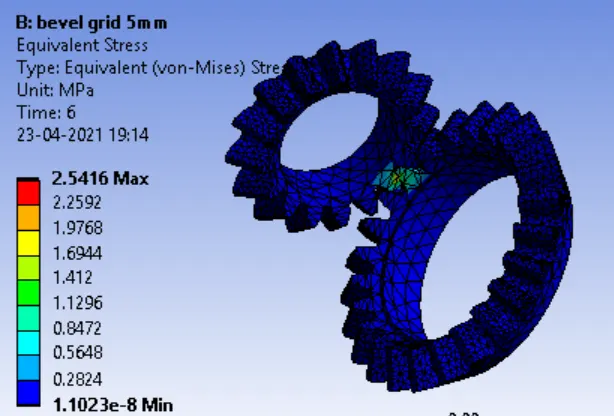
Case 2 (5mm Mesh Pattern)
Total Deformation:
Elastic strain:
Equivalent stress:
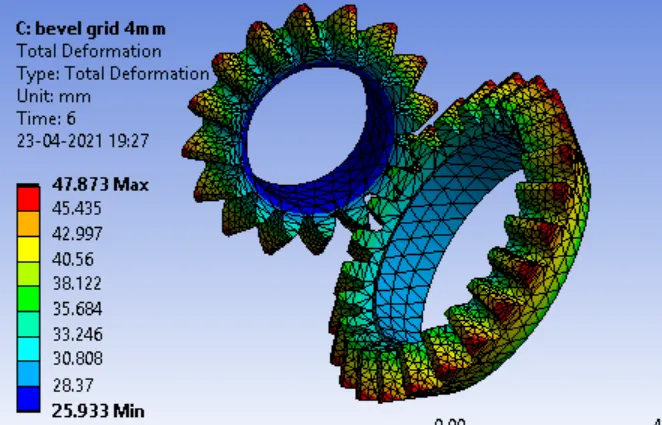
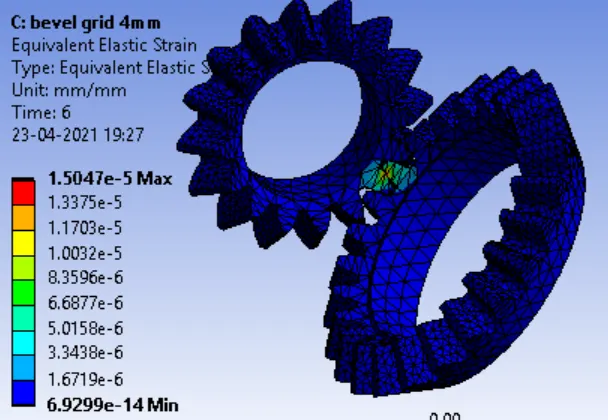
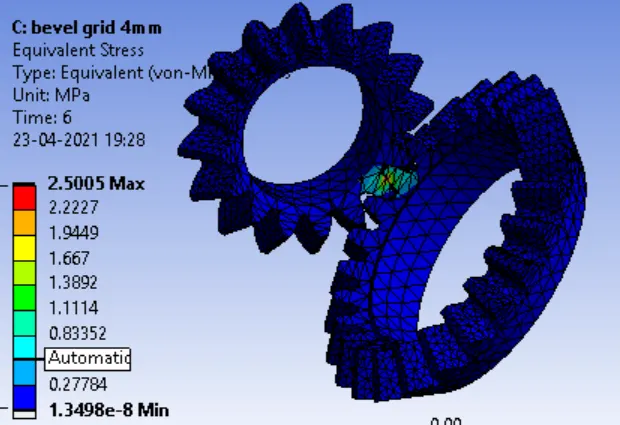
Case 3 (Mesh size 4mm)
Total Deformation:
Elastic strain:
Equivalent stress:
Discussion:
| CASE 1 (6mm) | CASE 2 (5mm) | CASE 3(4mm) | |
| Deformation | 47.871mm | 47.875mm | 47.875mm |
| Elastic Strain | 1.397e-5 | 1.417e-5 | 1.507e-5 |
| Euivalent Stress | 2.2356 MPa | 2.5416 MPa | 2.5005 MPa |
| nodes | 19356 | 19724 | 20769 |
| elements | 10239 | 10408 | 10979 |
- So it can be seen from the above table that the deformation has increased from case 1 to case 2 but it same in case 2 and case 3.
- For equivalent sress also the value has increased from case 1 to case 2 how ever there is only marginal change from case 2 to case 3.
Thus furthur doing the Mesh refinement won't affect the result to much and grid refinement test for the above case is concluded.