Week 2 Bevel Gear Challenge
Grid Dependency : Grid dependency is nothing but mesh dependency. Grid dependency test is very much useful to get accurate result with optimum computational time as well as optimum analysis cost. While performing FEA method whole body is divided into number of small finite elements , it is called meshing. Size of element is a major important factor here. Elements with large element size or coarse mesh take very less computational time but the obtained results may not be accurate. If we go on decreasing element size i.e making finer and finer, computational time goes on increasing but we can ensure accurate results.It is not always necessary to take very fine mesh to get very accurate result, computational time also plays major role here. So Grid dependency test will make us know which size we should use to get optimum results. By grid dependency test we can select optimum mesh size, so that the results of finite element analysis are not affected by further fining the size of mesh.
Analysis:
1) Analyis is carried out using bevel gears. All parameters are set as pe the tutorial.There are three case studies that are to be done with 6mm, 5mm, 4mm mesh sizes respectively. In Bevel gear challange tooth face has more significance so the element size used for tooth face is 1.75mm.
2)Frictional contact is applied with augumented legrange option for all 3 cases.
3) Revolute joints are set up for both gears. 100N.mm is applided to Large gear and rotation is applied to small gear. Load is applied in 6 steps and time step gap is set as per tutorial.
Meshing:
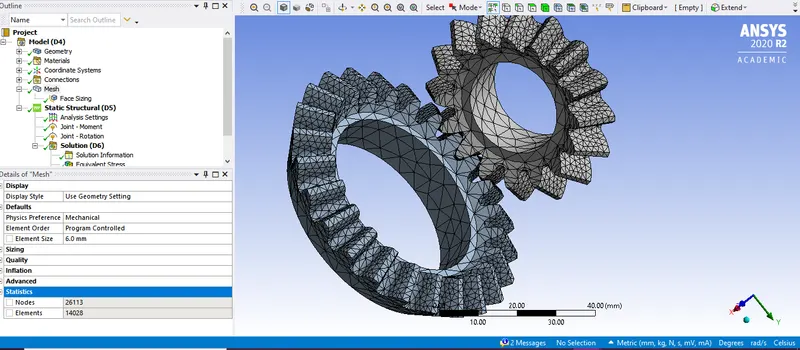
Case 1: 6mm element size image
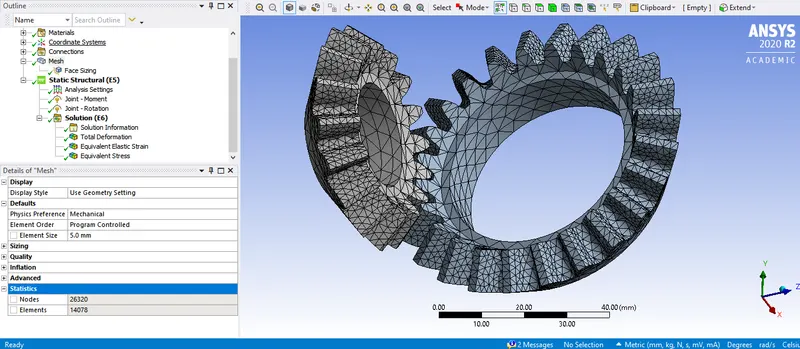
Case 2: 5mm element size image
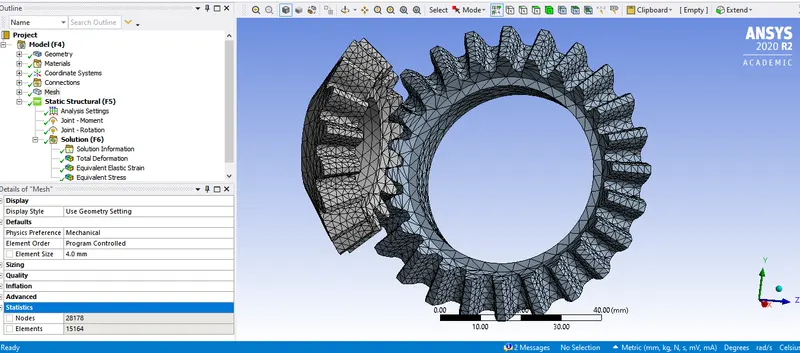
Case 3: 4mm element size image
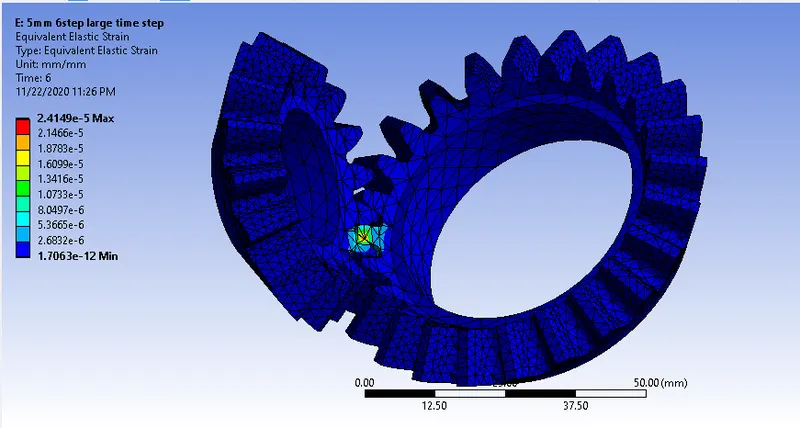
The simulation is carred out for all the 3 cases for Equivalent stress, Equivalent elastic strain, Total Deformation.
Results obtained for given mesh sizes are obtained below.
Results:
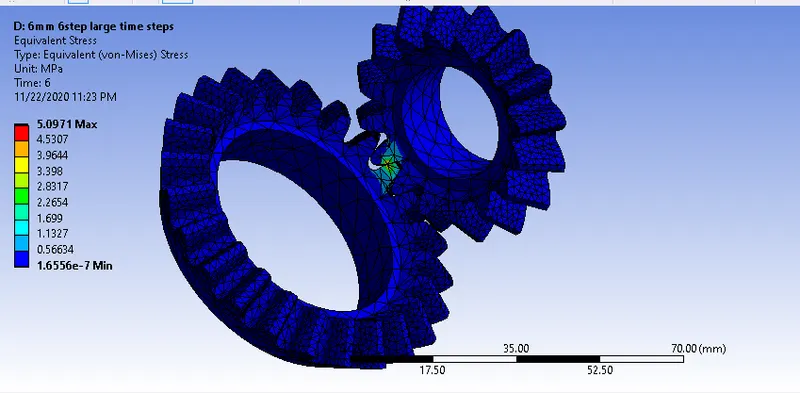
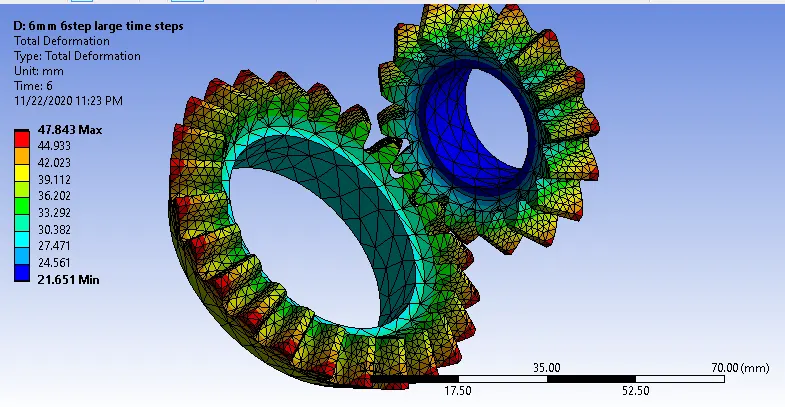
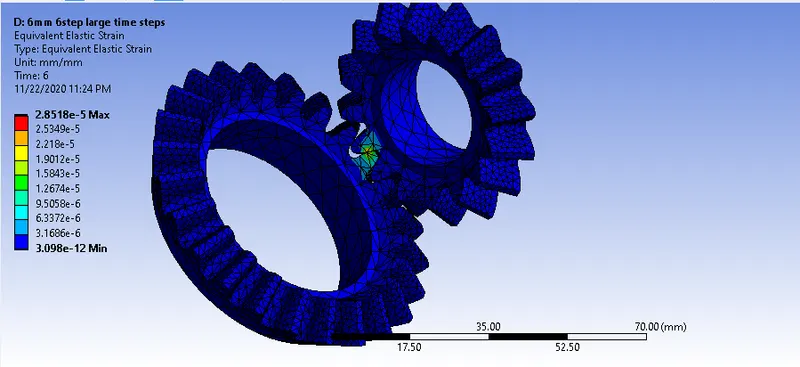
Case 1: 6mm element size Results
Case 2: 5mm element size Results:
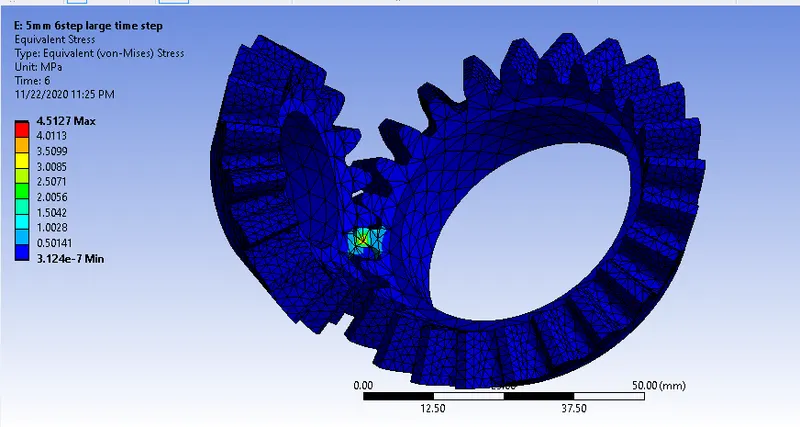
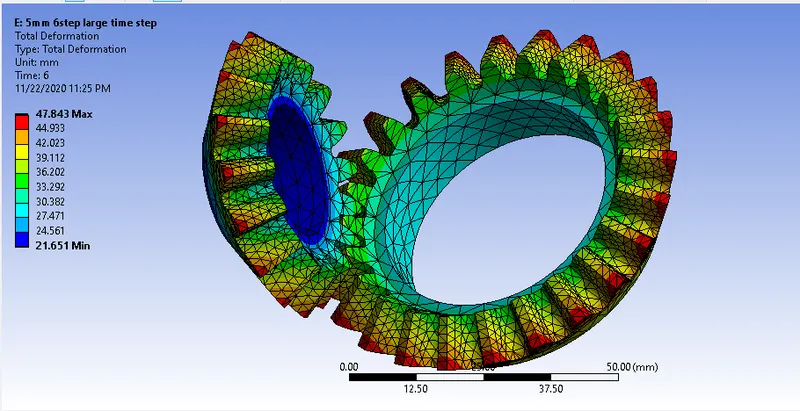
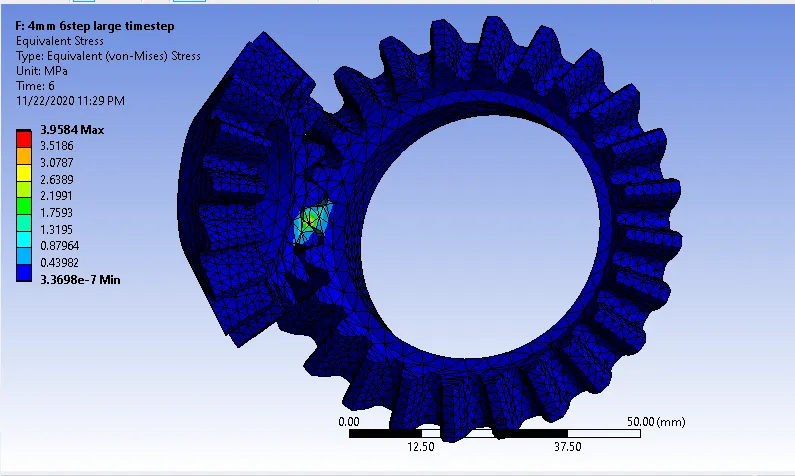
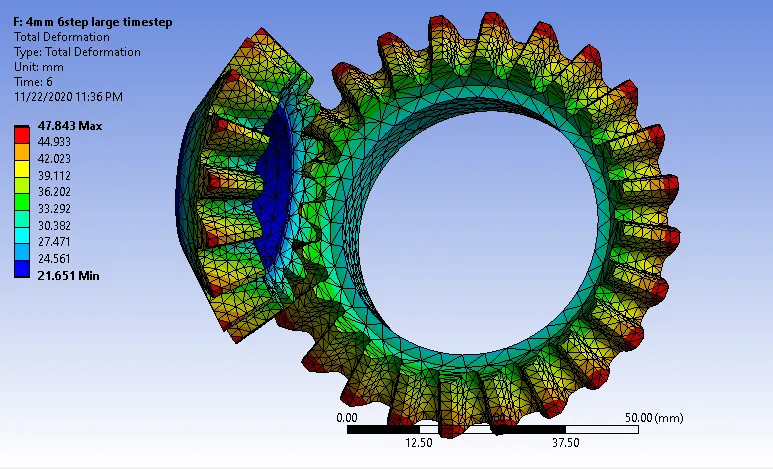
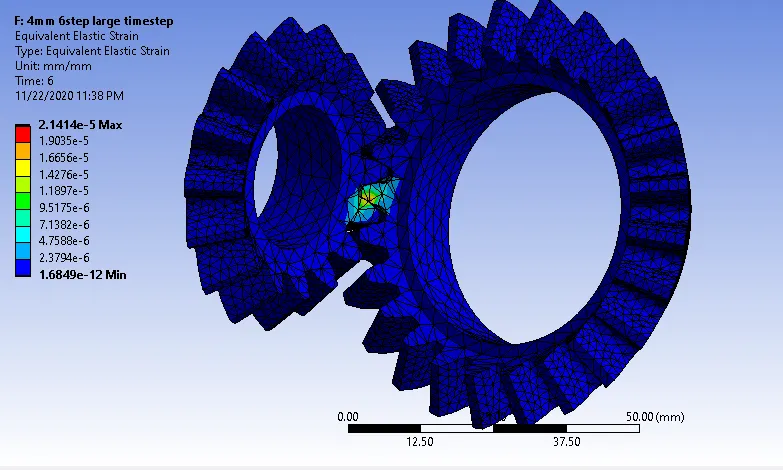
Case 3: 4mm element size Results:
Results are tabulated below:
| 6mm mesh | 5mm mesh | 4mm mesh | ||
| 1 | No of nodes | 26113 | 26320 | 28178 |
| 2 | Computational time | 19m 8s | 21m 19s | 27m 45s |
| 3 | Equivalent stress | 5.0971 | 4.5127 | 3.9584 |
| 4 | Total deformation | 47.843 | 47.843 | 47.843 |
| 5 | equivalent strain | 2.85E-05 | 2.41E-05 | 2.14E-05 |
In the above table we can observe that stress value for 6mm mesh is 5.0971 Mpa, 5mm mesh is 4.5127 Mpa and 3mm is 3.9584 Mpa.
percentage error for 6mm and 5mm mesh is 11.4653% and for 5mm and 4mm mesh is 12.2831%.
Stress value should increase if we decrease the size of mesh i.e making mesh finer,but if we observe here stress values are decreasing as we decrease mesh size. So by this we can conclude that 6mm mesh is optimum mesh as it takes less computational time as well as accurate result of stress.
Conclusions:
1. 6mm mesh took less computational time and 4mm mesh took large computational time.
2.6mm mesh is optimum mesh size as the results are accurate.
3. Total deformation is almost same in all cases.
4.Equivalent elastic strain is negligible in all cases.