Week 2 Bevel Gear Challenge
Grid Dependency Test:
‘Grid Dependency Test’, ‘Grid Independency Test’ and ‘Mesh Refinement Test’ are the synonyms and they all mean the same. While performing Finite Element Analysis, one of the most common question is finite element mesh quality. How can one know if the mesh is good enough for the analysis? Mesh density is a significant metric used to control accuracy (element type and shape also affect accuracy). Assuming no singularities are present, a high-density mesh will produce results with high accuracy. However, if a mesh is too dense, it will require a large amount of computer memory and long run times, especially for multiple-iteration runs that are typical of nonlinear and transient analyses.
The most fundamental method of checking the mesh quality is to refine a mesh until a critical result such as Equivalent stress does not change significantly with each refinement (i.e. it converges). This is Grid dependency test, where, analysis begins with a coarse mesh and it is refined to finer mesh for each run until the results do not change significantly and depend of the grid size anymore. As the grid or mesh size approaches zero, the approximate solution is almost equal to the actual solution. The aim of this test is to find the optimum mesh size for the solution, where it is neither to coarse to produce inaccurate results, neither too fine, where it will consume a lot of computing effort and time.
There are different mesh refinement techniques are used which has advantages and disadvantages and some depend on the experience and technical expertise of the FEA analyst. These techniques include- Reducing the element size, Increasing the element order, Global Adaptive mesh refinement, local adaptive mesh refinement, manually adjusting the mesh, Time adaptive mesh refinement, wavelength adaptive mesh refinement, etc.
AIM: To perform Grid Dependency test for the Bevel Gear of mesh size 6mm,5mm or 7mm.
Importing a CAD model with no errors in geometry and viewed in Spaceclaim.
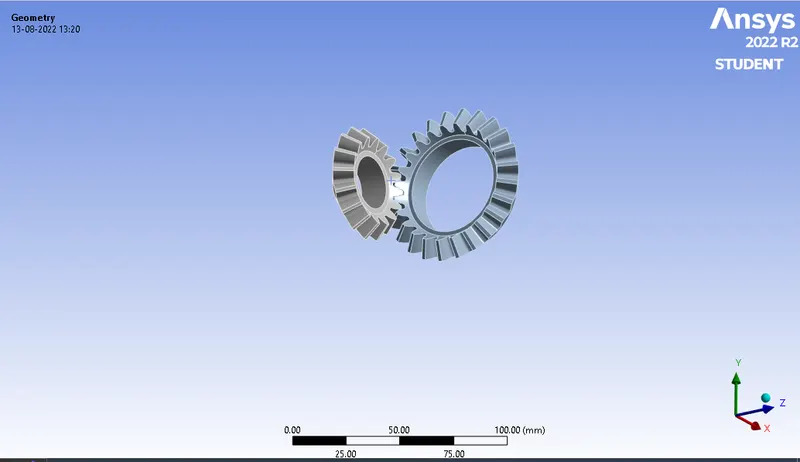
- Setup for analysis:
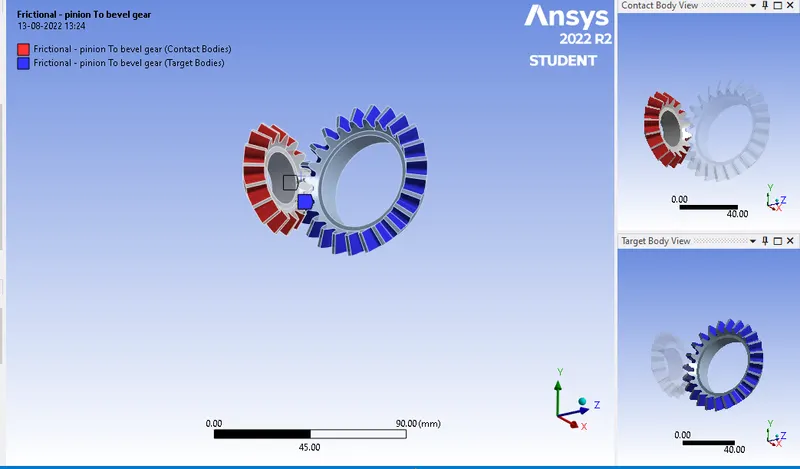
Contact setting: Structural Steel material is choosen for Bevel gear assembly system with the contact properties of:
1)Type:Frictional contact
2)Formulation:Augumented Lagrange
3)Interface Treatment:Adjust to touch
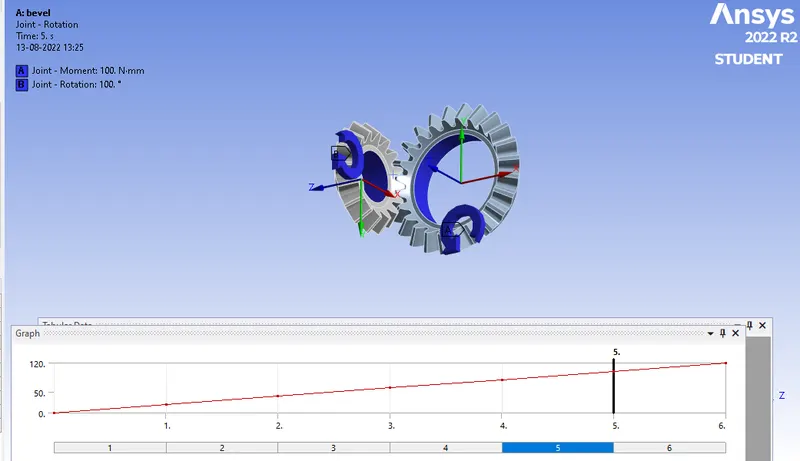
- Joint creation:
Two body ground Revolute joint is created for two mating gears with 16 & 24 teeths.
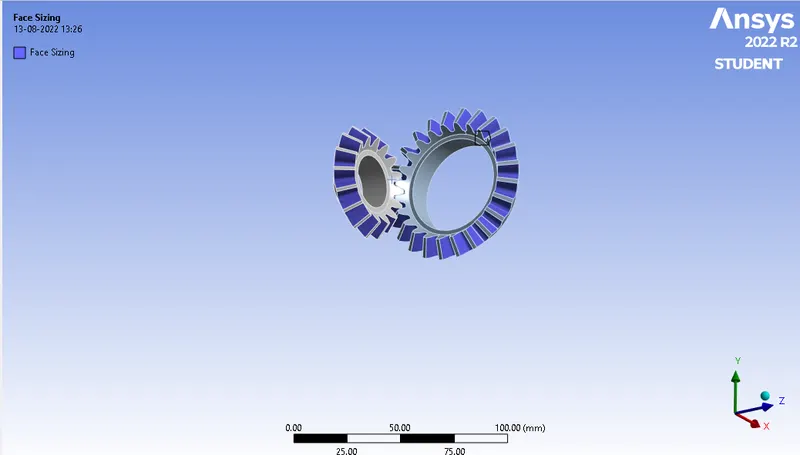
- Meshing:
Face sizing of gear teeths of both gear at 2.00 mm, which is basically the area of contact between two mating gears in order to avoid non covergence during solution.
- Analysis setting:
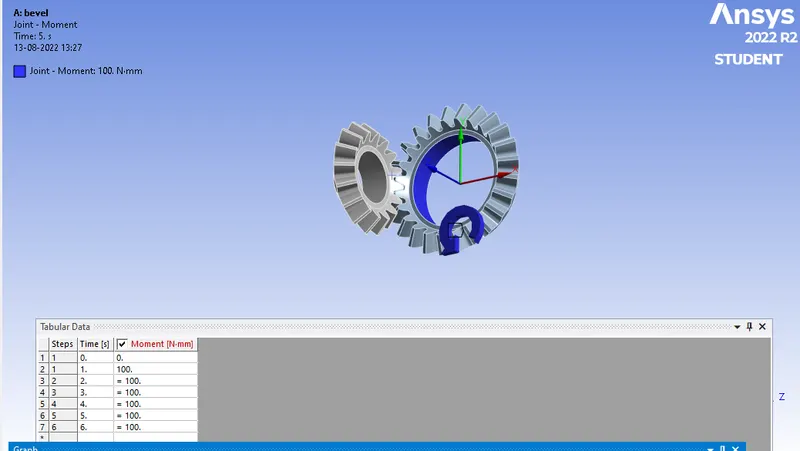
Larger gear with 24 teeth is given input of 100 Nmm torque
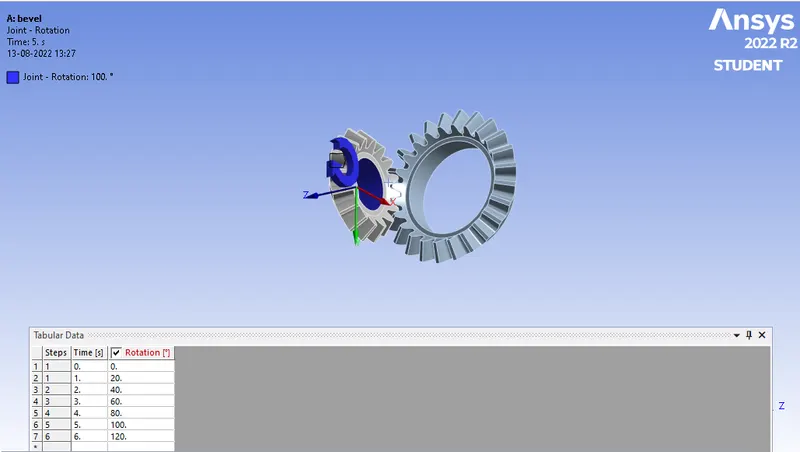
Smaller gear with 16 teeths is given rotation in 6 steps 20 degrees each from 0 to 120 degrees.
Results:
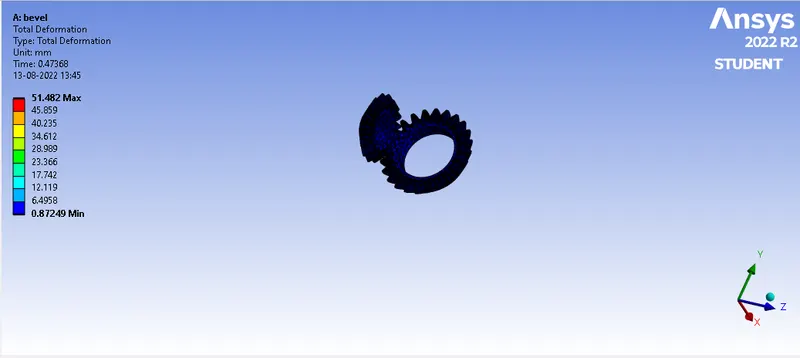
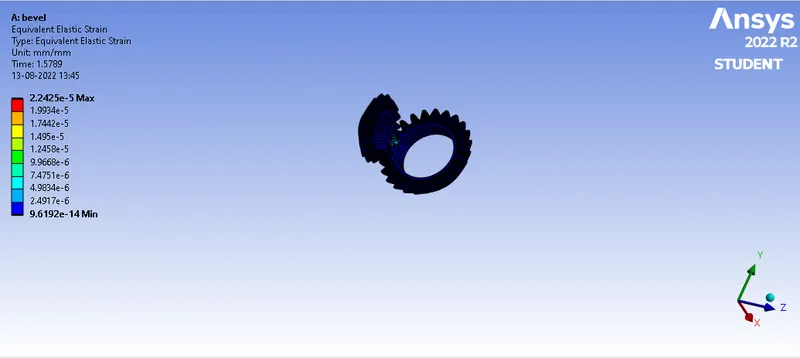
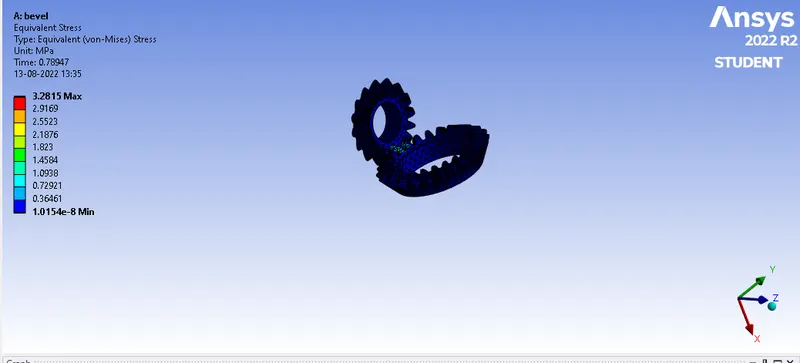
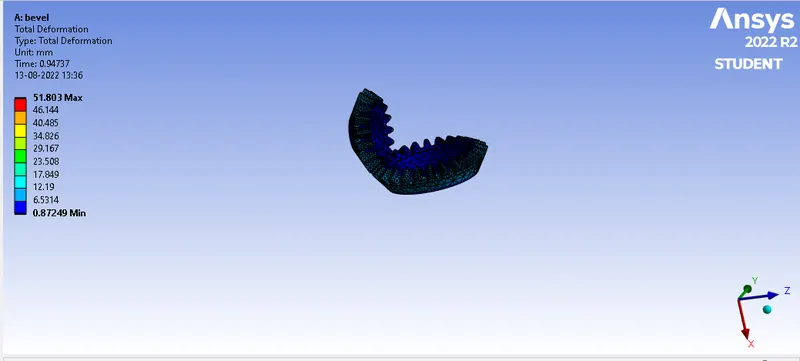
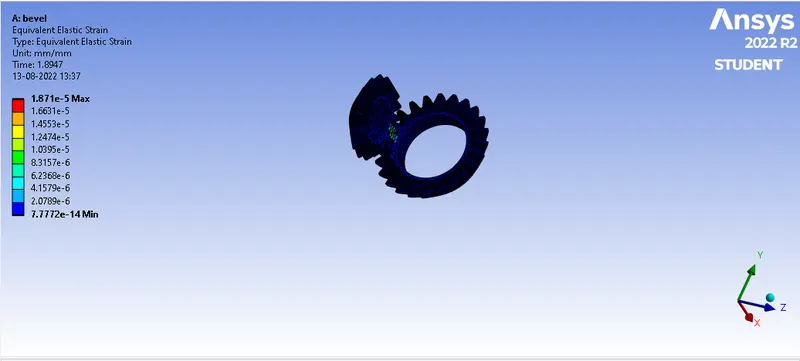
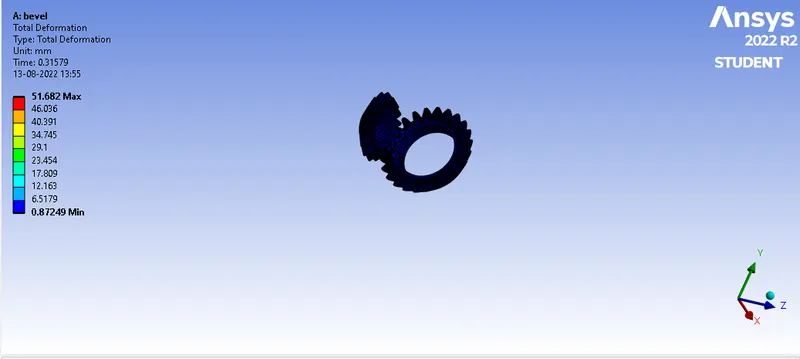
The analysis is doen for the model above and results generated for Total deformation,Equivalent Stress & Equivalent Strain for 6mm,5mm & 4mm mesh size are shown below alongwith force convergence graph.
Case 1: 6mm Mesh Size
Total Deformation:
 .Equivalent Elastic Strain:
Equivalent Stress:
Case 2: 5mm Mesh Size
Total Deformation:
Equivalent Elastic Strain:
Equivalent Stress:
Case 3: 4mm Mesh size
Total Deformation:
Equivalent Stress:
Equivalent Elastic Strain:
Conclusion:
Comparing the results of above three meshed models:
|
Element Size (mm) |
Max Total Deformation(mm) | Max Equivalent Elastic Strain (mm/mm) | Max Equivalent Stress(MPa) |
| 6 | 51.482 | 2.2425e-005 |
3.2815 |
| 5 | 51.803 | 1.871e-005 |
3.5815 |
| 4 | 51.682 | 1.871e-005 |
3.2815 |
Total deformation & Maximum Equivalent Strain are almost equal for all three meshed models, with decrease in mesh size there is only small changes observed in Maximum Equivalent Stress in all three models.
So we can conclude from here that mesh size of 6 mm is accurate and when we decrease mesh size there is no significant change in simulation solutions of Equivalent Stress,Equivalent Elastic Strain & Total Deformation.