Week 2 Air standard Cycle
Aim:
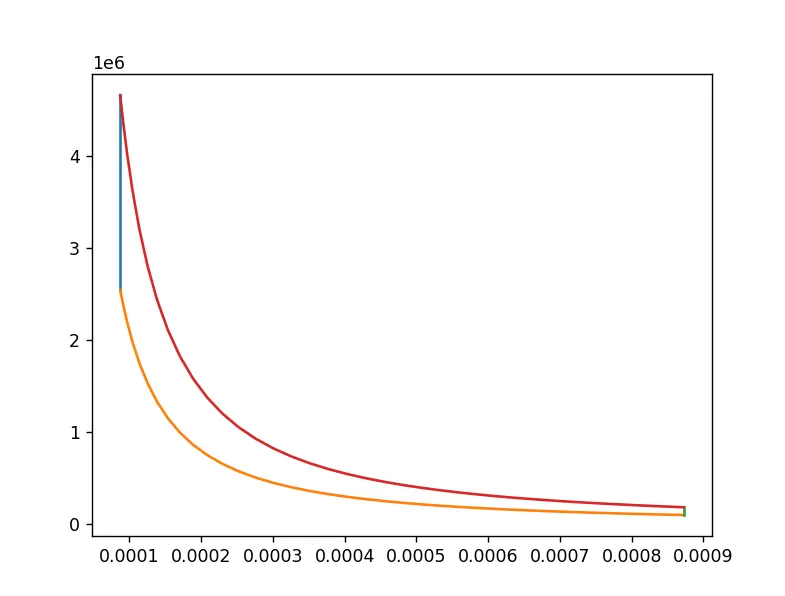
To write code to solve an otto cycle and make plots for it. with PV diagram and for the thermal efficiency of the engine
Theory:
Adiabatic compression (1-2)- Air and fuel mixture is compressed isentropically inside the cylinder.
Constant volume heat addition (2-3)- Combustion take place inside the cylinder due to external source.
Adiabatic expansion (3-4) - high pressure and high temperature gases expand isentropically inside the cylinder.
Constant volume heat rejection (4-1)- Gases come out from the cylinder and cycle is completed.
Explanation of coding logic:
"""
otto cycle simulator
"""
import math
import matplotlib.pyplot as plt
import numpy as np
def engine_kinematics(bore,stroke,con_rod,cr,start_crank,end_crank):
"""
engine_kinematics
"""
#geometric parameters
#crank pin radius
a = stroke/2
R = con_rod/a
#volume computation
v_s = (math.pi/4)*pow(bore,2)*stroke
v_c = v_s/(cr-1)
sc = math.radians(start_crank)
ec = math.radians(end_crank)
num_value = 50
dtheta = (ec-sc)/(num_value-1)
v = []
for i in range(0,num_value):
theta = sc+i*dtheta
term1 = 0.5*(cr-1)
term2 = R+1-math.cos(theta)
term3 = pow(R,2)-pow(math.sin(theta),2)
term3 = pow(term3,0.5)
v.append((1+term1*(term2-term3))*v_c)
return v
#inputs
p1 = 101325
t1 = 500
gamma = 1.4
t3 = 2300
bore = 0.1
stroke = 0.1
con_rod = 0.15
cr = 10
# volume computation
v_s = (math.pi/4)*pow(bore,2)*stroke
v_c = v_s/(cr-1)
v1 = v_c + v_s
#state point 2
v2 = v_c
#p2v2^gamma = p1v1^gamma
p2 = p1*pow(v1,gamma)/pow(v2,gamma)
#p2v2/t2 = p1v1/t1 |rhs = p1v1/t1 | p2v2/t2 = rhs | t2 = p2v2/rhs
rhs = p1*v1/t1
t2 = p2*v2/rhs
v_compression = []
p_compression = []
v_compression = engine_kinematics(bore, stroke, con_rod, cr, 180,0)
constant = p1*pow(v1,gamma)
p_compression = []
for v in v_compression:
p_compression.append(constant/pow(v,gamma))
# state point 3
v3 = v2
# p3v3/t3 = p2v2/t2 | rhs = p2v2/t2 | p3 = rhs*t3/v3
rhs = p2*v2/t2
p3 = rhs*t3/v3
v_expansion = engine_kinematics(bore, stroke, con_rod, cr, 0,180)
constant = p3*pow(v3,gamma)
p_expansion = []
for v in v_expansion:
p_expansion.append(constant/pow(v,gamma))
# state point 4
v4 = v1
#p4v4^gamma = p3v3^gamma
p4 = p3*pow(v3,gamma)/pow(v4,gamma)
#p4v4/t4 = rhs
t4 = p4*v4/rhs
plt.plot([v2,v3],[p2,p3])
plt.plot(v_compression, p_compression)
plt.plot([v4,v1],[p4,p1])
plt.plot(v_expansion, p_expansion)
plt.show()
#thermal efficiency
eff = (1/pow(cr,(gamma-1)))
eff = str(eff*100)
print('termal efficiency = ' + eff +'%')
Result: A typical gasoline automotives engine operates at around 39.810717055349734% of termal efficiency.
conclusion: About 60.1892829446% of energy is rejected as a waste of heat without being converted into useful work.
Resultant pv diagram for otto cycle: