Week -2
AIM:-
To make a simulink model of doorbell using solenoid block and use a thermistor to sense the temprature of heater and turn on or turn off the fan.
OBJECTIVE:-
- Make a Simulink model of Doorbell using solenoid block with the following details.
Create a situation where the switch is closed for 2 seconds and then released. Observe the physical movement of the plunger.
- Use a thermistor to sense the temperature of a heater & turn on or turn off the fan as per the below conditions.
Temperature source: 20 °C from 0 to 10 seconds, 27 °C from 10 to 30 seconds, 23 °C from 30 to 50 seconds
Fan conditions: ON if the temperature above 25 °C, OFF otherwise.
THEORY:-
- DOORBELL:- When you hold down a doorbell button, it closes an electrical circuit so that household current
flows through the electromagnet (or electromagnets) by way of a transformer. The transformer
is a simple device that takes the 120-volt household current and steps it down to a 10-volt current
(see Inside a Power-Cube Transformer to find out how). This current is then passed through the
electromagnet wire.
The magnetic field of the electromagnet is put to work to drive some sort of a noisemaking
apparatus. There are a number of different ways to configure the doorbell components in order to
produce different sorts of noises. In the next couple of sections, we'll look at three common
systems: the buzzer, the bell and the chime.
- SOLENOID:-A solenoid is a device comprised of a coil of wire, the housing and a moveable plunger (armature). When an electrical current is introduced, a magnetic field forms around the coil which draws the plunger in. More simply, a solenoid converts electrical energy into mechanical work.
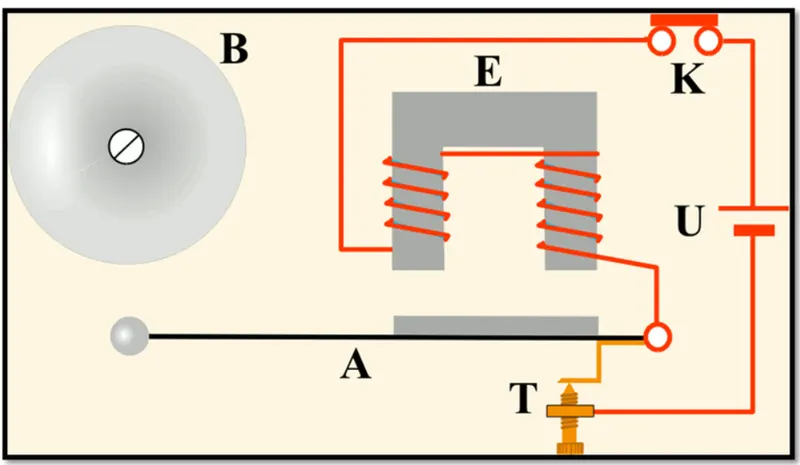
SIMULINK MODEL:-
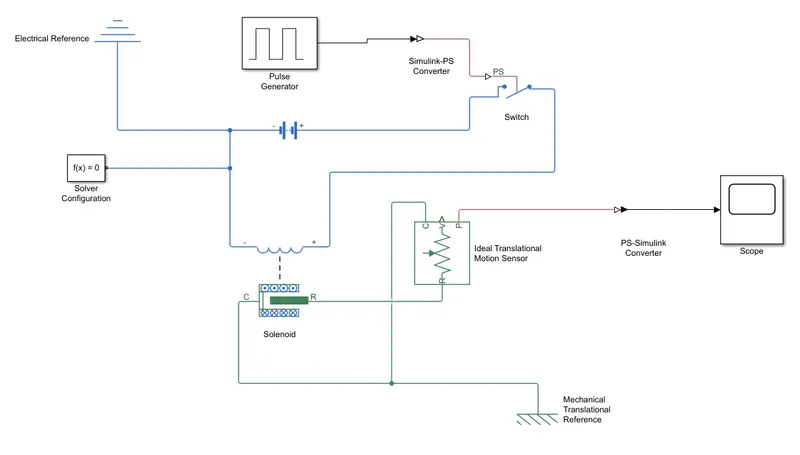
BlOCKS USED:-
- Pulse generator.
- Simulink-PS coverter.
- Switch.
- Battery.
- Solenoid.
- Solver Configuration.
- Ideal Translation motion sensor.
- Scope.
To feed the input pulse generator block is created. The input of the pulse generator is created.
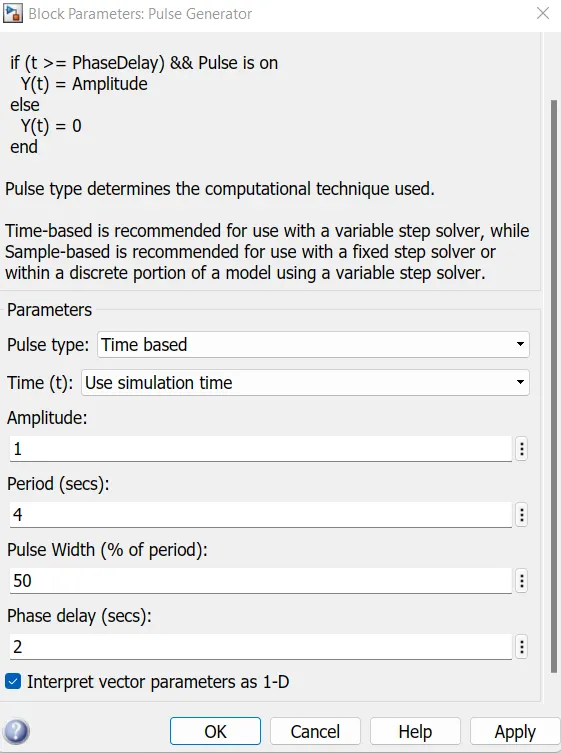
I have given the amplitude as 1. To achieve 2 seconds of phase and 2 seconds of ringing give the time period is 4 seconds with a pulse width of 50%.
OUTPUT:-
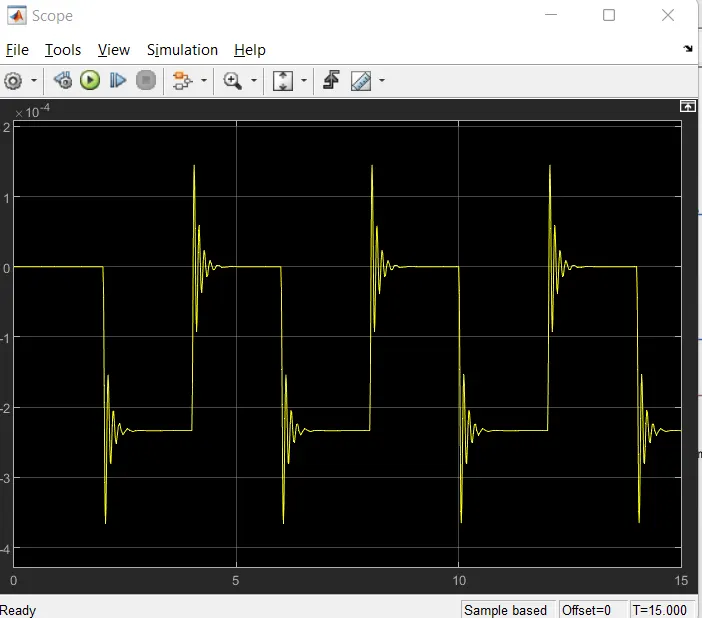
The Amplitude shows the bell is ringing at the interval of 2 second with phase delay of 2 second. This is shown by the scope.
AIM:-
To make the simulink model by using a thermistor to sense the temperature of a heater & turn on or turn off the fan as per the below conditions:
OBJECTIVE:-
Use a thermistor to sense the temperature of a heater & turn on or turn off the fan as per the below conditions.
Temperature source: 20 °C from 0 to 10 seconds, 27 °C from 10 to 30 seconds, 23 °C from 30 to 50 seconds
Fan conditions: ON if the temperature above 25 °C, OFF otherwise.
THERMISTOR:-
A thermistor is a thermally sensitive resistor that exhibits a precise and predictable change in resistance proportional to small changes in body temperature. How much its resistance will change is dependent upon its unique composition. Thermistors are part of a larger group of passive components. And unlike their active component counterparts, passive devices are incapable of providing power gain, or amplification to a circuit.
THERMISTOR TYPES:-
There are two types of thermistors. NTC or Negative Temperature Coefficient thermistors, and PTC or Positive Temperature Coefficient thermistors. The difference is that NTC thermistors exhibit a DECREASE in resistance as body temperature increases, while PTC thermistors exhibit an INCREASE in resistance as body temperature increases.

SIMULINK MODEL:-
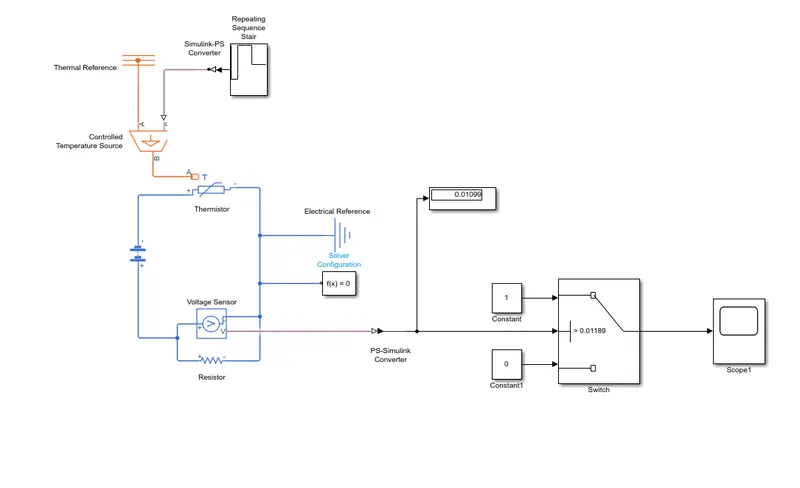
BlOCKS USED:-
- Repeating sequence stair.
- PS-simulink converter.
- Controlled temprature source.
- Thermal reference.
- Thermistor.
- Battery.
- Resistor.
- Voltage Sensor.
- Electrical Reference.
- Solver configuration.
- PS-simulink converter.
- Constant.
- Switch.
- Scope.
Here the input is feed through the block Repeating Sequence Stair.
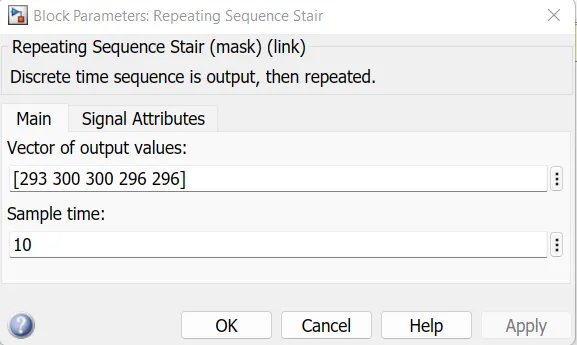
The input Parameter of Repeating Sequence Stair is modified as per given conditions.
Temperature source: 20 °C from 0 to 10 seconds, 27 °C from 10 to 30 seconds, 23 °C from 30 to 50 seconds
Fan conditions: ON if the temperature above 25 °C, OFF otherwise.
OUTPUT:-
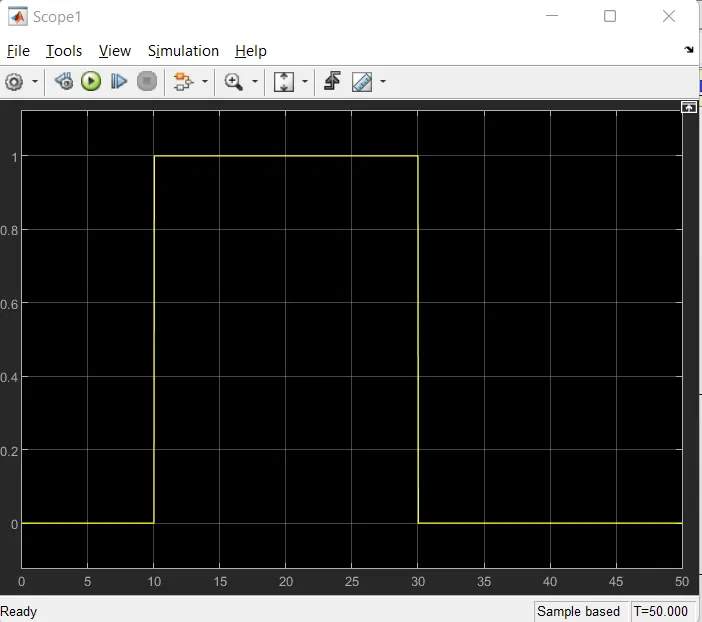
So on the given condition fan will 'ON' only if the themprature is above 25 degree celcius which is in the time period of 10 to 30 second. which is shown in the above output graph.