Week 2- 2R Robotic Arm Challenge
AIM:
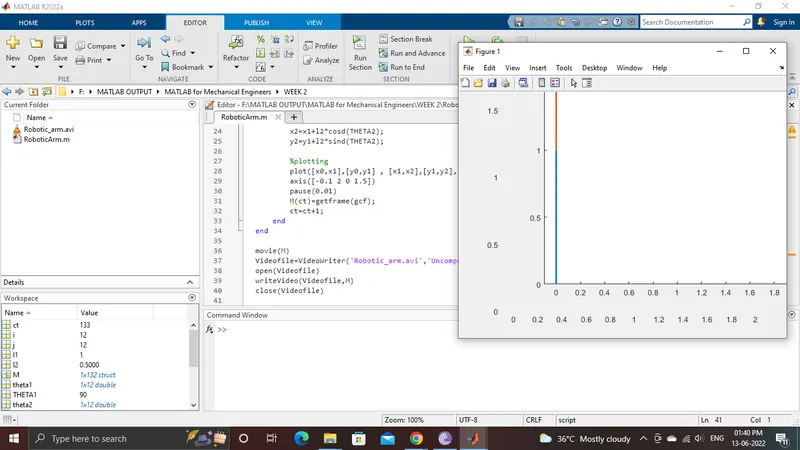
To Write a program in Matlab to simulate the forward kinematics of a 2R Robotic Arm
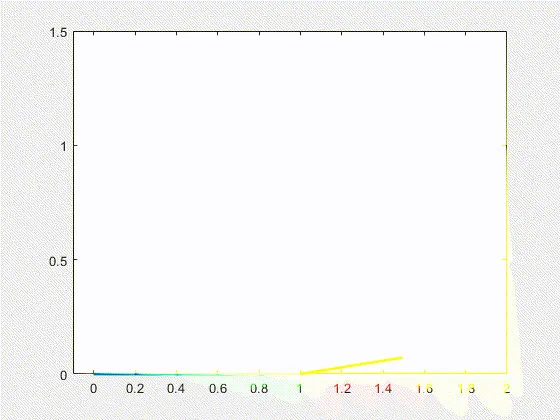
To Create an animation file of the plot.
Robotic arms are machines that are programmed to execute a specific task or job quickly, efficiently, and extremely accurately. Generally motor-driven, they’re most often used for the rapid, consistent performance of heavy and/or highly repetitive procedures over extended periods of time, and are especially valued in the industrial production, manufacturing, machining and assembly sectors.
A typical industrial robot arm includes a series of joints, articulations and manipulators that work together to closely resemble the motion and functionality of a human arm (at least from a purely mechanical perspective). A programmable robotic arm can be a complete machine in and of itself, or it can function as an individual robot part of a larger and more complex piece of equipment.
A great many smaller robotic arms used in countless industries and workplace applications today are benchtop-mounted and controlled electronically. Larger versions might be floor-mounted, but either way they tend to be constructed from sturdy and durable metal (often steel or cast iron), and most will feature between 4-6 articulating joints. Again, from a mechanical perspective, the key joints on a robotic arm are designed to closely resemble the main parts of its human equivalent - including the shoulder, elbow, forearm and wrist.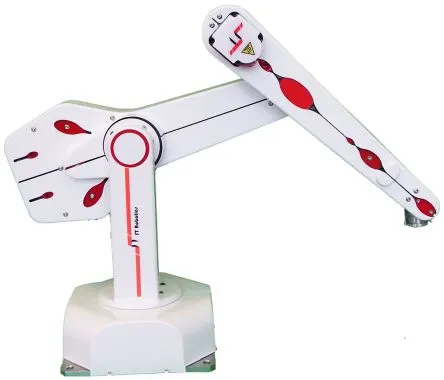
Such is the speed and power that industrial robot arms can work at, there’s a pressing need to be extremely safety-conscious when programming and using them. However, when deployed appropriately, they can vastly increase production rates and accuracy of placement and picking tasks, as well as performing heavy-duty lifting and repositioning functions that would be impossible even for groups of multiple human workers to carry out at any sort of pace.
As technology has advanced and the manufacturing costs of robotic components has fallen over the years, the past decade or so has seen a very rapid expansion in the availability and affordability of robots and robotic arms across a very wide range of industries. This means that they’re far more commonly encountered in smaller-scale operations than they once were, because they’re no longer only an economically viable option for large-scale production lines outputting very high volumes of product.
PROGRAM: