Week 12 - Validation studies of Symmetry BC vs Wedge BC in OpenFOAM vs Analytical H.P equation
Aim:
- Write a program in Matlab that can generate the computational mesh.
- Perform simulation of floe through pipe using openFoam.
Conditions :
- Flow is laminar.
- Fluid flowing through pipe is incompressibe.
Hagen–Poiseuille equation:
is a physical law that gives the pressure drop in an incompressible and Newtonian fluid in laminar flow flowing through a long cylindrical pipe of constant cross section.The Hagen-Poiseuille equation is only valid for long pipes whose length is relatively large compared to their diameter.
Hydrodynamic entrance length:
Fluids with low viscosity reaches its free stream velocities at very small distances as there is no hinderance with other molecules.But fluids with high viscosity takes a larger distance to reach the free stream velocity.At the entrance the velocity of the fluid near to the wall will have less velocity as there will be friction between the wall and the fluid.towards centre velocity will be increasing and after a length the velocity is same at all positions ,This length til which velocity varies is called hydrodynamic entrace region /length.The region after this region is fully devloped region.
Since there are no velocity gradients outside the hydrodynamic boundary layer, the shear stresses are negligible. In this undisturbed flow, the viscosity of the fluid plays no role. But within the boundary layer, the shear stresses are usually no longer negligible and have a decisive influence on the flow. Even if the boundary layer is defined very precisely, the change of the properties of the flow inside and outside of this “sharp” boundary is smooth!
Fully devloped laminar Flow:
Flow is said to have reached Fully devloped flow if it have the same velocity profile at any cross-section within the pipe.
For the simulation of laminar flow through a pipe as creating mesh for whole pipe and running simulation may not be supported in all computers a wedge shaped profile is created and simulations are performed on the wedge shaped profile.
Values:
Diameter D = 0.002m
r =D/2;(this is the distance from centre to outer circumference)
mu = 0.00089`N/m^2`(dynamic viscosity)
`rho=987(kg)/m^2`
Re = 2100(dimension less renoylds number)
Formulas used for calculation:
`V_(avg) = (R_e*mu)/(rho*D)`
`Deltap =(8*mu*L*V_(avg))/r^2`
Kinematic pressure =`Deltap/rho`
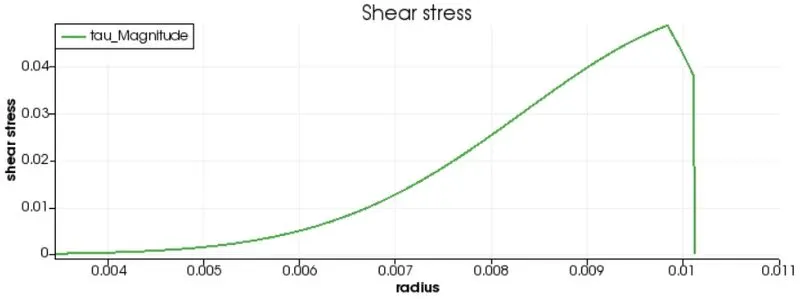
Shear stress `tau =(2*mu*v_(max)*R)/r^2`
Matlab code for creating blockMesh dict file:
Steps for simulation:
- icoFoam is the solver used for simulating incompressible flows.
- open icofoam in th incompressible folder copy cavity folder into run file.
- copy the blockMeshDict file created from matlab into the system folder deleting the previous one.
- change the timestep according to the problem which gives cfl value less than 1.
- Run Allrun command to create polyMesh file.open the Cavity folder and run blockMesh command.this creates mesh.
- Then ckeck mesh using'checkMesh command' and then run the solver icoFoam.to vie the results give paraFoam command.
In fully developed laminar flow, each fluid particle moves at a constant axial velocity along a streamline and the velocity profile u(r) remains unchanged in the flow direction. There is no motion in the radial direction,and thus the velocity component in the direction normal to flow is everywherezero.
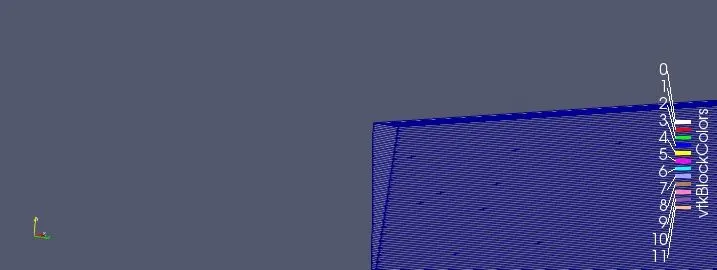
Mesh with angle `10^o`
Mesh with angle `25^o`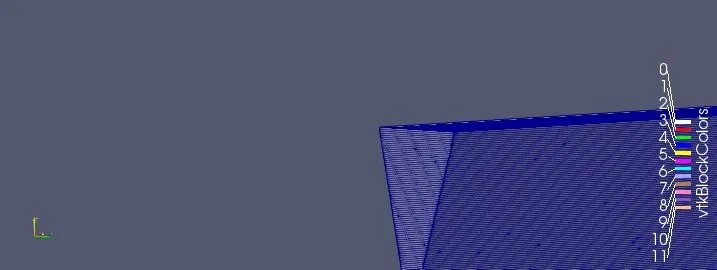
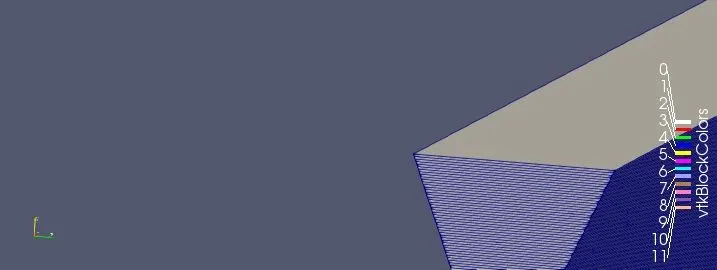
Mesh with angle `45^o`
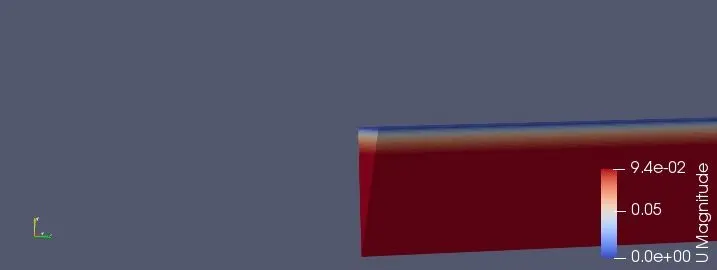
Velocity simulation of wedge with angle `10^o`
Velocity simulation of wedge with angle `25^o`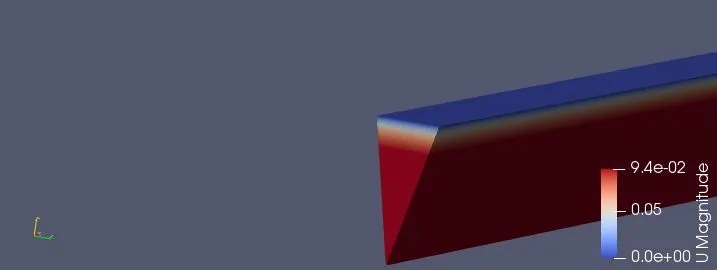
Velocity simulation of wedge with angle `45^o`
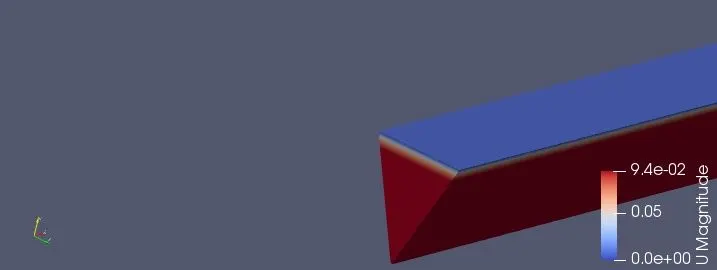
Velocity plot for `10^o` wedge:
Velocity at the entrance
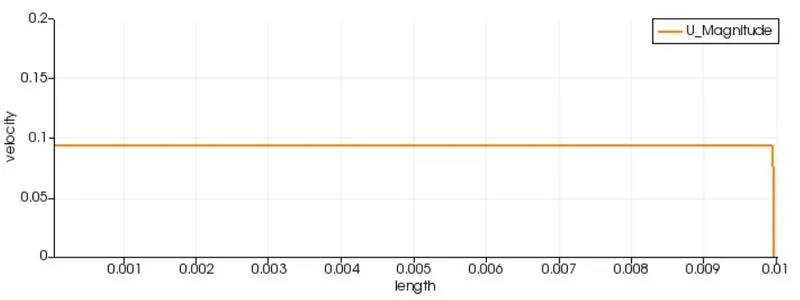
Velocity at adistance 0.05m from entrance:
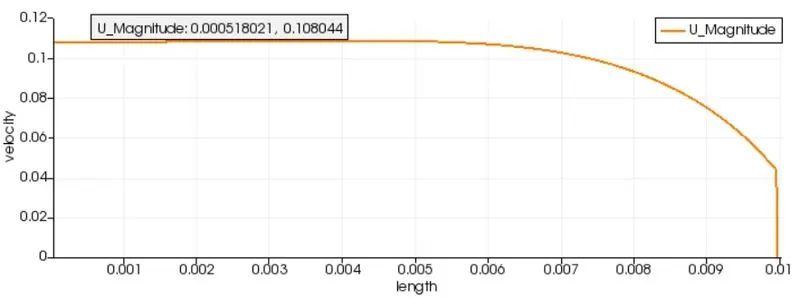
Velocity at adistance 0.9m from entrance:
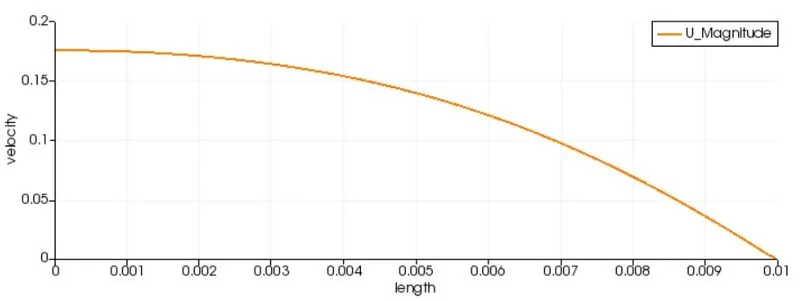
Velocity at adistance 1.9m from entrance:
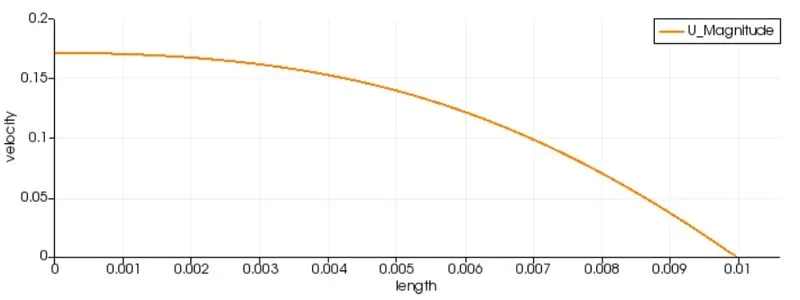
Velocity Simulation for `25^o`:
Velocity at the entrance:
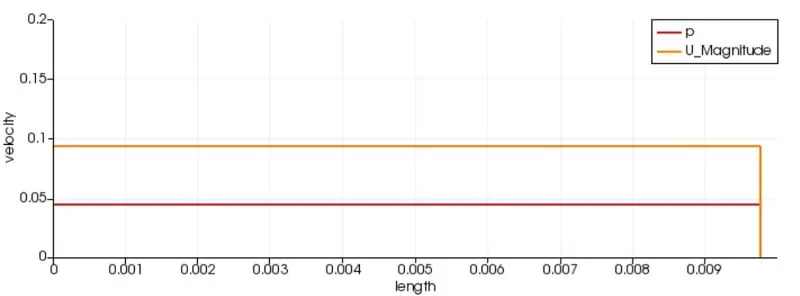
Velocity at adistance 0.05m from entrance:
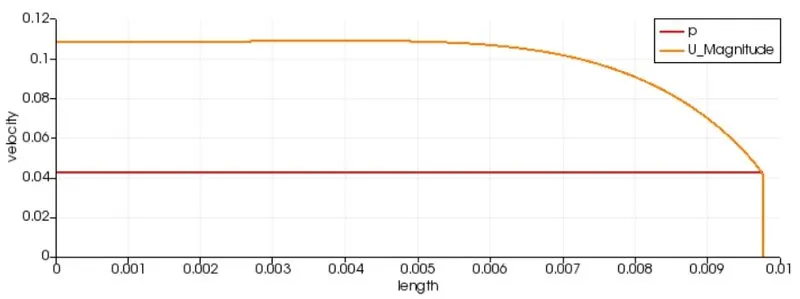
Velocity at adistance 0.9m from entrance:
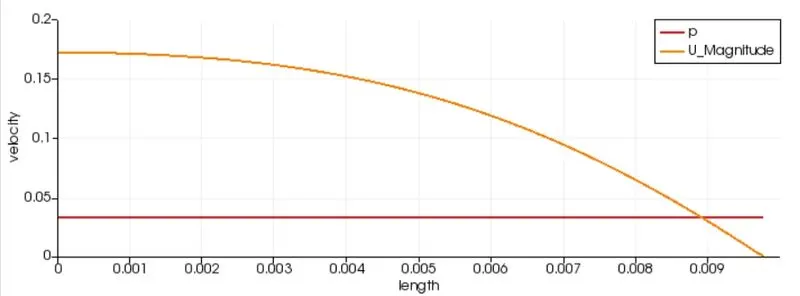
Velocity at adistance 1.9m from entrance:
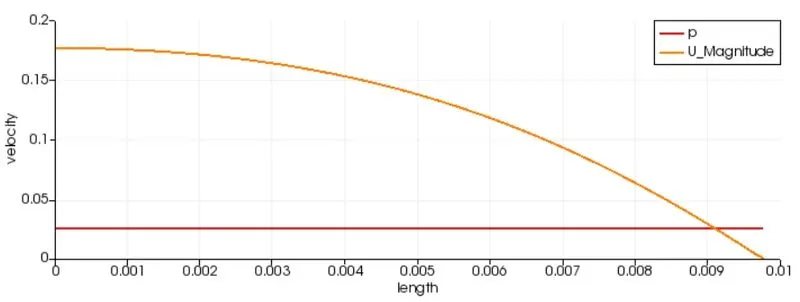
Velocity Simulation for `45^o`:
velocity at the entrance:
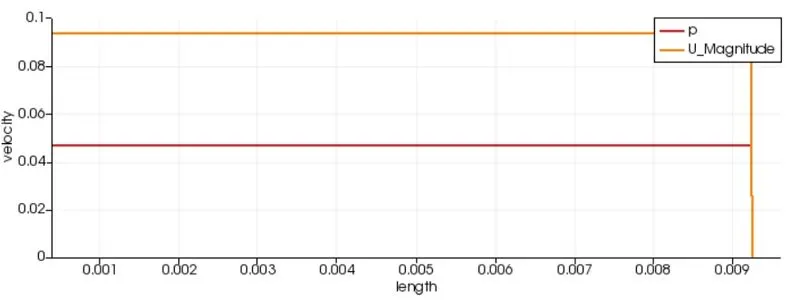
Velocity at adistance 0.05m from entrance:
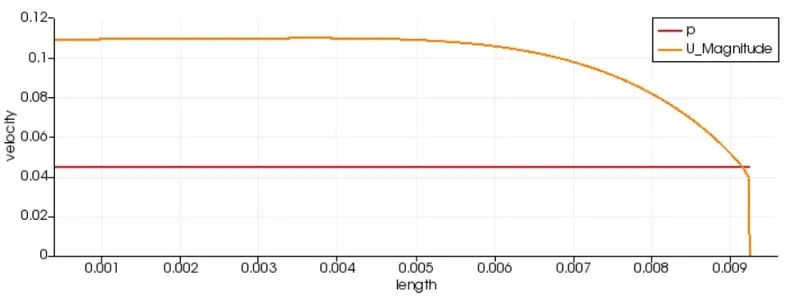
Velocity at adistance 0.9m from entrance:
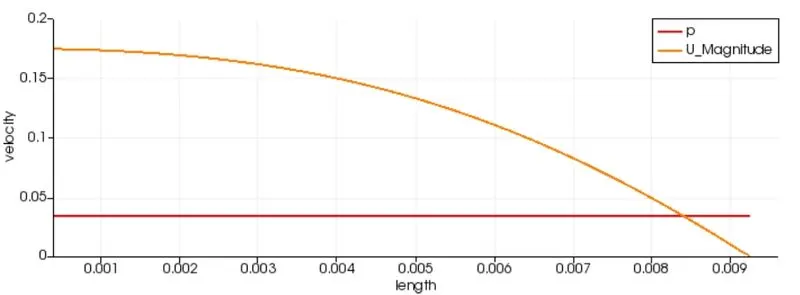
Velocity at adistance 1.9m from entrance:
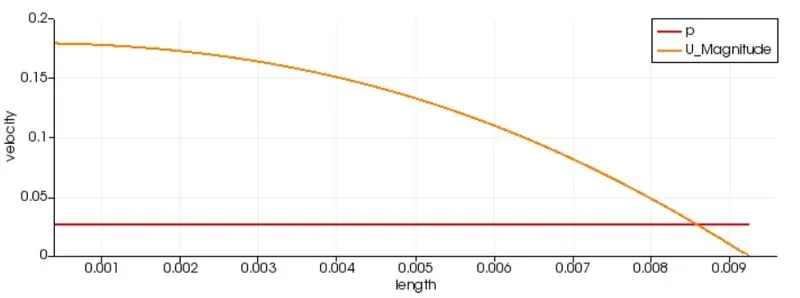
Shear stress:
When the fluid is in motion, shear stresses are developed due to the particles in the fluid moving relative to one another.For a fluid flowing in a pipe, fluid velocity will be zero at the pipe wall. Velocity will increase while moving towards the center of the pipe. Shear forces are normally present because adjacent layers of the fluid move with different velocities compared to each other.
Shear stress `10^o`
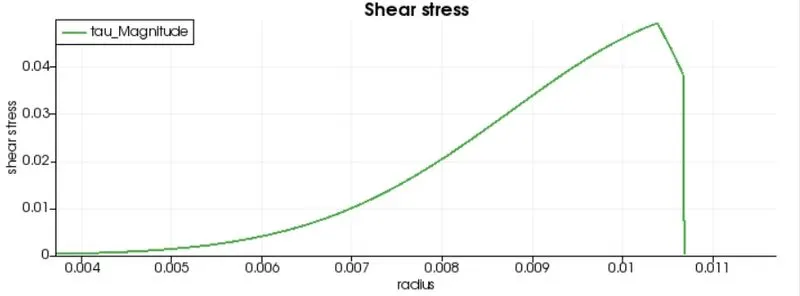
Shear stress `25^o`
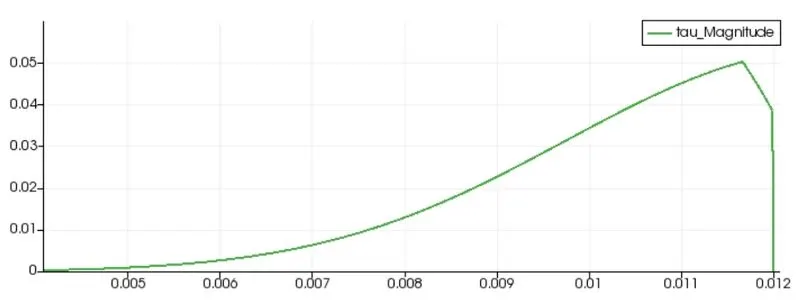
Shear stress `45^o`
Conclusion:
- The difference between the analytical method and numerical method values doesnt change much.
- The simulation time with boundary conditions symmentry and Wedge vary.The simulation time of the bounadrt condition symmentry takes more time compared to the one with wedge boundary condition.
- Simulation time also varies with the mesh size and timestep size.
- There is a large variation in the simulation time with change in the boundary conditions wedge and symmentry.Boundary condition with Symmentry took more time than wedge.
| Wedge angle | Max Velocity | Analytica velocity | Pressure |
| 10 | 0.1875 | 0.175459 | 0.02045 |
| 25 | 0.1875 | 0.177356 | 0.02151 |
| 45 | 0.1875 | 0.179623 | 0.02133 |