Week 12- Major Project (CFD Analysis on Combustion in a SCRAMJET engine)
Introduction:
- Before understanding the SCRAMJET engine, first, need to understand the TURBOJET engine and RAMJET engine.
TURBOJET Engine:
- The turbojet is an airbreathing jet engine typically used in aircraft. It consists of a gas turbine and a propelling nozzle. The gas turbine has an air inlet which includes inlet guide vanes, a compressor, a combustion chamber, and a turbine (that drives the compressor). The compressed air from the compressor is heated by burning fuel in the combustion chamber and then allowed to expand through the turbine. The turbine exhaust is then expanded in the propelling nozzle where it is accelerated to high speed to provide thrust.
- Design
- Air intake
- Compressor
- Combustion chamber
- Turbine
- Nozzle
- Thrust augmentation
- Afterburner
- Air intake:
- An intake, or tube, is needed in front of the compressor to help direct the incoming air smoothly into the rotating compressor blades. Older engines had stationary vanes in front of the moving blades. These vanes also helped to direct the air onto the blades. The air flowing into a turbojet engine is always subsonic, regardless of the speed of the aircraft itself.
- Compressor:
- The compressor is driven by the turbine. It rotates at high speed, adding energy to the airflow and at the same time squeezing (compressing) it into a smaller space. Compressing the air increases its pressure and temperature. The smaller the compressor, the faster it turns.
- Compressor types used in turbojets were typically axial or centrifugal. Early turbojet compressors had low-pressure ratios up to about 5:1.
- Combustion Chamber:
- The burning process in the combustor is significantly different from that in a piston engine. In a piston engine, the burning gases are confined to a small volume, and as the fuel burns, the pressure increases. In a turbojet, the air and fuel mixture burn in the combustor and pass through to the turbine in a continuous flowing process with no pressure build-up. Instead, a small pressure loss occurs in the combustor.
- The fuel-air mixture can only burn in slow-moving air, so an area of reverse flow is maintained by the fuel nozzles for the approximately stoichiometric burning in the primary zone. Further compressed air is introduced which completes the combustion process and reduces the temperature of the combustion products to a level that the turbine can accept. Less than 25% of the air is typically used for combustion, as an overall lean mixture is required to keep within the turbine temperature limits.
- Turbine:
- Hot gases leaving the combustor expand through the turbine. Typical materials for turbines include Inconel and Nimonic. The hottest turbine vanes and blades in an engine have internal cooling passages. Air from the compressor is passed through these to keep the metal temperature within limits. The remaining stages do not need cooling.
- In the first stage, the turbine is largely an impulse turbine (similar to a Pelton wheel) and rotates because of the impact of the hot gas stream. Later stages are convergent ducts that accelerate the gas. Energy is transferred into the shaft through momentum exchange in the opposite way to energy transfer in the compressor. The power developed by the turbine drives the compressor.
- Nozzle:
- After the turbine, the gases expand through the exhaust nozzle producing a high-velocity jet. In a convergent nozzle, the ducting narrows progressively to a throat. The nozzle pressure ratio on a turbojet is high enough at higher thrust settings to cause the nozzle to choke.
- If, however, a convergent-divergent de Laval nozzle is fitted, the divergent (increasing flow area) section allows the gases to reach supersonic velocity within the divergent section. Additional thrust is generated by the higher resulting exhaust velocity.
- Net Thrust:
- The net thrust `F_N` of a turbojet is given by
- `F_N=(dotm_(air)+dotm_(f))V_j-dotm_(air)V`
- Where,
- `V_j` = speed of the jet (the exhaust plume) and is assumed to be less than sonic velocity
- `V` = true airspeed of aircraft
- If the speed of the jet is equal to sonic velocity then the nozzle is said to be " choked". If the nozzle is choked, the pressure at the nozzle exit plane is greater than atmospheric pressure, and extra terms must be added to the above equation to account for the pressure thrust
- The rate of flow of fuel entering the engine is very small compared with the rate of flow of air. If the contribution of fuel to the nozzle gross thrust is ignored, the net thrust is: `F_N=dotm_(air)(V_j-V)`
- The speed of the jet must exceed the true airspeed of the aircraft if there is to be a net forward thrust on the airframe. The speed `V_j` can be calculated thermodynamically based on adiabatic expansion.
- `F_N=(dotm_(air)+dotm_(f))V_j-dotm_(air)V`
- The net thrust `F_N` of a turbojet is given by
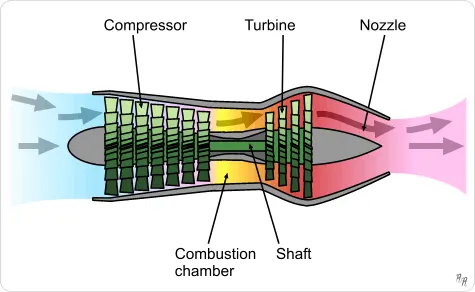
Figure: Turbojet engine
Ramjet Engine:
- A ramjet is a form of air-breathing jet engine that uses the forward motion of the engine to produce thrust. Since it produces no thrust when stationary (no ram air) ramjet-powered vehicles require an assisted take-off like a rocket assist to accelerate it to a speed where it begins to produce thrust. Ramjets work most efficiently at supersonic speed around Mach 3 (2,300 mph; 3,700 km/h) and can operate up to speeds of Mach 6 (4,600 mph; 7,400 km/h).
- Ramjets can be particularly useful in applications requiring a small and simple mechanism for high-speed use, such as missiles.
Note:
- As speed increases, the efficiency of a ramjet starts to drop as the air temperature in the inlet increases due to compression. As the inlet temperature gets closer to the exhaust temperature, less energy can be extracted in the form of thrust. To produce a usable amount of thrust at yet higher speeds, the ramjet must be modified so that the incoming air is not compressed (and therefore heated) nearly as much. This means that the air flowing through the combustion chamber is still moving very fast (relative to the engine), in fact, it will be supersonic—hence the name supersonic-combustion ramjet, or scramjet.
Design:
- The first part of a ramjet is its diffuser (compressor) in which the forward motion of the ramjet is used to raise the pressure of its working fluid (air) as required for the combustion of fuel. It is then passed through a nozzle to accelerate it to supersonic speeds. This acceleration gives the ramjet a forward thrust.
- A ramjet is much less complex than a turbojet in so far as it comprises an air intake, a combustor, and a nozzle but no turbomachinery.
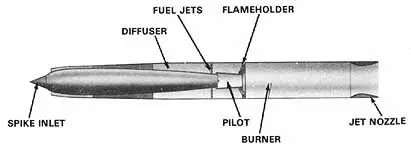
Figure: Ramjet
Construction:
- Diffuser
- Combustor
- Nozzle
Diffuser:
- The diffuser is that part of the ramjet which converts the high velocity of the air approaching the intake into high (static) pressure required for combustion.
- Subsonic and low-supersonic ramjets use a pitot-type entrance for the inlet to capture air. This is followed by a widening internal passage (subsonic diffuser) to achieve a lower subsonic velocity which is required at the combustor. At low supersonic speeds a normal (plane) shock wave forms in front of the inlet.
Combustor:
- As with other jet engines, the combustor has to raise the temperature of the air by burning fuel. This takes place with a small pressure loss. The air velocity entering the combustor has to be low enough such that continuous combustion can take place in sheltered zones provided by flame holders.
- Since there is no downstream turbine, a ramjet combustor can safely operate at stoichiometry fuel: air ratios, which implies a combustor exit stagnation temperature of the order of 2,400 K (2,130 °C; 3,860 °F) for kerosene.
Nozzle:
- The propelling nozzle is a critical part of a ramjet design since it accelerates exhaust flow to produce thrust.
- Subsonic ramjets accelerate exhaust flow with a nozzle Supersonic flight typically requires a convergent-divergent nozzle.
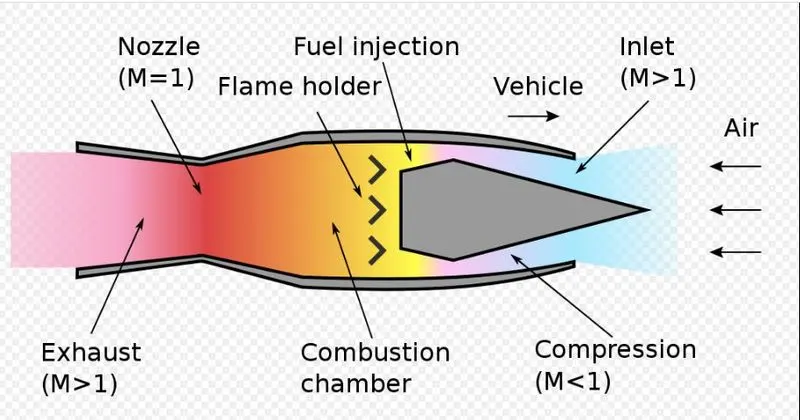
Figure: Ramjet
SCRAMJET (Supersonic Combustion RAMJET):
- A scramjet (supersonic combustion ramjet) is a variant of a ramjet airbreathing jet engine in which combustion takes place in supersonic airflow. As in ramjets, a scramjet relies on high vehicle speed to compress the incoming air forcefully before combustion (hence ramjet), but whereas a ramjet decelerates the air to subsonic velocities before combustion using shock cones, a scramjet has no shock cone and slows the airflow using shockwaves produced by its ignition source in place of a shock cone. This allows the scramjet to operate efficiently at extremely high speeds.
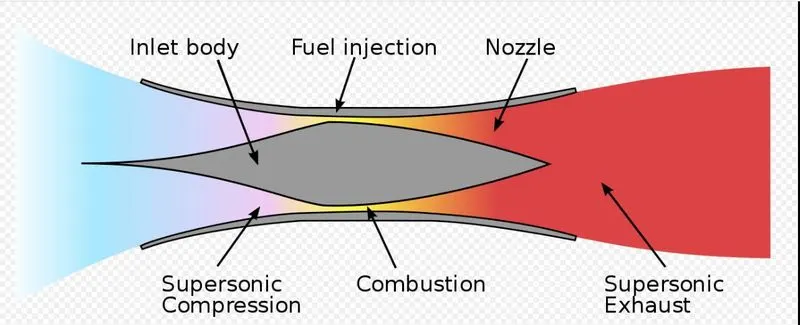
Figure: SCRAMJET
- Design principle
- The scramjet is composed of three basic components: a converging inlet, where incoming air is compressed; a combustor, where gaseous fuel is burned with atmospheric oxygen to produce heat; and a diverging nozzle, where the heated air is accelerated to produce thrust.
- Unlike a typical jet engine, such as a turbojet engine, a scramjet does not use rotating, fan-like components to compress the air; rather, the achievable speed of the aircraft moving through the atmosphere causes the air to compress within the inlet.
- As such, no moving parts are needed in a scramjet. In comparison, typical turbojet engines require multiple stages of rotating compressor rotor, and multiple rotating turbine stages, all of which add weight, complexity, and a greater number of failure points to the engine.
- Due to the nature of their design, scramjet operation is limited to near hypersonic velocities. As they lack mechanical compressors, scramjets require the high kinetic energy of a hypersonic flow to compress the incoming air to operational conditions. Thus, a scramjet-powered vehicle must be accelerated to the required velocity (usually about Mach 4) by some other means of propulsion, such as turbojet or rocket engines.
- While scramjets are conceptually simple, the actual implementation is limited by extreme technical challenges. Hypersonic flight within the atmosphere generates immense drag, and temperatures found on the aircraft and within the engine can be much greater than that of the surrounding air.
Advantages of Scramjet:
- Does not have to carry oxygen
- No rotating parts make it easier to manufacture than a turbojet
- Has a higher specific impulse (change in momentum per unit of propellant) than a rocket engine
Disadvantage:
- Difficult/expensive testing and development
- Very high initial propulsion requirements
Testing difficulties:
- Unlike jet or rocket propulsion systems facilities which can be tested on the ground, testing scramjet designs use extremely expensive hypersonic test chambers or expensive launch vehicles, both of which lead to high instrumentation costs.
Comparison:
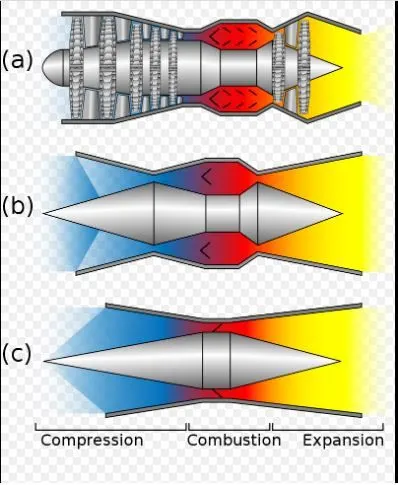
Figure: Compression, Combustion and Expansion region of (a) Turbojet (b) Ramjet and (c) SCRAMJET engines