Week 11: Project 2 - Emission characterization on a CAT3410 engine
Objectives:
- To set up the case for spray, combustion, & emissions.
- To evaluate the results & compare the selected bowl configurations.
- To evaluate engine performance parameters for both piston bowl sector(omega & open-w) geometries of a CAT3410 engine.
- To run imulations with both these pistons & characterize the emissions (Soot, NOx & UHC).
Geometry:
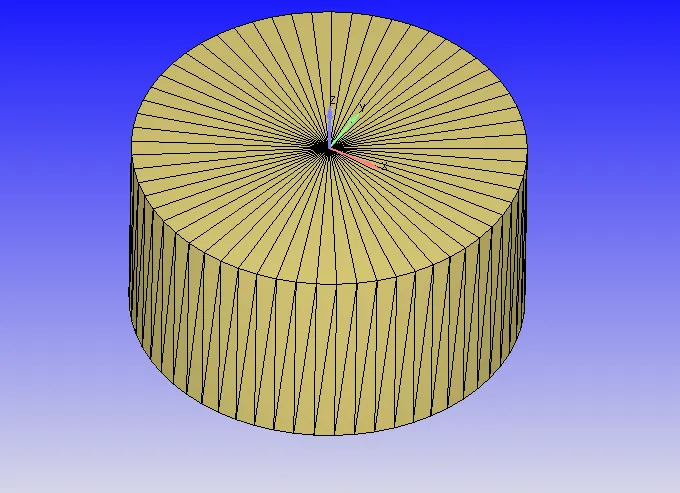
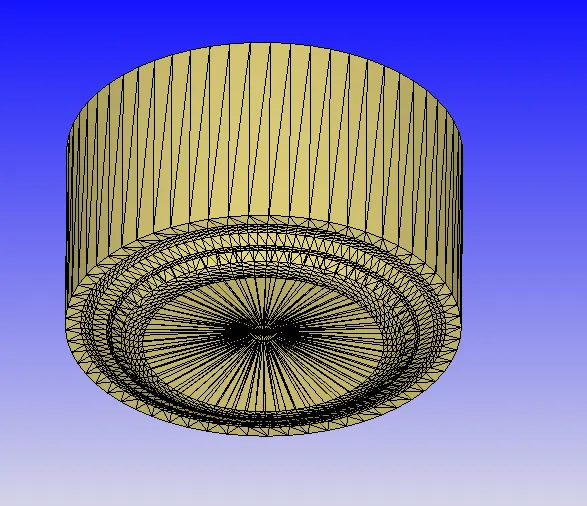
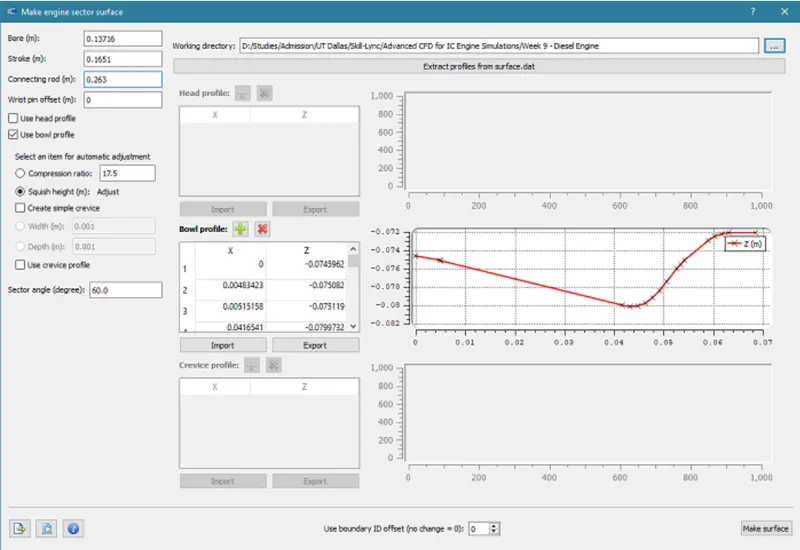
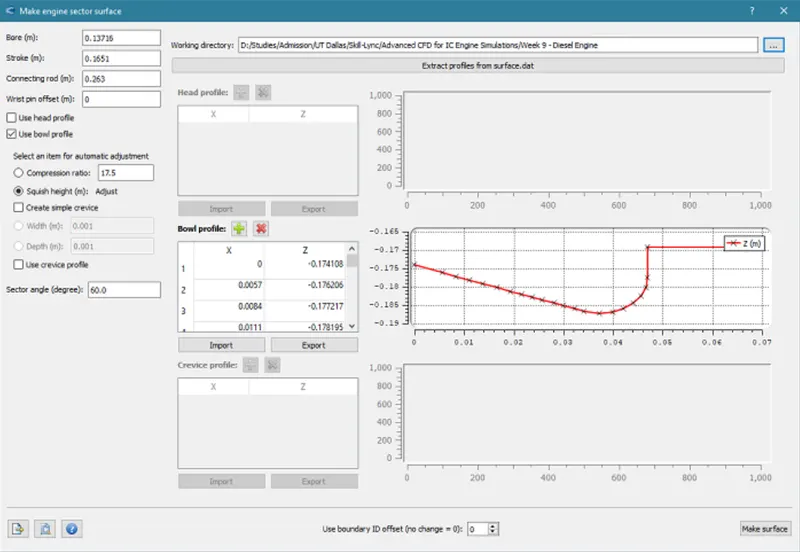
The above geometry does not consist of any exhaust & inlet valves which is a closed cycle system. For efficient computational simulation & to reduce time a sector(60 deg) of the above geometry is solved. To extract the sectors of the engines "Make engine sector surface" option from Tools was set up from where the bowl profiles of both the geometries(omega & open-w) are loaded & the sectors are obtained.
The geometric parameters of the engine are as follow:
- Bore: 0.13716 m
- Stroke: 0.1651 m
- Squish height: 0.0001 m
- Connecting Rod: 0.263 m
- Compression Ratio: 17.5
- RPM: 1600
1. Open-W Piston
2. Omega Piston
The surface geometries generated from this tool are shown below:
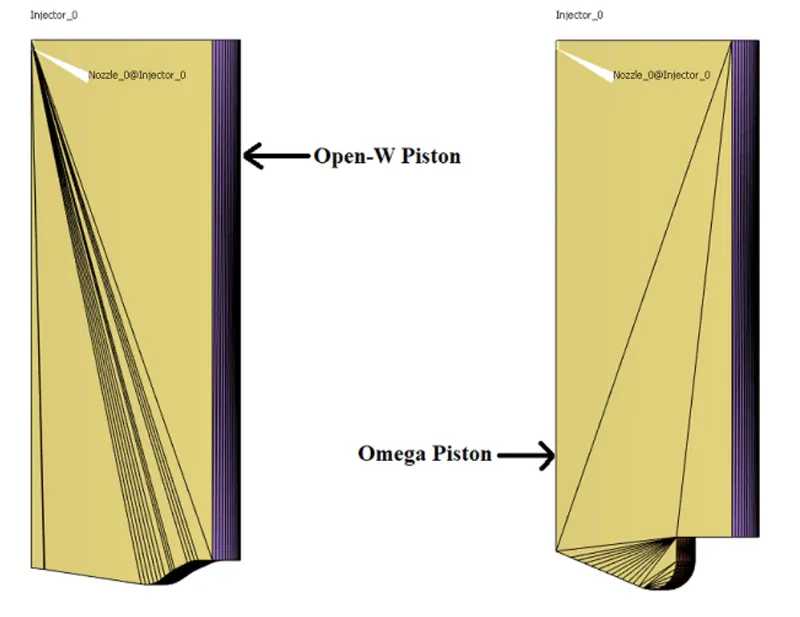
Sector geometries are useful in running quick simulations when there is an asymmetry in the model involved. This engine consist of 6 nozzles, hence the model can be decided into 360/6=60(deg) sectors.
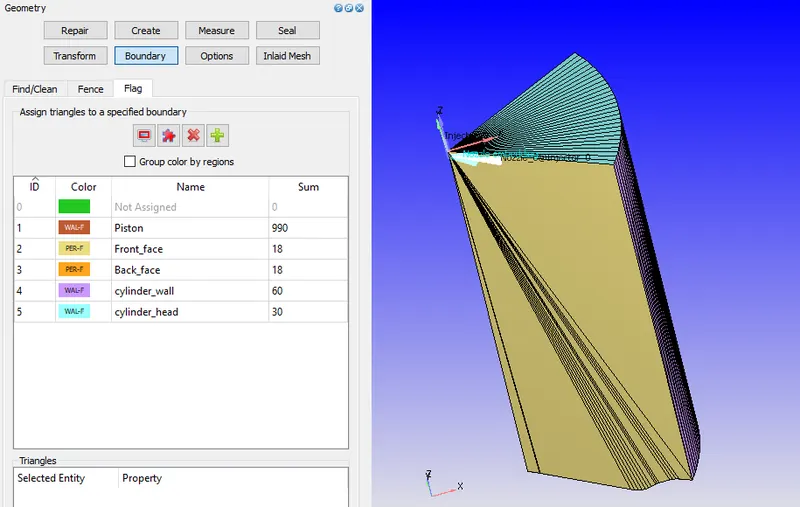
Boundary flagging of open w
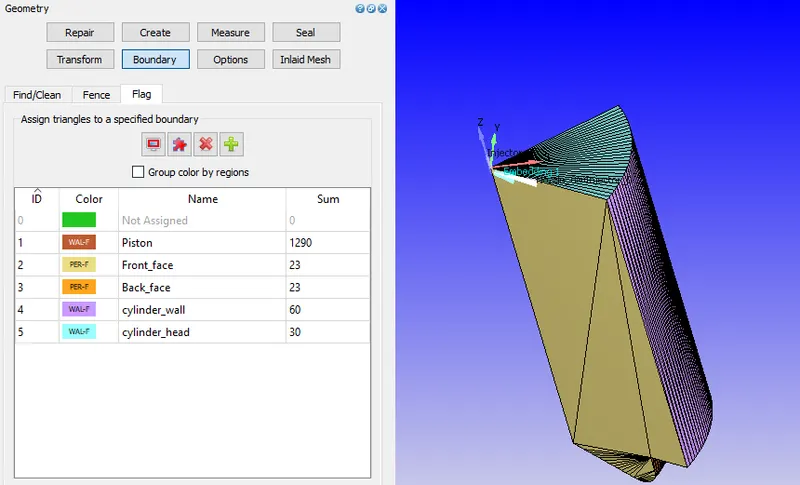
Boundary flagging of omega
Spray Modelling:
There are two types of spray modelling techniques that Converge uses: Gaseous & Liquid Sprays. Gaseous sprays are modelled using Eulerian solver which is the cell-centred solver. For Liquid sprays, Lagrangian Solver is used to model discrete parcels & the Eulerian solver to model continuous fluid domain. These lagrangian parcels need to be transferred to the Eulerian or gas phase domain where heat, momentum & mass transfer is facilitated through source term in the species transport equations. The various links that Converge uses to get from Eulerian to Lagrangian & capture the physical processes is known as Sub-Grid Modelling. Lagrangian specification of the flow field is a way of looking at fluid motion where the observer follows an individual fluid parcel as it moves through space & time. Plotting the position of an individual parcel through time gives the pathline of the parcel. Heat, momentum & mass transfer occur between the discrete & continous phases via source terms in transport equations.
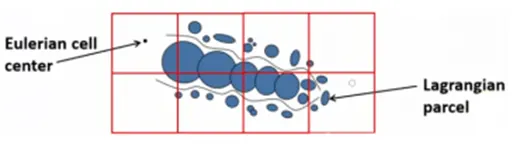
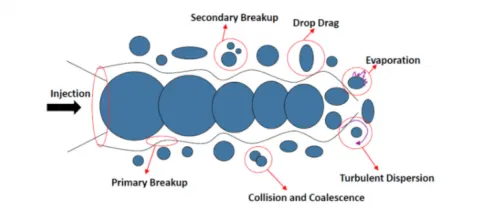
A parcel represents a collection of identical fuel drops that has the same properties. These parcels are introduced into the domain of the injector which statistically represent the entire spray field. These spherical parcels need to capture the liquid sprays which they do by undergoing several physical processes.
Evaporation Model:
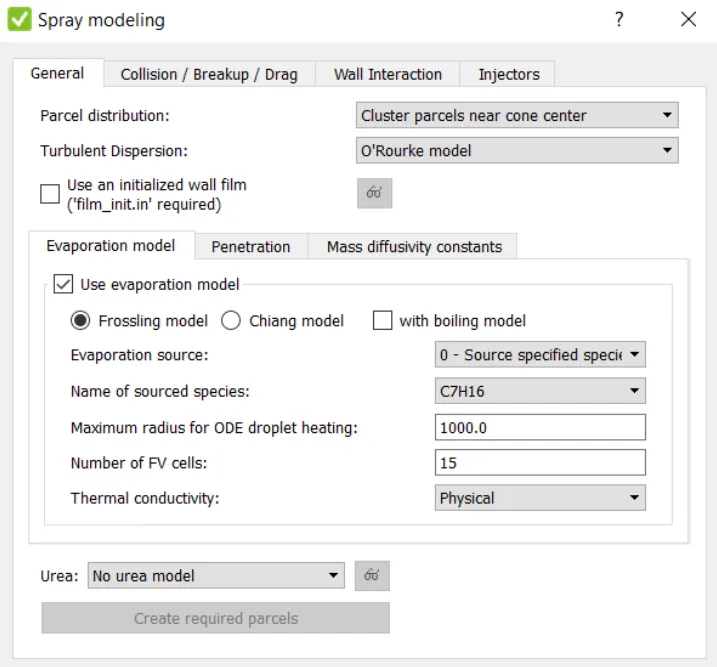
The spray evaporation that takes place needs to be considered & for that converge uses certain st&ard pre-created models such as Frossling, Chiang, or with boiling. In this project, the Frossling model is used & it does not need to provide the particular equations as Converge takes care of it. Converge asks for evaporation source to simulate multi-component vaporization. The source used in this project is "Source all base parcel species" which denotes multi-component liquid species evaporate into the base species. As the evaporation source is specified, the maximum radius of ODE droplet heating needs to be specified as well, its basically a temperature discretization parameter which will control if drop temperature is uniform or radially varying. If the drop radius exceeds maximum value the converge assumes a radially varying temperature or else uniform temperature distribution is assumed.
Spray Penetration & Distribution:
Converge writes the liquid & vapor penetration lengths at each output interval, it calculates vapor penetration length for each nozzle. For each cell that meets the criteria that fuel vapor mass fraction exceeds the user-specified value or cell size does not exceed user-specified bin size, converge calculates the center of the nozzle to the center of the cell. The parcel distribution is done in two ways where the parcels are either distributed evenly throughout the cone or clustered near the center of the cone. Depending upon the requirement either distribution can be selected, for this project, even distribution is selected.
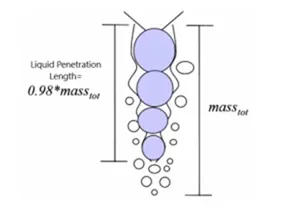
Penetration length:
Just as how LPL is calculated, Converge calculates the Vapor Penetration Length (VPL) for each nozzle. The solver calculates fuel vapor mass fraction in each cell inside the spray cone. For each cell that meets the below two criterias, distance from center of nozzle to cell center of vapur mass is calculated.
- The fuel vapor mass fraction exceeds the user specified Fuel Vapor Mass Fraction.
- The cell size does not exceed the user specified Bin Size. A bin size of atleast twice the size of the cells in the spray cone must be present.
Parcel distribution
Converge assumes that injection is conical for solid cone sprays. The injector introduces parcels by either clustering them near cone center or distributing them evenly throughout the cone. By various imaging techniques it has been shown that gasoline is 'evenly distributed throughout cone.
Collision/Coalescence & Drop Drag:
Drop Collision options allows to select how the drops will interact with each other. No Collision means that the two parcels will never collide & will only pass by each other. There are two other models, O'Rourke Numercial Algorithm & NTC Algorithm which dictate how the parcels will interact among themselves.If in a spray simulation parcels collide with parcels only in the same cell, it can lead to grid sensitivity, which is why converge has an adaptive collision mesh to reduce the grid sensitivity, Once collision mesh is checked, the parcels can collide across grid cells, requiring no additional mesh or any other setup.
Injector Models:
The constants under Kelvin-Helmholtz model control how the parcel will breakup. Stability equation or dispersion will tell how long it will take for the disturbance on a parcel to go unstable. Since this equation has been derived in a simple manner, putting these constants will help increase or decrease the time to breakup & also size of child droplets. When K-H model predicts the size of child droplets, it gets multiplied by model-size constant for further breakup.
Spray Rate Graph
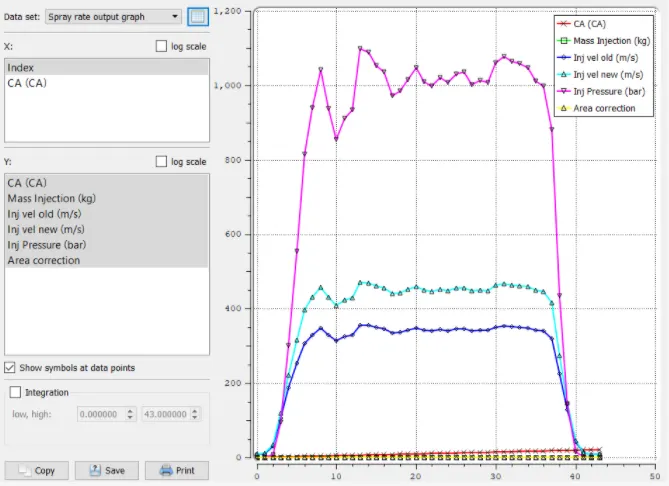
This graph is obtained from tools - Spray rate preview, where we can see the graph of rate shape, peneteration velocity, injection pressure etc wrt crank angle provided in rate shape.
Gas Simulation
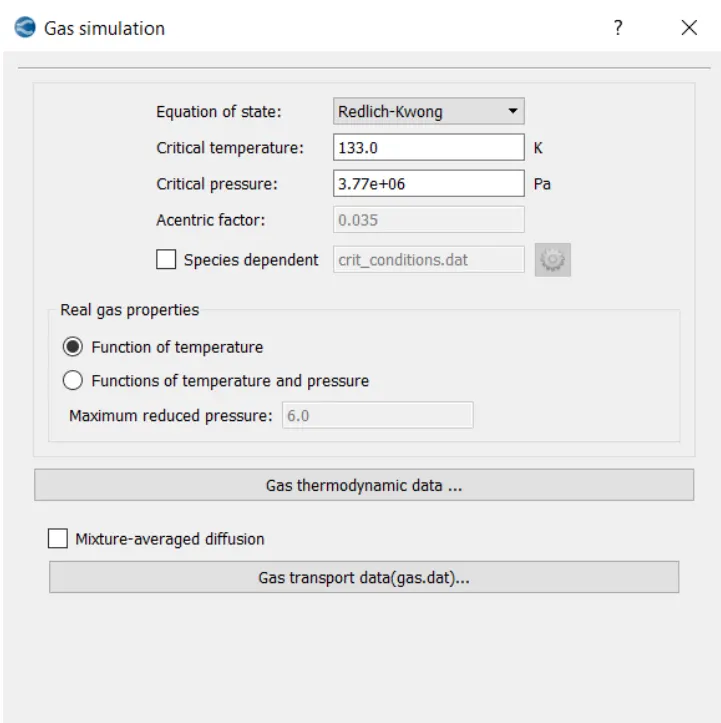
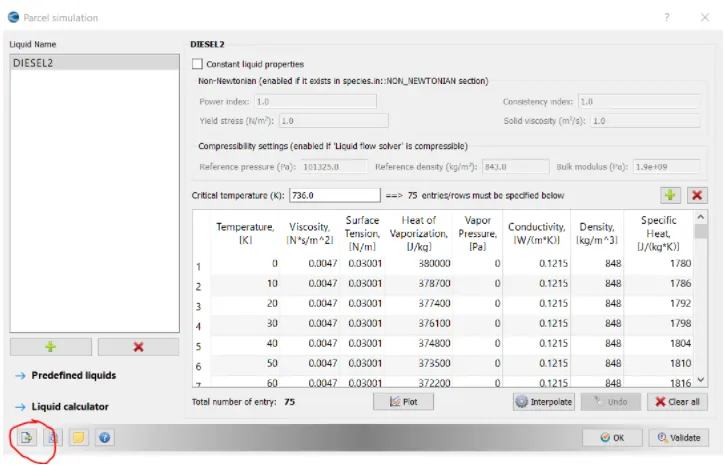
The gas thermodynamic data is completed by importing the therm.dat file.
Reaction Mechanism
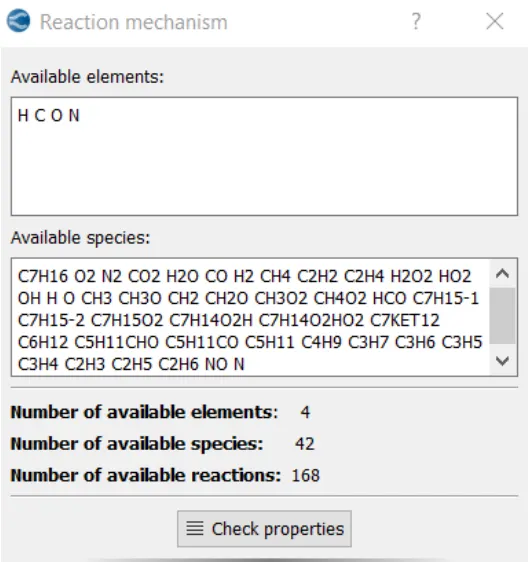
The reaction mechanism is set up using the mech.dat file.
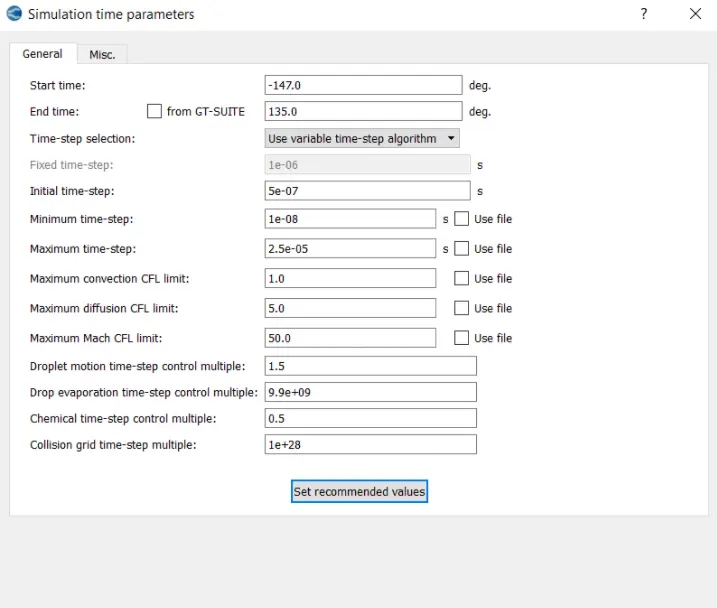
Simulation Time Parameters
Boundary
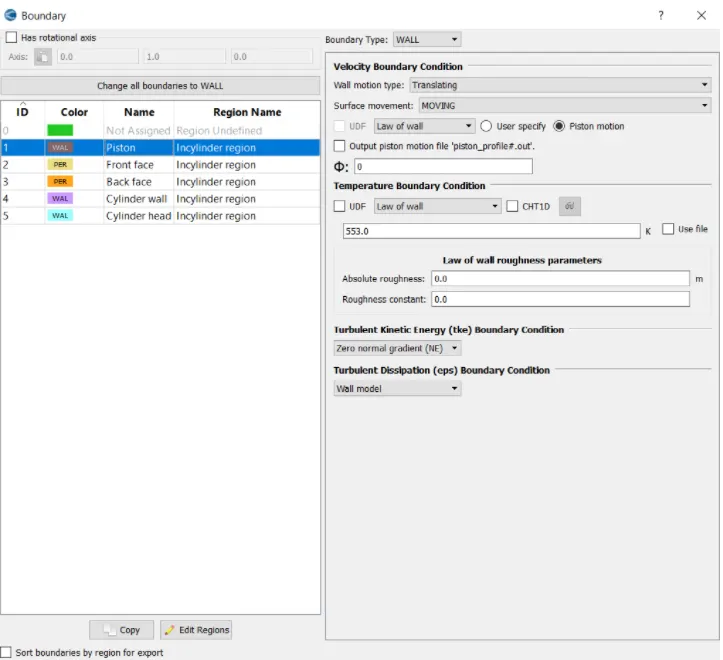
Each of the boundary values for respective boundaries is input by deriving from the boundary.in file.
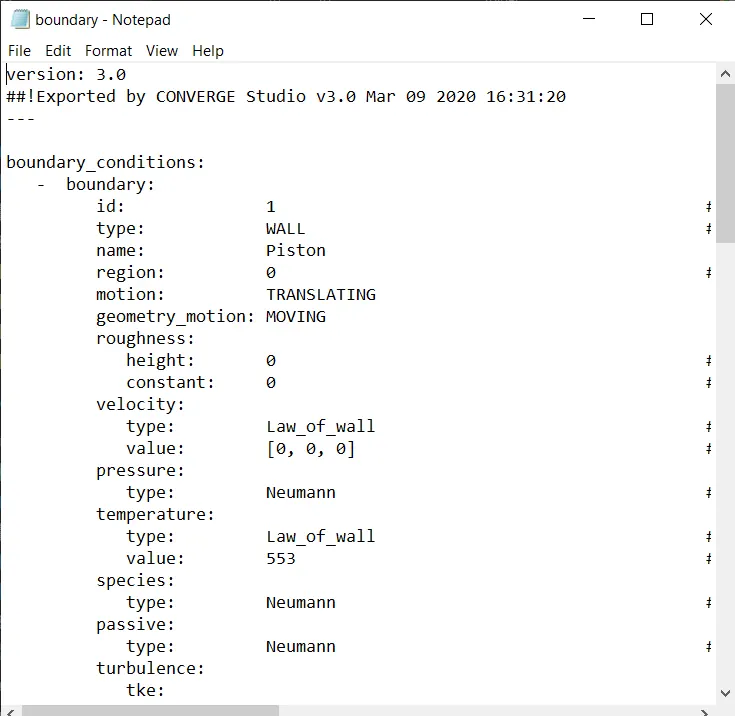
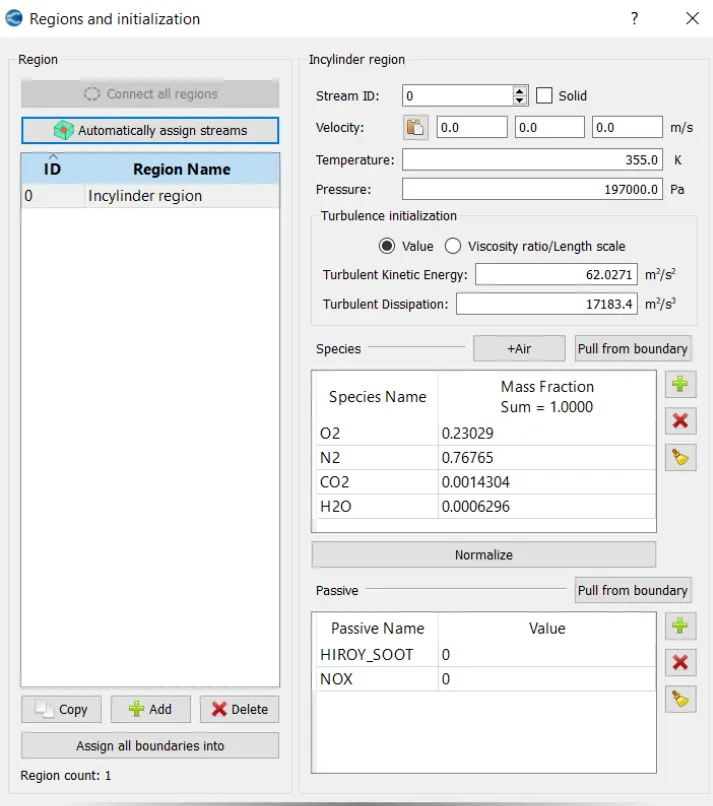
Regions & Initialization
Spray Modeling
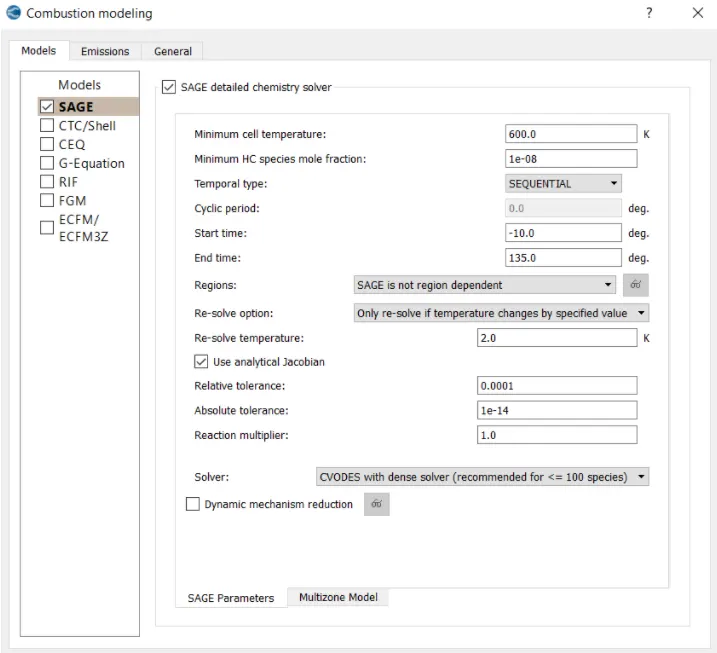
Combustion Modeling
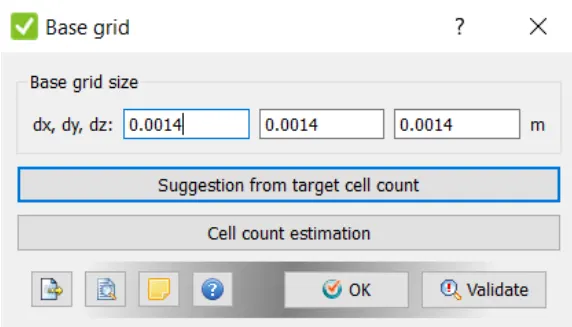
Grid
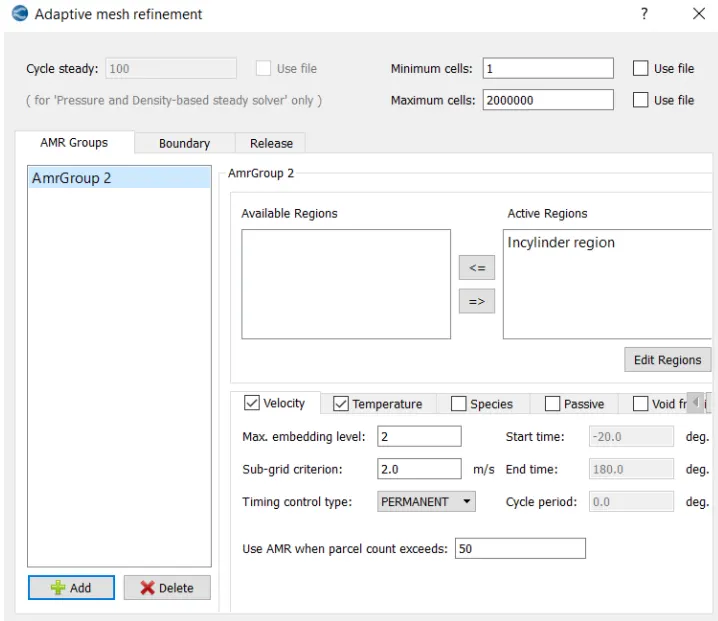
AMR
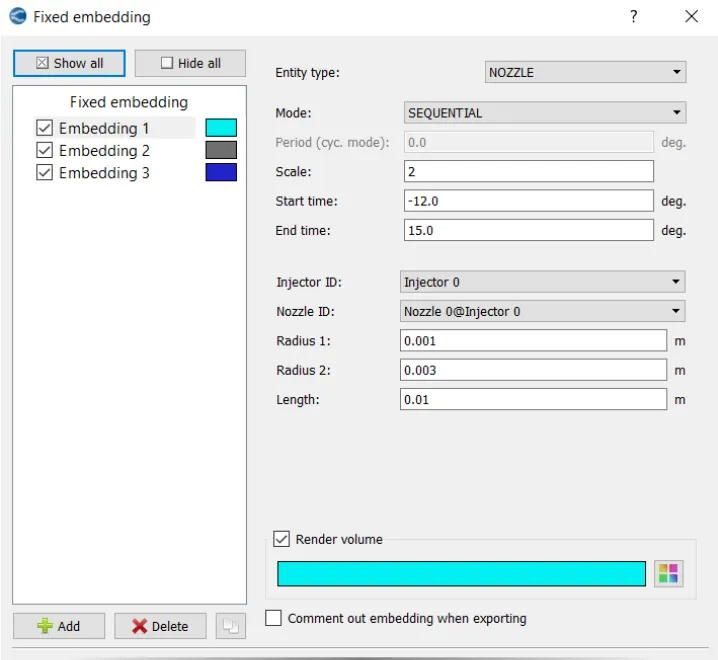
Fixed Embedding
Combustion efficiency is defined as the ratio of total heat energy released by the burning of fuel to the total energy content of fuel mass in a cycle.
Mass of fuel injected = 1.621e-4 kg
Calorific value of fuel = 45.6e6 J/kg
Integrated heat released for Open-W= 7212.06 J
Integrated heat released for Omega = 7279.46 J
RESULTS
Plots:
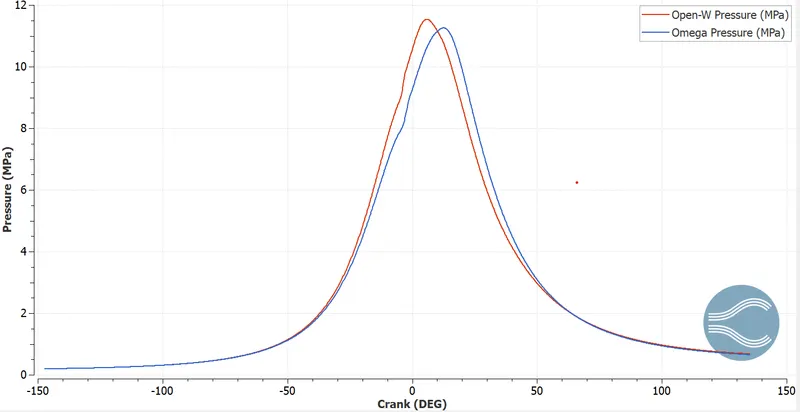
1. Pressure
2. Temperature
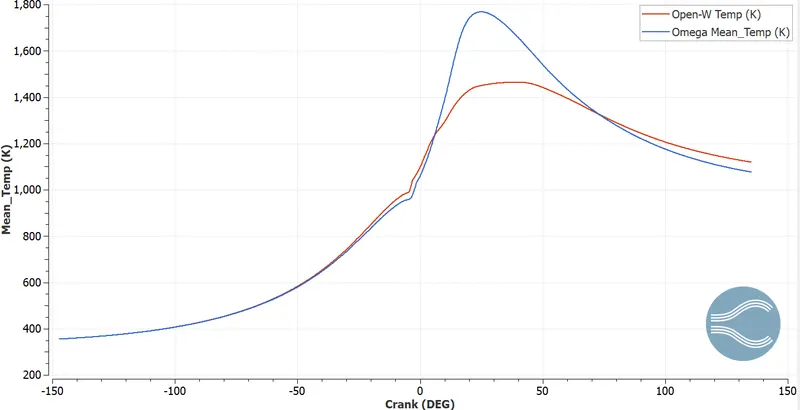
The temperature difference in both piston configurations suggests that NOx emission would be higher in the Omega piston. We will dive into the inference of this plot in the NOx emissions plot separately.
3. IHR
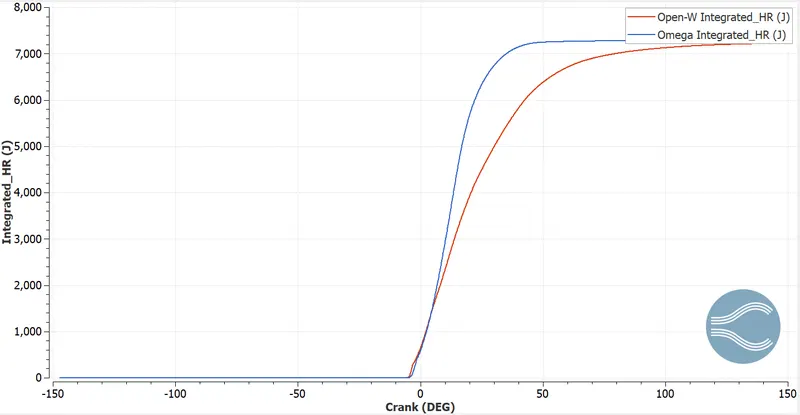
The integrated heat release denotes the amount of power generated from the combustion. From the given plot, a slight decrease in power is evident in the Open-W piston configuration. This can be due to factors such as:
Lesser fuel to burn/ Unburnt fuel
Incorrect timing
Insuffucuent air
4. HHR
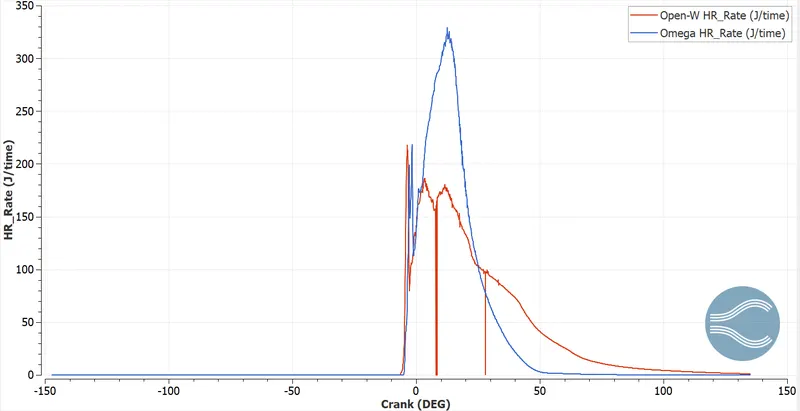
Significant Heat release rate increase, denoting might have unburnt fuel potential.
5. Hiroy Soot
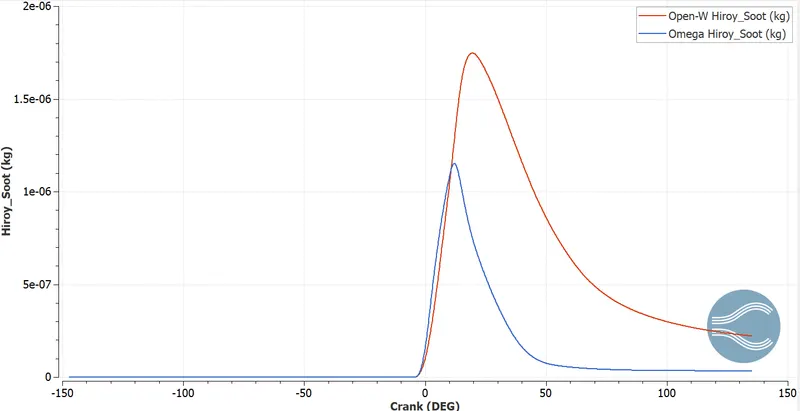
Because of the way fuel is injected & ignited, soot formation occurs more commonly in diesel than in gasoline engines. Unlike gasoline where the fuel/air mixture is ignited with a spark, fuel, & air entering the diesel cylinder ignite spontaneously from the high pressure in the combustion chamber. The fuel & air mixture in diesel engines typically do not mix as thoroughly as they do in gasoline engines. This creates fuel-dense pockets that produce soot when ignited. While the majority of soot easily escapes through the exhaust, some get past the piston rings & end up in the oil.
As soot builds to abnormal levels, engine problems begin. Soot thickness oil & negatively affect viscosity, which means the engine has to work harder to start & run during cold temperatures. Soot circulation also contributes to the formation of varnish & carbon deposits throughout the engine, which can wear down valves & seals, reducing efficiency & eventually causing failure. When excessive soot collects, it forms a congealed mass known as sludge, which is the leading cause of premature failure in diesel engines.
Hence, from the plot, we can infer that the degree of unburnt fuel is way higher in the case of the Open-W piston than the Omega piston. Hiroy Soot is a harmful carcinogen & must be eradicated using suitable measures such as advanced three-way Catalytic convertors, or by perfecting the combustion process by reducing unburnt gaseous fuel.
Hiroy Soot Emission:
https://drive.google.com/file/d/11QVsgEqK4brsugmOGUqhe9Atpj0X4YPW/view?usp=share_link
6. NOx
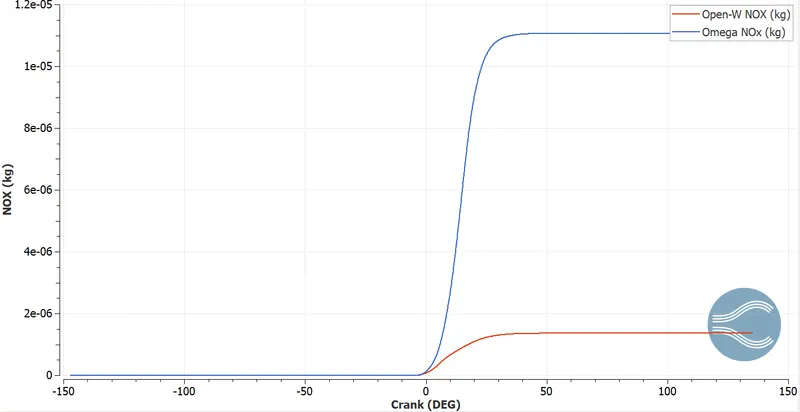
A compression ignition (diesel) engine runs all the time with a lean air-fuel mixture, the value of the equivalence factor (`lamda`) depending on the engine's operating point (speed & torque). The reason for this is the working principle of a diesel engine: controlling load not through air mass (which is always in excess) but through fuel mass (injection time).
Since lean mixture denotes more oxygen & lesser fuel, the nitrogen present in the air is more likely to combine with excess oxygen & produce NOx. This happens under high pressure & high-temperature conditions, which are the operating conditions of a diesel engine where spontaneous ignition takes place without the need for a spark. Hence as we earlier saw the higher incylinder temperature in omega piston configuration, NOx emission is higher as a result of it.
NOx Emission:
https://drive.google.com/file/d/1u-E6nvCQPRX9vTakpXIHutS8tfI4QSpl/view?usp=share_link
7. CO
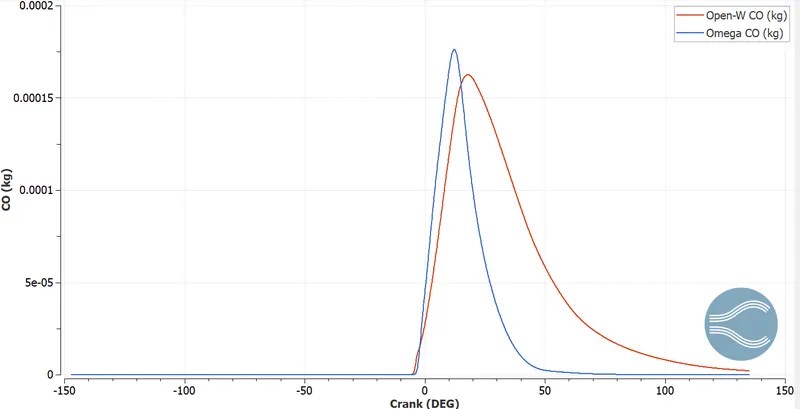
Even with higher values during combustion, the overall output values have decreased for Omega piston regarding the CO emissions. Open-W has an even slightly higher emission in this setup.
8. UHC
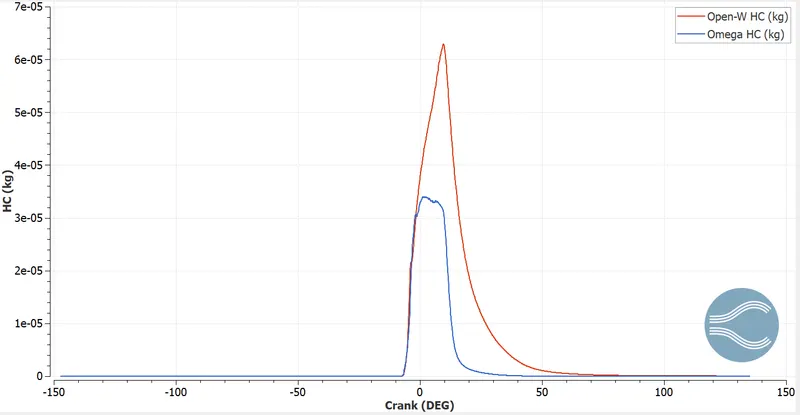
Hydrocarbon emissions are composed of unburned fuels as a result of insufficient temperature which occurs near the cylinder wall. Hydrocarbons consist of thous&s of species, such as alkanes, alkenes, & aromatics. They are normally stated in terms of equivalent CH4 content.
Diesel engines normally emit low levels of hydrocarbons. Diesel hydrocarbon emissions occur principally at light loads. The major source of light-load hydrocarbon emissions is lean air-fuel mixing. In lean mixtures, flame speeds may be too low for combustion to be completed during the power stroke, or combustion may not occur, & these conditions cause high hydrocarbon emissions.
In Diesel engines, the fuel type, engine adjustment, & design affect the content of hydrocarbons. Besides, HC emissions in the exhaust gas depend on irregular operating conditions. High levels of the instantaneous change in engine speed, untidy injection, excessive nozzle cavity volumes, & injector needle bounce can cause significant quantities of unburned fuel to pass into the exhaust.
9. Fuel Mass
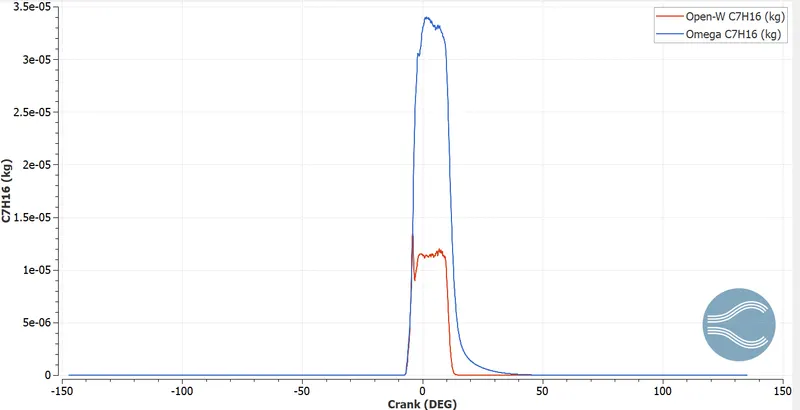
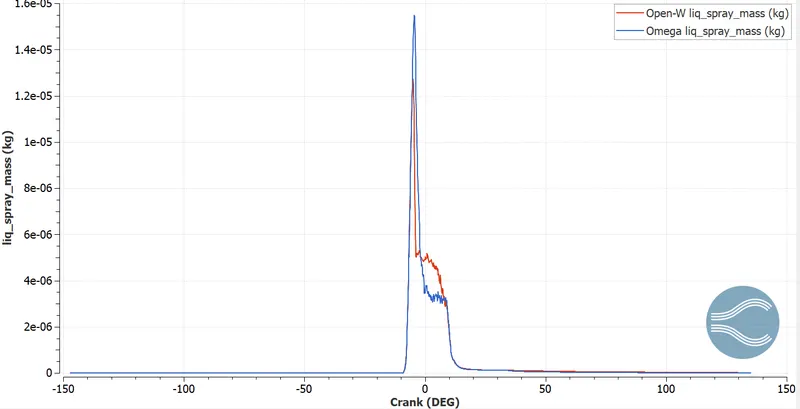
10. Liquid Spray Mass
11. Spray Penetration
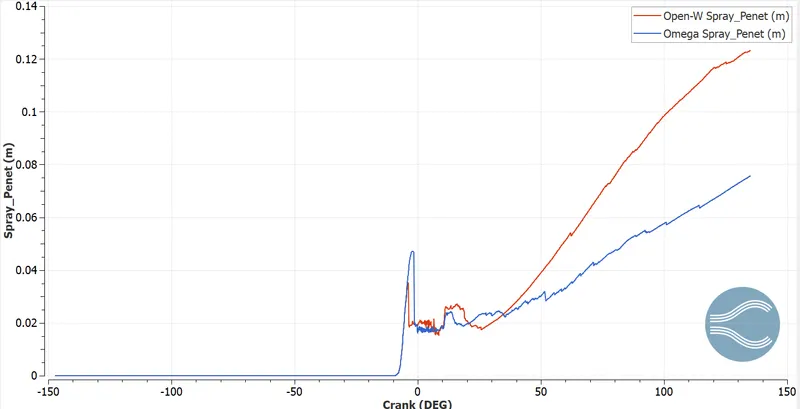
From the plots above, we can see that the spray penetration length for the Open-W piston is far lower than the Omega piston, even with the same spray & nozzle configurations. There is also a loss of fuel in the combustion chamber & this is where we need to take a closer look at the reception of fuel on the respective bowl profiles.
The spray penetration length actually buys time for the fuel to atomize & vapourize in the high pressure & high-temperature circumstances of the engine. If there is no time for the liquid to vapourize or if it sticks along the surface of the piston due to an inaccurate angle of reception between the nozzle & the low-profile, there will be unburnt fuel that produces soot & also loss of power.
Open-W piston vs Omega piston
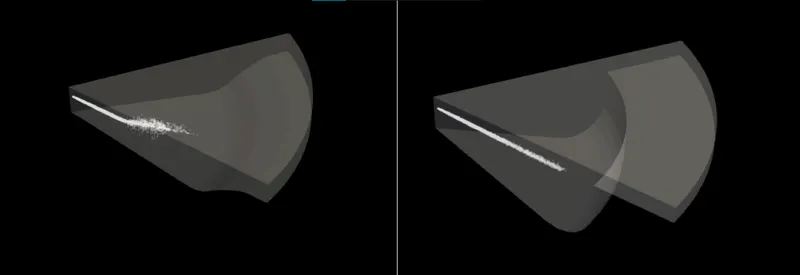
When both of the piston bowl profiles are set next to each other & the parcel simulation is done, we can clearly see that the angle of entry of fuel spray is incompatible with the higher elevation of the Open-W piston configuration, causing to cut short the penetration length of the spray.
Fuel Spray:
https://drive.google.com/file/d/1Hf-RfCRXDjC6f33720QVpti6pYw7Q7q-/view?usp=share_link
Engine Performance:
From the values calculated in the engine performance tool, we can get:
Open-W piston

- IMEP = 1.24 x 10^6 Pa
- Power = work/time
- RPM = 1600
- RPS = `1600/60` = 26.67
- Degrees per second: 26.67 x 360 =9600(deg)/sec
- Duration of combustion: 270.156/9600(deg) = 0.028 sec
- Power P = Work/Time = 3028.53/0.028 =108.16 KW
Omega piston
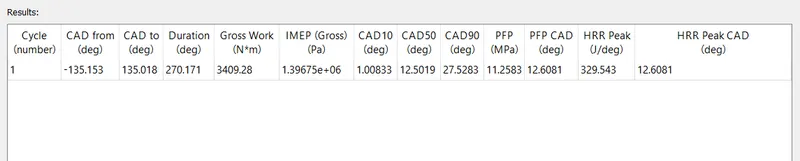
- IMEP = 1.396 x 10^6 Pa
- Power = work/time
- RPM = 1600
- RPS = `1600/60` = 26.67
- Degrees per second: 26.67 x 360 =9600(deg)/sec
- Duration of combustion: 270.156/9600(deg)= 0.028 sec
- Power P = Work/Time = 3409/0.028 =121.23 KW
Conclusion:
- Due to higher temperatures in Omega Pistons, Soot and NOx emissions are higher. CO and HC emissions are higher in the Open-W pistons due to unburnt fuel.
- To obtain the higher performance of the Open-W piston injector angle needs to be corrected to avoid the fuel impingement.
- If primary goal is to reduce NOx and soot formation then OpenW has an edge here. On the other hand OpenW geometry faces issues like unburnt fuel during combustion and due to higher fuel impingement, there is a delay in combustion due to very less vapourization of fuel as compared to omega geometry leadsing to the formation of unburnt species.
- NOx emissions are higher in the Omega piston and that can be reduced by lowering the temperature values in the combustion chamber using methods such as Exhaust Gas Recirculation etc.