Week 11: Project 2 - Emission characterization on a CAT3410 engine
Geometry-A 3d geometry of Port fuel injection engine was imported to converge for analysis.
Make Engine Sector Surface:
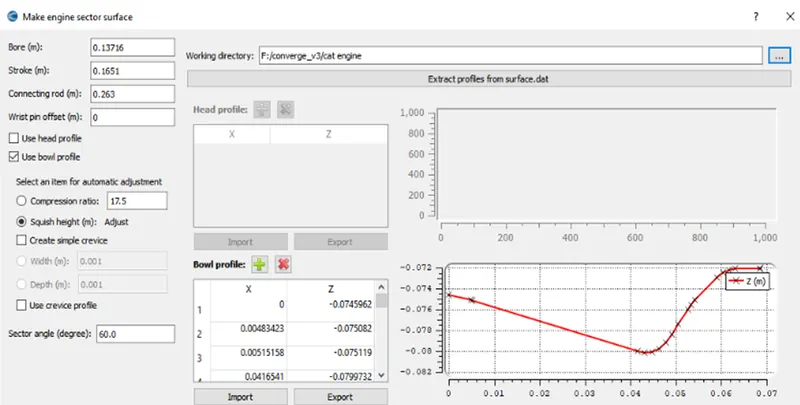
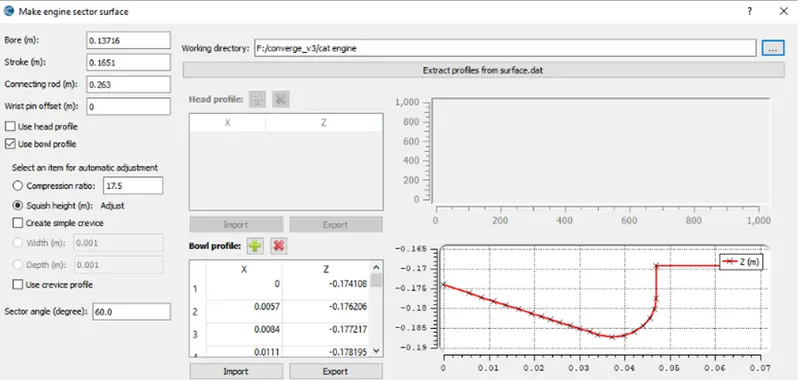
Using the make surface utility in converge studio both the open W sector and omega sector of piston was extracted.
Open W Piston Profile:
Omega Piston Profile:
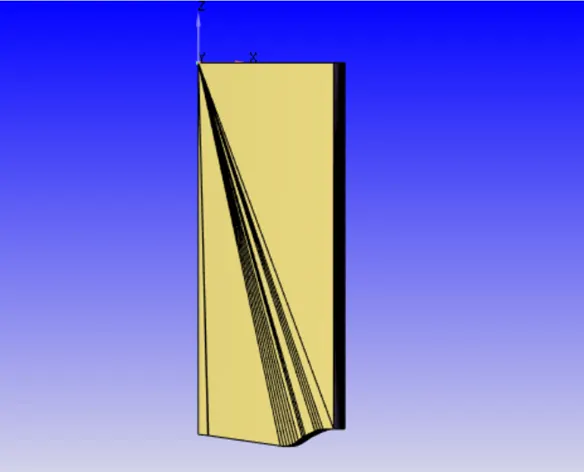
Geometry for Open W Piston:
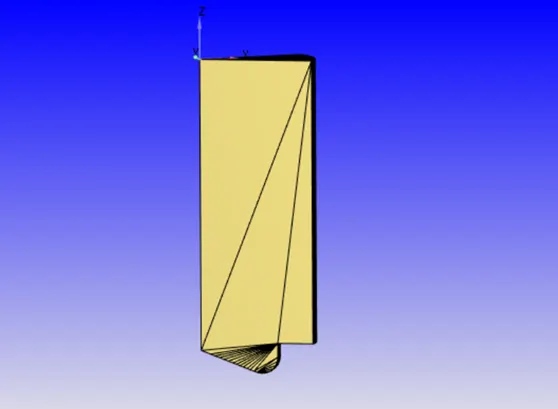
Geometry for Omega Piston:
Setup-
Application Type-
Crank angle-based IC engine
Physical Parameters:
Bore =0.13716 m
Stroke = 0.1651 m
Connecting rod length = 0.263 m
RPM = 1600
Materials-
Gas Simulation- The therm.dat file was uploaded to get the thermodynamic properties of the fuel.
Parcel Simulation- C7H16 was selected from predefined liquids.
Reaction Mechanism
Species-Parcel C7H16(n Heptane)
Mesh-
Simulation Time Parameters:
Run Parameters:
Transient, Full hydrodynamic.
Simulation Time Parameters:
Start time : -147 deg
end time : 135 deg
Initial time step:5e-7 ,Minimum time step:1e-08 ,Maximum time step:2.5e-5
Boundary Conditions:
Boundary Type-WALL , Wall motion-Translating and Surface-Moving
Law of wall for velocity & temperature boundary conditions
Piston-Velocity-piston motion, temperature - 553K
Boundary Type-WALL , Wall motion-Stationary and Surface-Fixed
Law of wall for velocity & temperature boundary conditions
Cylinder wall - 433 K
Cylinder Head-523 K
Boundary Type-Periodic , Periodic Type-Stationary and Periodic Shape-Rotational-45 deg
Front Face & Back Face
Regions and Initial conditions:
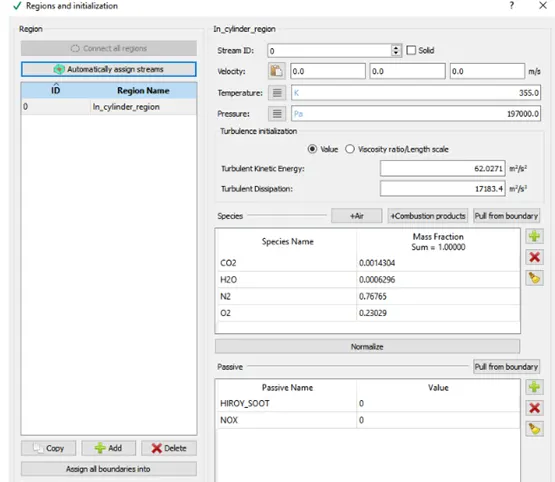
Physical models:
Spray Modelling:
Frossling model
collison model-NTC collision,collision outcomes-Post collison outcomes
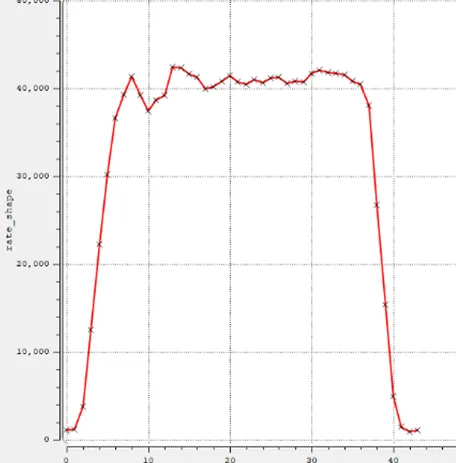
Injection Parameters:
Total injected mass = 2.70167e-5 Kg
Injection start time = -9.0
Injection duration = 21
Fuel temperature = 341K
Total number of injected parcels per nozzle=50000
Rate shape implementation:
Combustion Modelling:
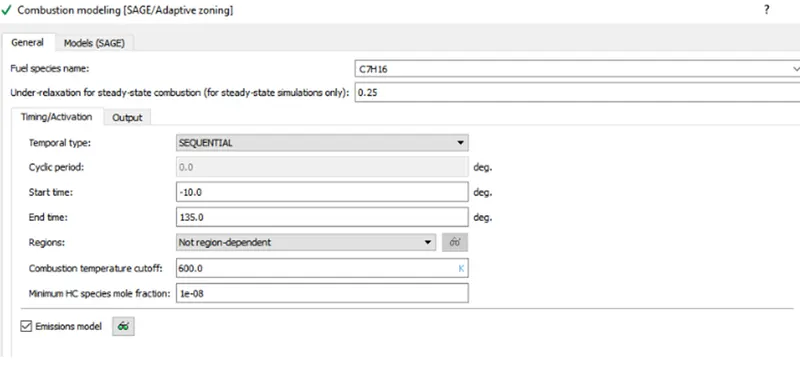
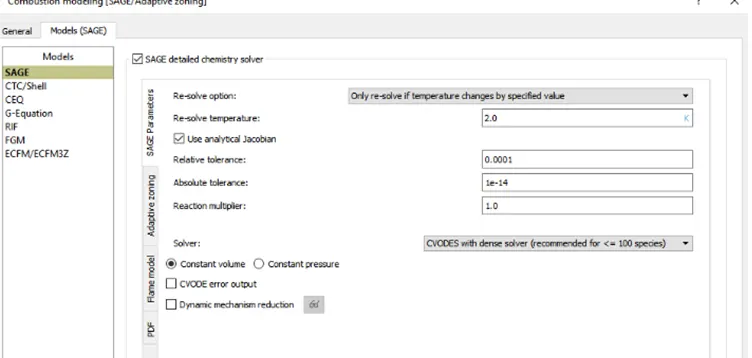
Sage Model:
Turbulence Modelling:
RANS k-epsilon RNG model
Grid Control:
Base Mesh- dx=dy=dz=0.004m
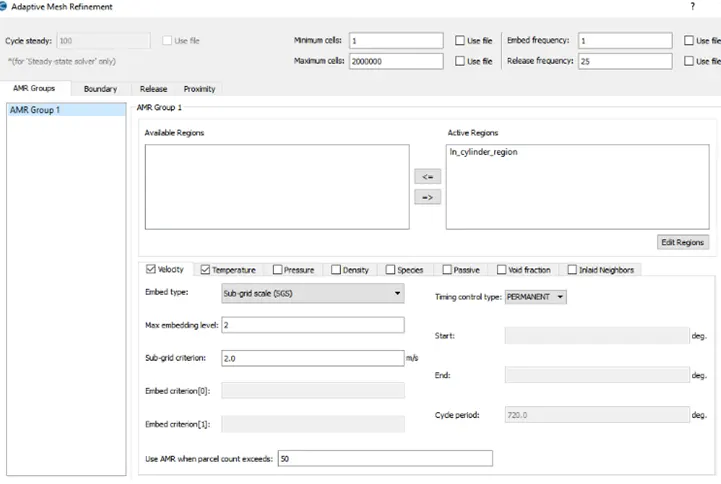
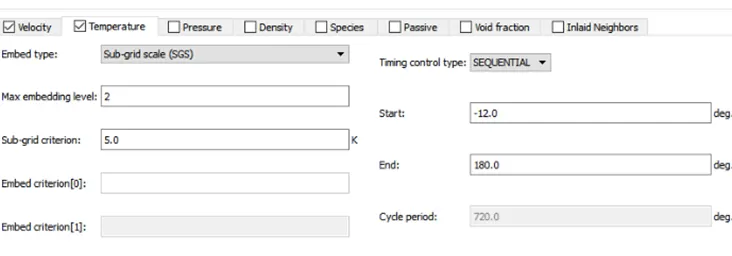
Adaptive Mesh Refinement:
Velocity Adaptive Mesh Refinement
Temperature Adaptive Mesh Refinement
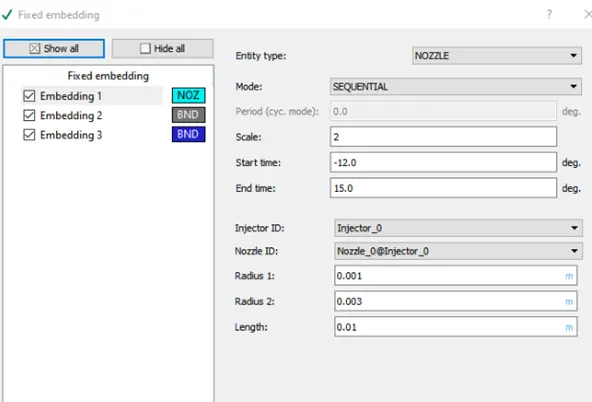
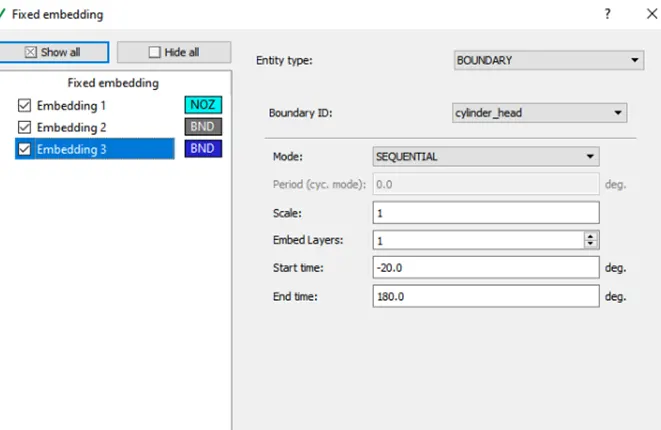
Fixed Embedding:
Nozzle
Sequential,Scale-2
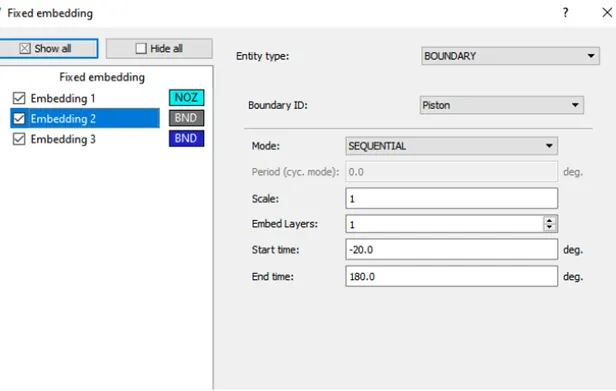
Boundary Embedding
Piston-Sequential, Scale-1, embed layers-1
Boundary embedding-
cylinder head-Sequential, Scale-1 ,Embed layers-1
Results-
Analysis for Open W and Omega Piston
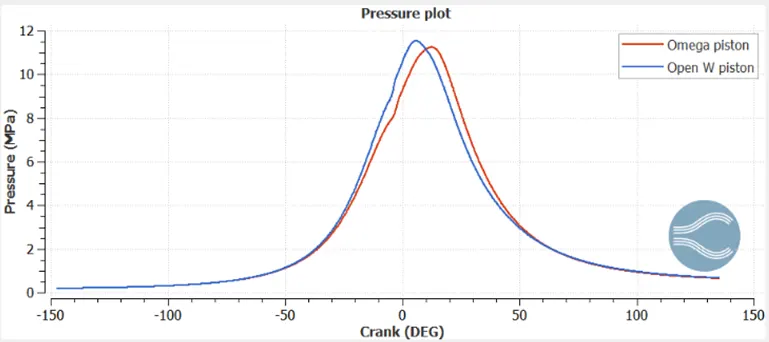
Pressure Vs Crank angle:
From the below figure we can see that the peak pressure for open W piston is higher than the omega piston.
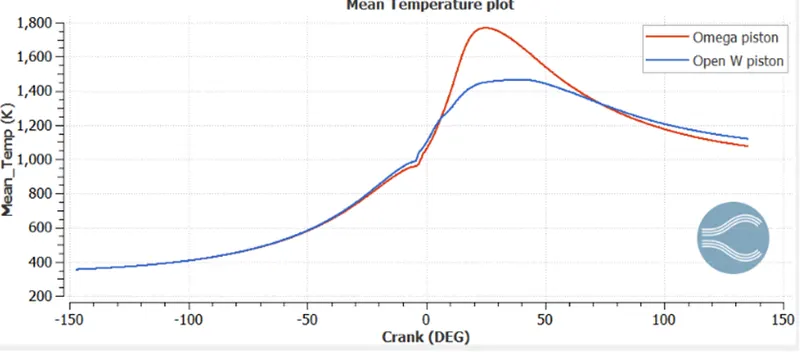
Mean Temperature Vs Crank angle:
From the below figure we can see that the peak mean temperature is significantly lower for open W piston and the omega piston is having a higher peak mean temperature. This might be an indication that the fuel is not burnt properly in case of open W piston.
Integrated Heat Release rate:
From the below figure we can see that the integrated heat release rate is lower in case of open W piston. At the end we can see that the total heat release is less in open W piston. That means for same amount of fuel injection we are getting less heat output for open W piston.
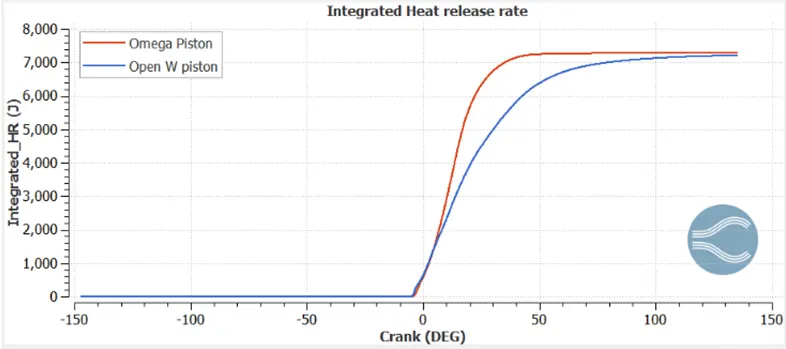
So from the above graph the heat release for Omega piston is 7279.46 J and open W piston is 7211.73 J
Lower heating value(LHV) of C7H18=42.78 MJ/kg
The difference is 67.73 J per cycle.
Mass of fuel required for 67.73 J=67.73/42.78*10^6=1.6e-6 kg
Mass of fuel required for 67.73 J for 1000 cycles=0.0016 kg
So 0.0016 kg mass of fuel wasted for Open W piston configuration for 1000 cycles.
Emissions analysis for Open W and Omega Piston
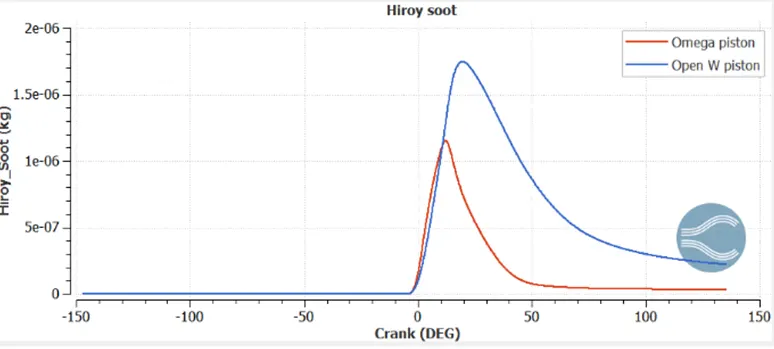
Comparison of Soot formation:
Open W piston has more soot formation than omega piston
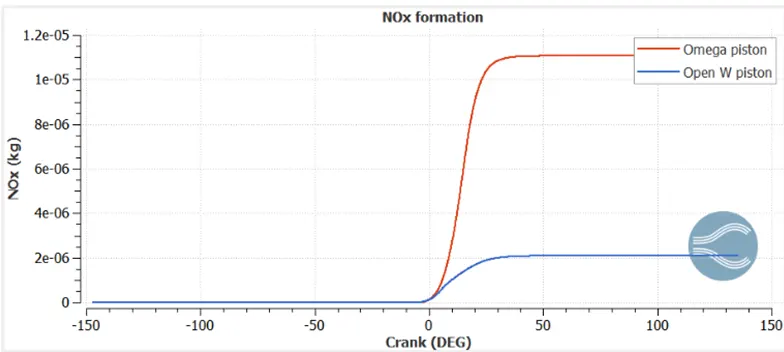
Comparison of NOx formation:
From the below graph its seen that open W piston has very low NOx emissions as compared to Omega piston which is also indicated by the low temperature is our earlier analysis.
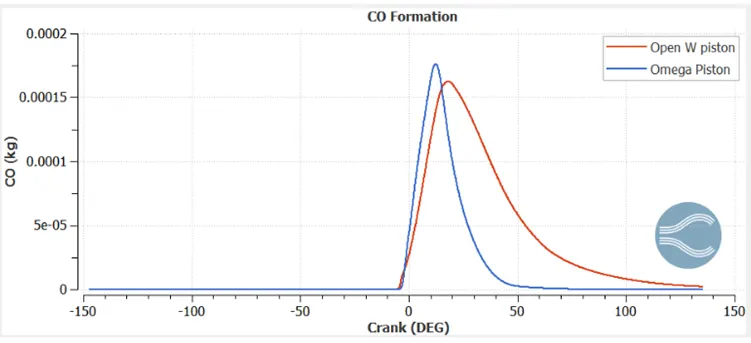
Comparison of CO formation:
From the below graph its seen that open W piston has more CO emissions which signifies that there is unburnt fuel for open W design.
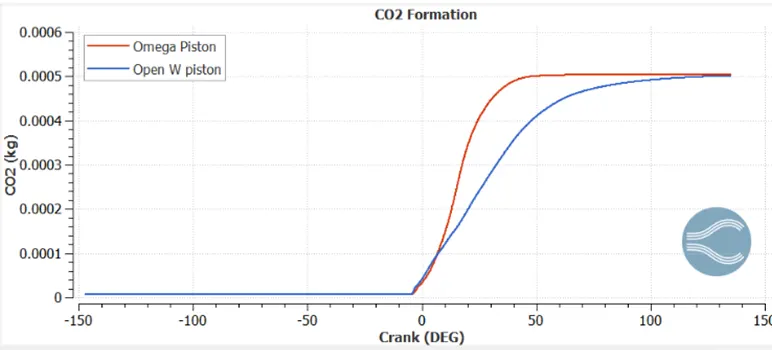
Comparison of CO2 formation:
CO2 formation is more in case of Omega piston.
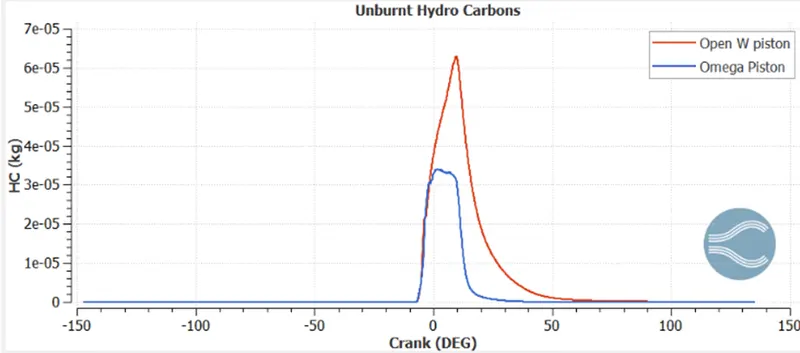
Comparison of Unburnt hydrocarbon:
From the below graph it’s clear that unburnt fuel is significantly higher in case of open W piston.
IMEP and Power Calculation:
From the engine performance calculator the following results were obtained:
For Open W Piston:

INDICATED MEAN EFFECTIVE PRESSURE(IMEP)=1.24e+6 pa
Speed of engine=1600 rpm
=1600/60=26.66 rps
Speed in degree/second=360*26.66=9597.6 degree/s
270.156 deg duration in seconds=270.156/9597.6=0.0281 s
Gross Work=3028.53 J
Power=3028.53/0.0281=107.7 KW
For Omega Piston:

INDICATED MEAN EFFECTIVE PRESSURE(IMEP)=1.39e+6 pa
Speed of engine=1600 rpm
=1600/60=26.66 rps
Speed in degree/second=360*26.66=9597.6 degree/s
270.156 deg duration in seconds=270.156/9597.6=0.0281 s
Gross Work=3409.28 J
Power=3409.28/0.0281=121.3 KW
Animation:
Adaptive Mesh Refinement:https://www.youtube.com/watch?v=BDKrukv46WU
Animation of temperature variation in engine:https://www.youtube.com/watch?v=PMFmsTkhdSA
From the animation we can clearly see that NOx emissions is more in Omega piston:https://www.youtube.com/watch?v=ouH49e5Rcv8
From the animation we can clearly see that soot emissions is more in open W piston:https://www.youtube.com/watch?v=Fw2_04V9dvw
CONCLUSION:
Simulations for two types of pistons for diesel engine CAT3410 was performed and following conclusion is drawn.
1. The peak mean temperature is significantly lower for open W piston and the omega piston is having a higher peak mean temperature which indicates there is unburnt fuel.
2. The integrated heat release rate and power output is lower in case of open W piston.
3. Open W piston has very low NOx emissions as compared to Omega piston.
4. Open W piston has more CO emissions which signifies that there is unburnt fuel for open W design. And it is confirmed as the soot production is more in open W piston.
5. CO2 emissions are more in case of Omega piston. Geometry for Open W Piston: