Week 11: Project 2 - Emission characterization on a CAT3410 engine
Aim: - Emission characterization on a CAT3410 engine.
Objective: -
- To create a sector geometry of combustion chamber with baseline Omega piston of a CAT3410 engine and an Open-W piston and run simulation for both.
- To calculate their performance parameter (Imep, HRR).
- Characterize and compare their emissions (Soot, NOx and UHC).
Introduction: -
CAT3410 is an industrial engine which is manufactured by the CATERPILLAR Company. It operated with the diesel as a fuel. The fuel is sprayed form nozzle at head and compression ignition is used to ignite the fuel. The baseline engine consists of omega piston. An open-W piston specific simulation is also carried out to compare the emission n performance of these two-piston bowl profiles.
To reduce the calculation time sector are created from the models.
For Open-W piston -
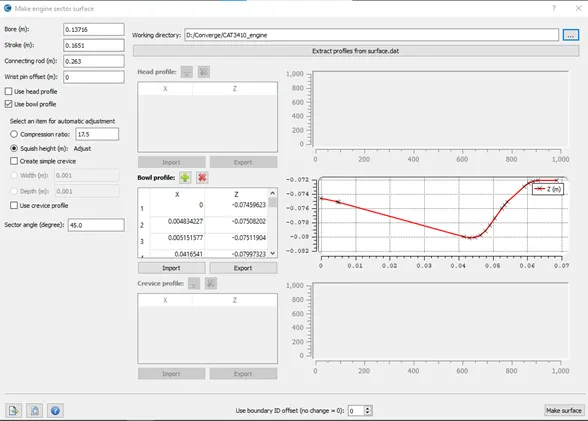
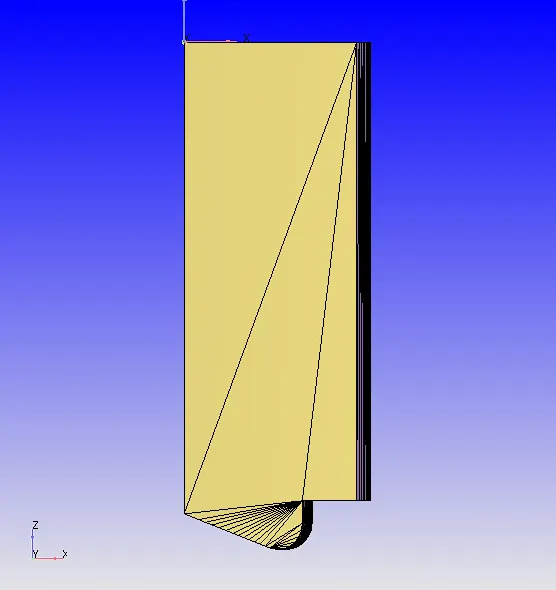
A 45-deg. sector geometry is created using Open-W piston surface file.
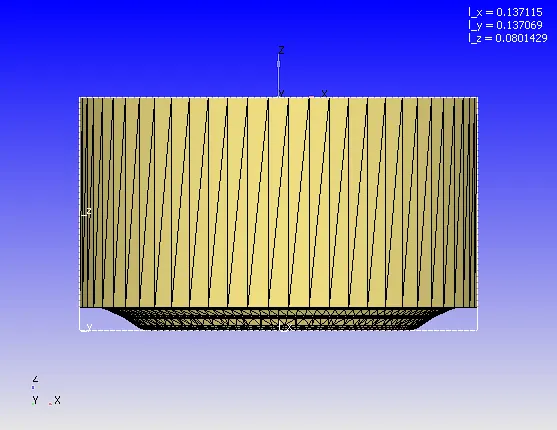
Sector is made using Tool -> Make profile from surface.dat, and bowl profile is imported in the proile section.
sector of Open-W piston
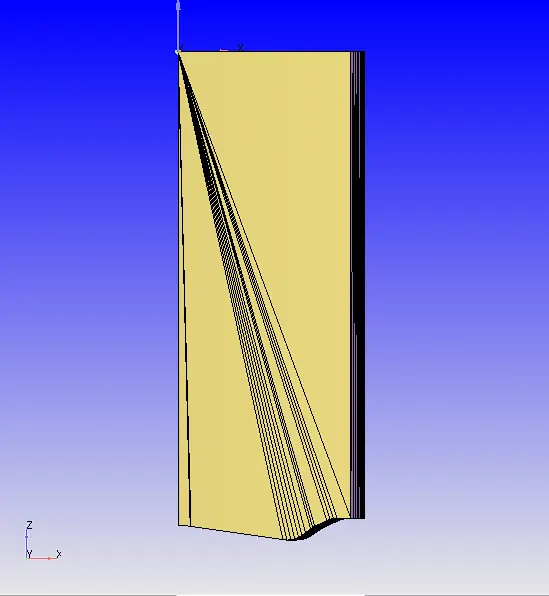
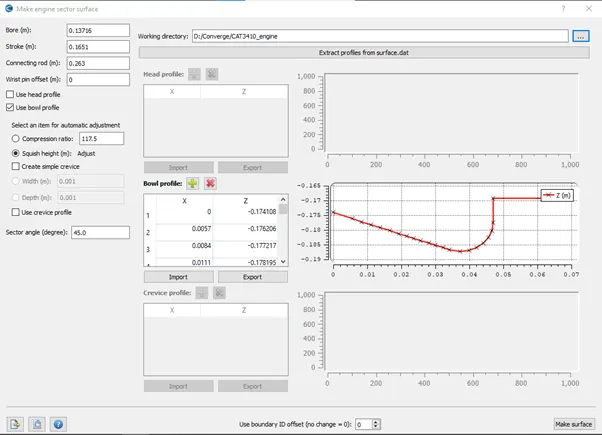
For Omega piston
the bowl profile of the omega is provided, hence profile extraction from surface file is not needed.
sector o Omega piston
Case Setup: -
1. Application Type- Crank angle-based IC engine.
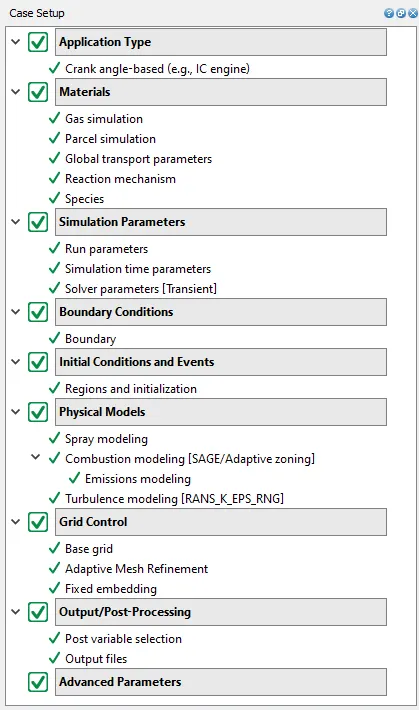
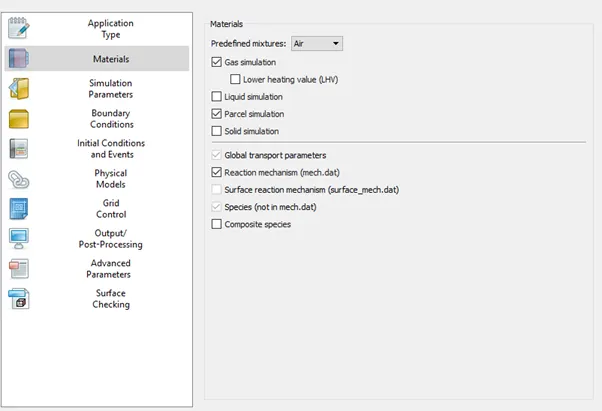
2. Gas simulation with along with Parcel simulation and Air as predefined mixture.
3. DIESEL2 is selected from predefined liquid in Parcel simulation.
4. Density Based Transient State Solver is used with Compressible Gas Flow solver and Incompressible liquid Flow solver with no hydrodynamic simulation and PISO Navier-Stokes’s solver scheme.
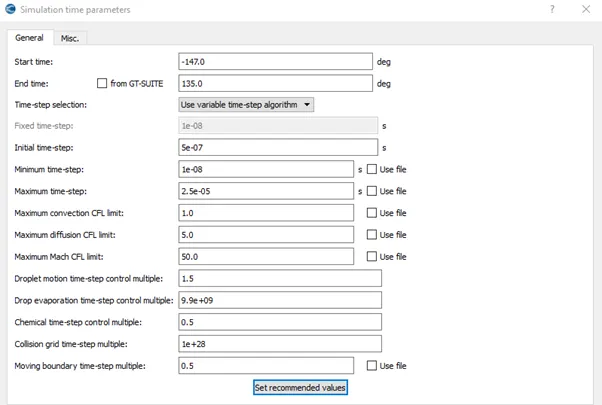
5. The solution run for -147 deg. to 135 deg.
6. Region –
in_cylinder_region:
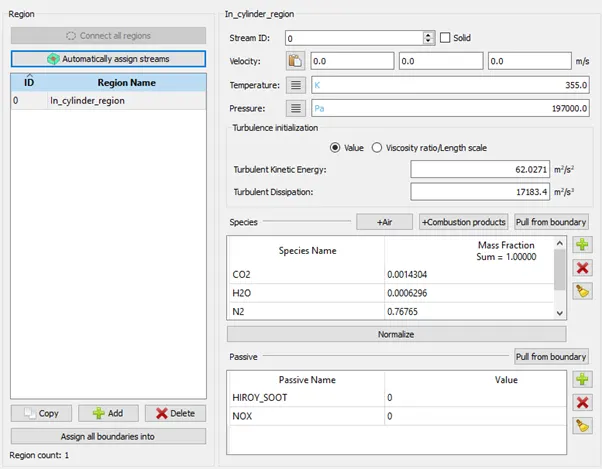
7. Boundary Condition:
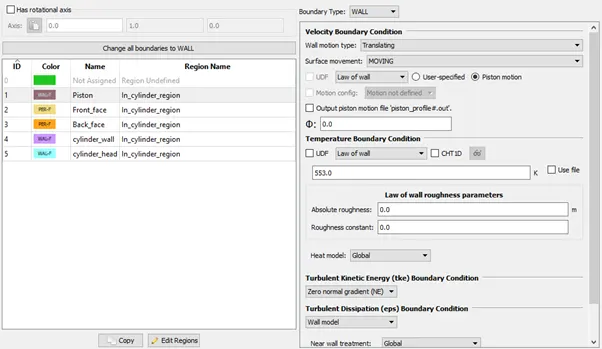
All are fixed boundary except front face and back face which are rotational periodic where back is match pair of front face.
The temp. BC for cylinder_wall and cylinder_head is 433 K and 523 K respectively
8. Realizable K-epsilon is used for turbulence modelling with recommended values.
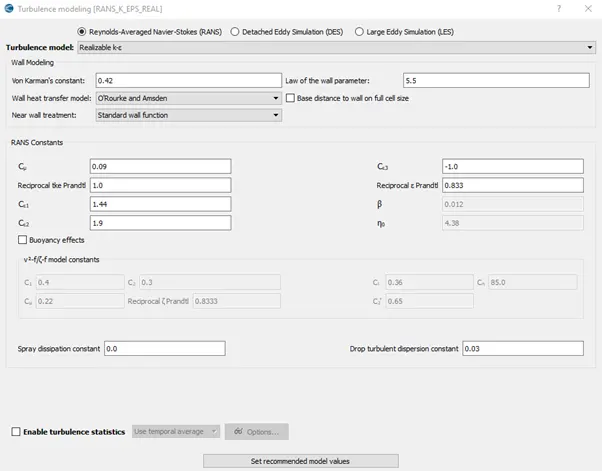
9. Spray Model:
Spray Modelling is turned On. O’Rourke model for turbulent Dispersion is used.
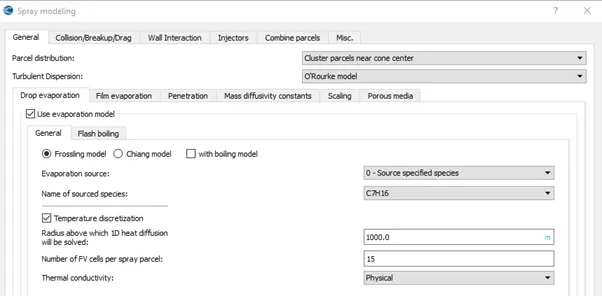
Solid cone spray injection type is used in which fuel is concentrated along axis of the nozzle. As diesel/heavier fuel tend to concentrated along axis rather than spread and uniformly distribute throughout the cone s in the case of petrol/iso-octane to get near accurate results.
An injector is added with a nozzle with DIESEL2 as fuel and KH along with RT model is used for Injector spray.
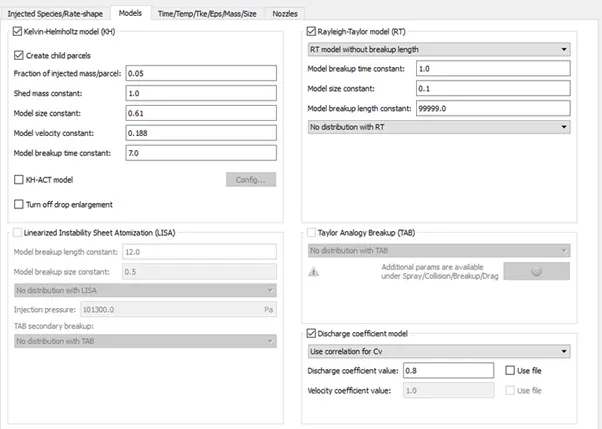
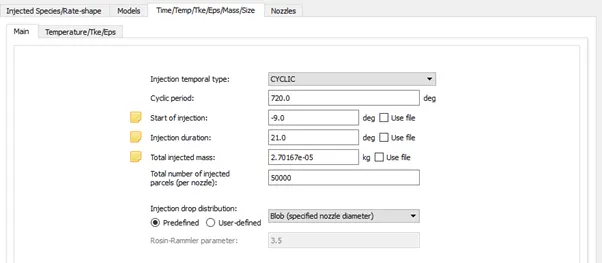
Since sector is used hence total injected mass is divided in 8 quadrants’ as 45 deg. sector is used.
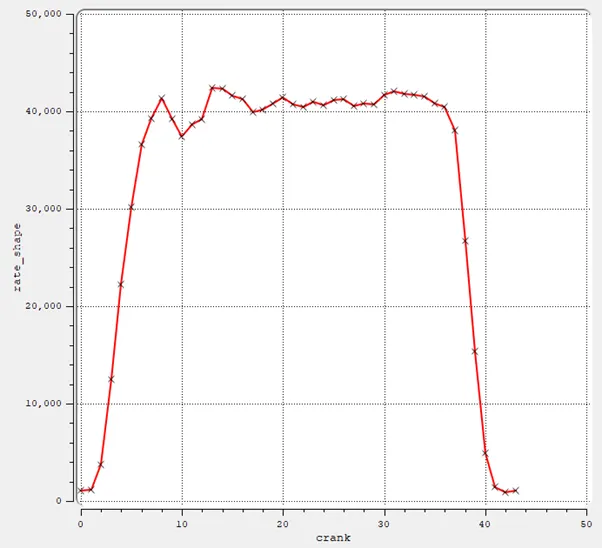
following Rate shape for the fuel is used to spray in the chamber.
10. Combustion Model:
CONVERGE’s SAGE detailed chemistry solver uses local conditions to calculate reaction rates based on the principles of chemical kinetics. This solver is fully coupled to the flow solver, but the chemistry and flow solvers parallelize independently of one another, which speeds up the simulation.
It is used with Adaptive Zoning where bin temp size is 5 K.
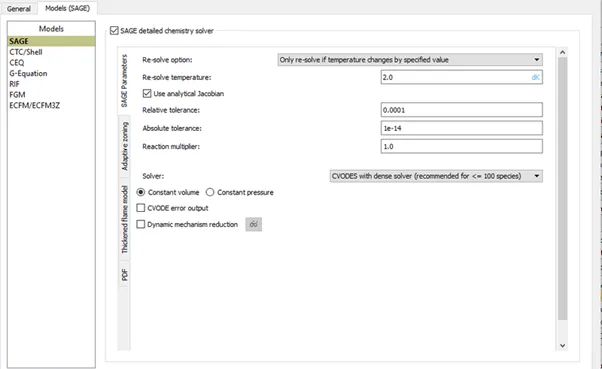
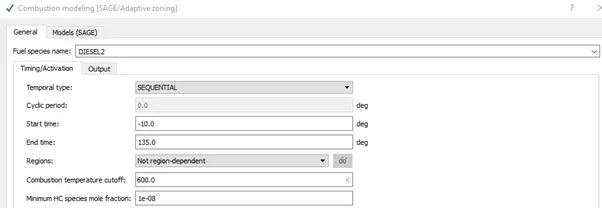
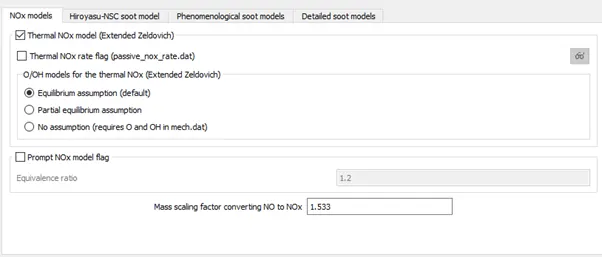
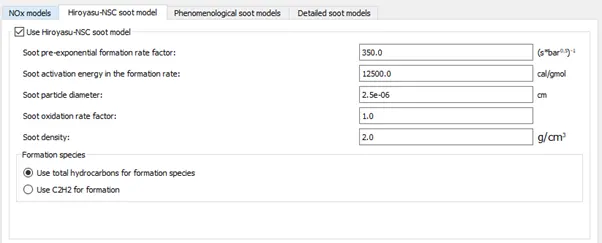
Emission modelling – NOx and Hiroyasu-HSC soot model is used to characterize the emissions.
11. Base grids of 0.004 m or other for respective cases are generated for all axis.
Fixed Embedding is marked in grid control tab and 3 embedding are added. One at injector and others at piston and cylinder head.
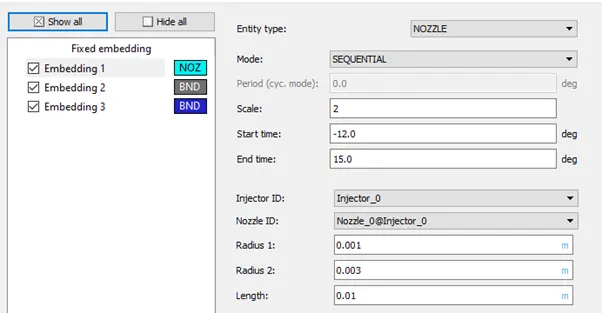
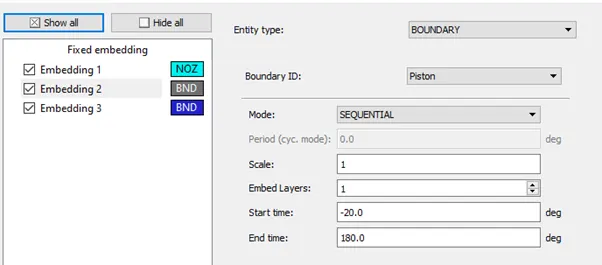
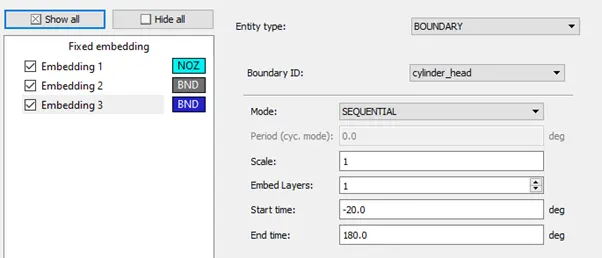
Adaptive Mesh Refinement is also used to refine Velocity and Temperature.
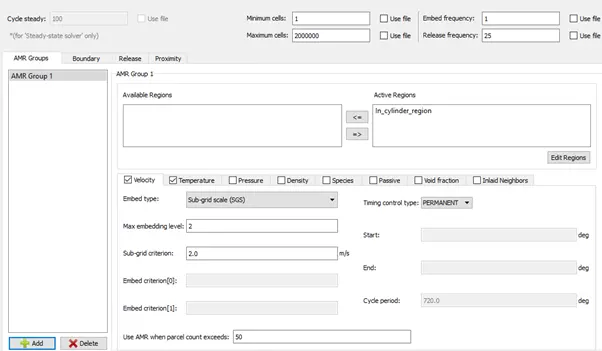
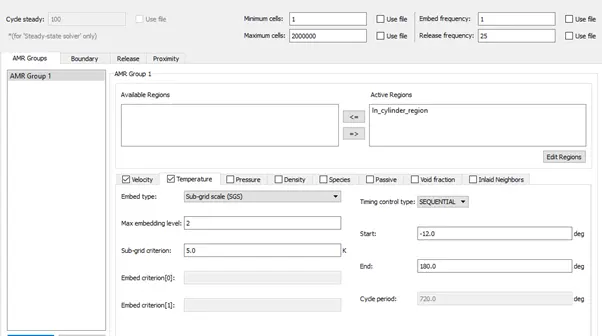
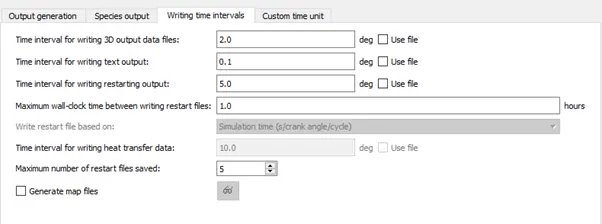
12. 3D output data is written after every 10 deg.
13. The input files are exported to a folder to further solving.
Solving using Cygwin:
The Cygwin directory is navigated to the above saved folder and following code is entered to solve the problem.
"mpiexec.exe -n 2 "C:\Program Files\Convergent_Science\CONVERGE\3.0.16\bin\intelmpi\converge.exe" restricted </dev/null> logfile &"
where address in quotes gives the path of folder containing input file exported earlier.
Results: -
Mesh Animation –
Total Cell Count –
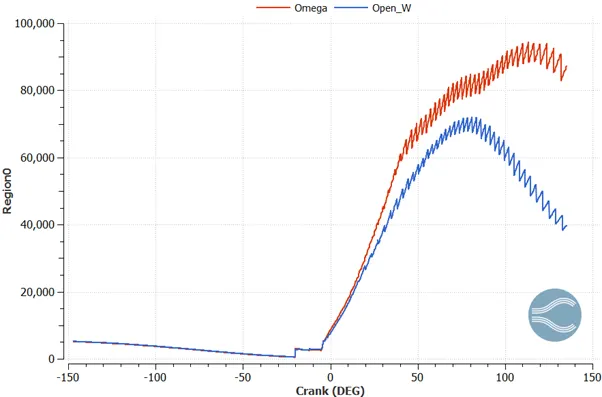
In open-W the AMR stop early as the combustion stage completes before it completes in Omega piston hence the cell count drops after the combustion stroke. Hence there is lot of unburnt Hyrocarbons.
Maximum Pressure
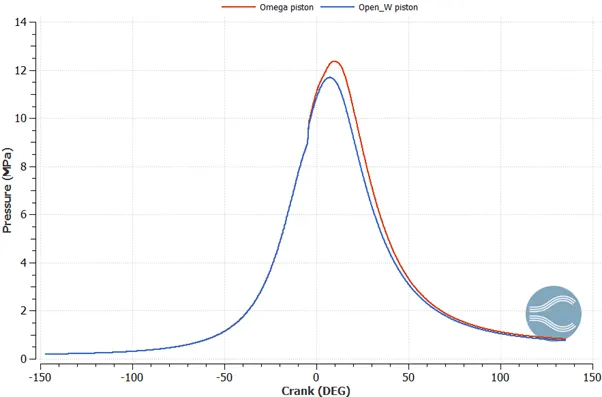
Here the Open-W pistons attains Max. Pressure earlier than in Omega Piston.
Max. pressure is higher for Omega in comparision to Open-W to upto 10 %.
Velocity animation:
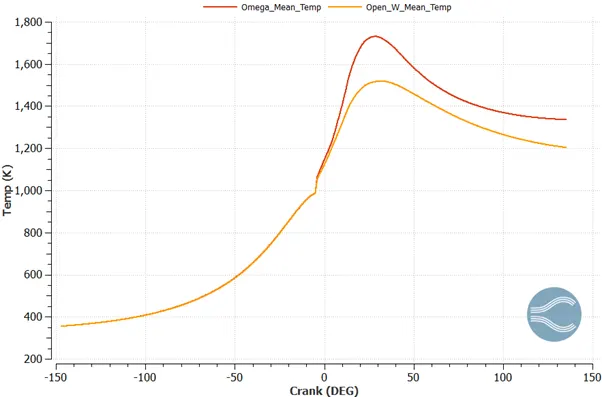
Mean Temperature
Temperture Animation:
Even though the Max. temperature Profile is almost similar the Mean Temperature for Omega is greater as Fuel get properly Burnt and converted into more energy.
Fuel spray Impinges on the Open-W piston hence reduces Atomization of fuel causing incomplete Combustion decreasing Combustion efficiency.
Heat Release Rate and Integrated HR
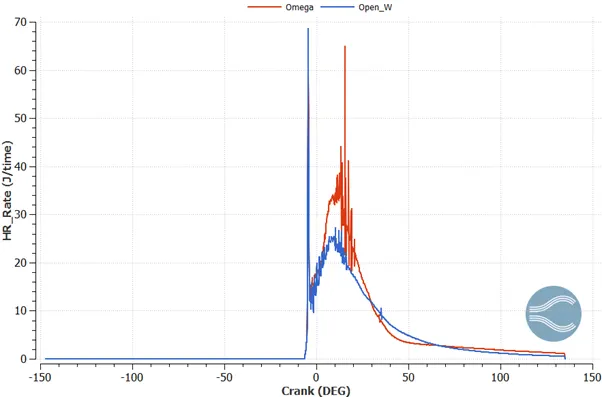
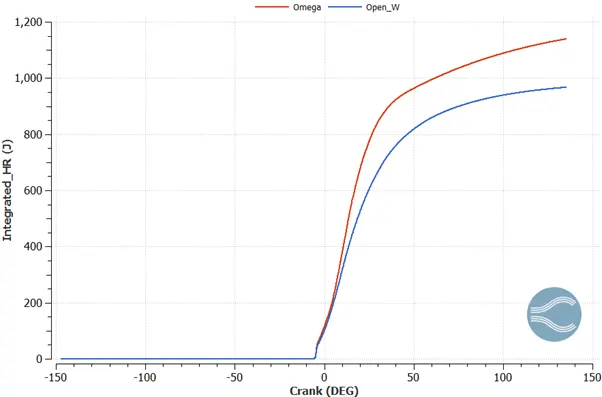
The heat release initiates early in Open-W as spike suggest but the integrated Heat release is higher in Omega as Compared to other. This also indicated that Omega has Higher Combustion efficiency.
Performance –
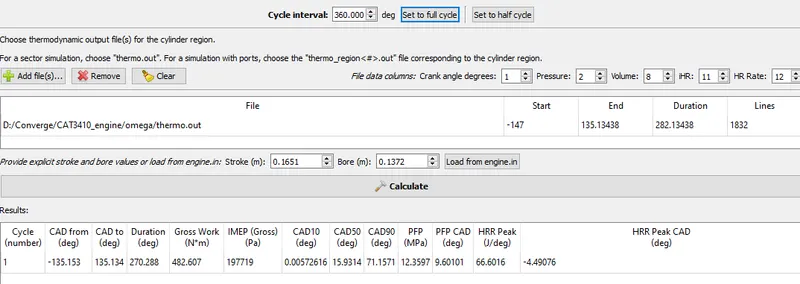
Omega piston
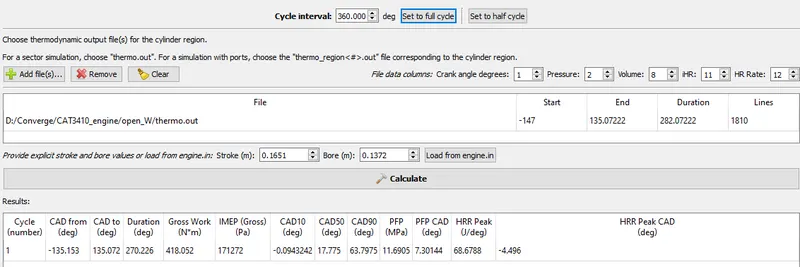
Open-W piston
|
RPM |
1600 |
|
RPS |
1600/60 = 26.67 |
|
Degree /sec |
26.67*360 = 9601.2 |
|
Duration (in deg.) |
270.226 deg. |
|
time for work done |
270.226 /9601.2 = 0.028145 sec |
| Omega Piston |
Open-W Piston |
| work = 482.607 N-m | work = 418.052 N-m |
| IMEP = 1.97719 bar | IMEP = 1.71272 bar |
|
power = work/time for work done = 482.607 / 0.02814 =17.147 KW |
power = work/time for work done = 418.052 / 0.028145 = 14.853 KW |
|
Torque = power/ 2π*RPS = 17.147 / 2π*26.67 = 102.326 N-m |
Torque = power/ 2π*RPS = 14.853 / 2π*26.67 = 88.639 N-m |
Emission –
NOx and Its animation:
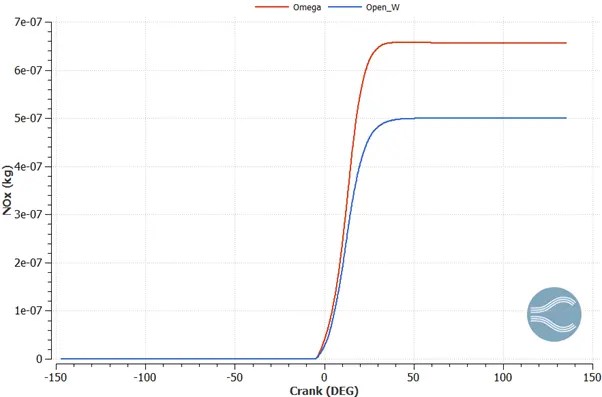
The Omega produces Higher amount of NOx as compared to Open-W.
HIROY soot
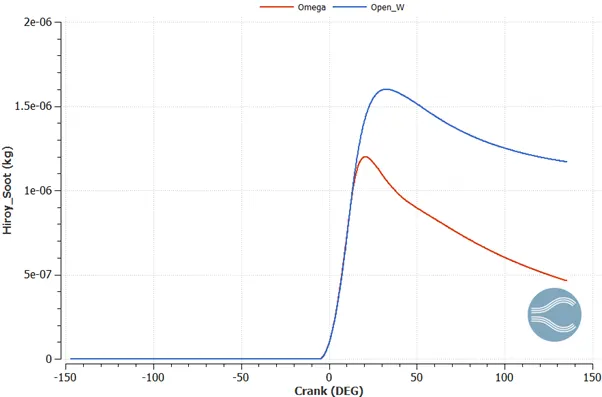
The Omega produces lower amount of soot as compared to Open-W.
Unburnt Hydro-Carbon (CO2, CO, HC):
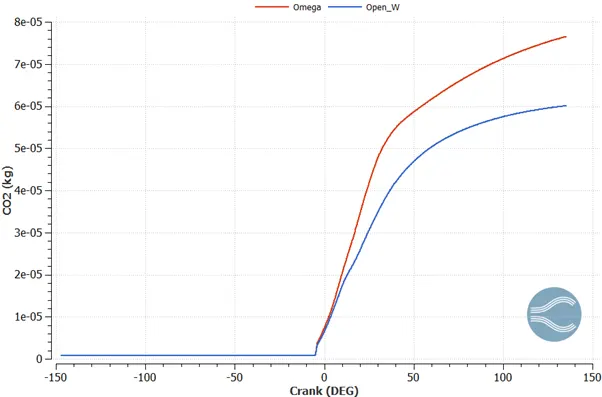
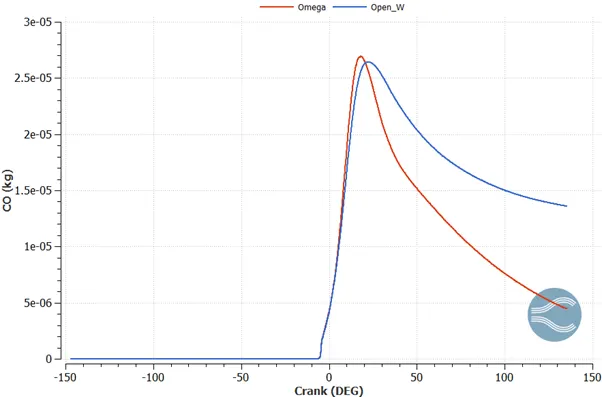
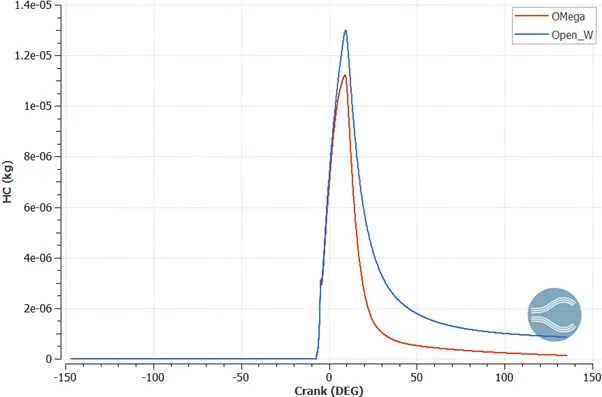
Omega produces more CO2 than But since incompete combustion in Open-W amount of CO is higher which is more hazadrous than CO2.
Conclusion: -
1. On the Basis of performace the Omega gives More torque and Power Than Open-W.
2. NOx content is higher for Omega which is of Concern and can be brought under consideration with Selective Catalytic Reduction (SCR) technology.
3. Formation of soot is higher in Open-W as incomplete combustion due to improper position and timing of spray which could be adjusted to bring down UHC an soot.