Week-11 Challenge: Braking
1. For a defined driving cycle, calculate the energy required for braking.
To calculate the energy required for braking during a defined driving cycle, we need to know the following parameters:
- The mass of the vehicle
- The initial velocity of the vehicle
- The final velocity of the vehicle
- The distance covered during the braking period
- The efficiency of the braking system
Once we have these parameters, we can use the following formula to calculate the energy required for braking:
Energy = 1/2 * Mass * (Initial Velocity^2 - Final Velocity^2) * Efficiency / Distance
Here, the energy is in Joules, mass is in kilograms, velocity is in meters per second, distance is in meters, and efficiency is a unitless quantity between 0 and 1.
We can obtain the values of the parameters for a defined driving cycle from experimental data or simulation results. Once we have these values, we can plug them into the above formula to obtain the energy required for braking during the cycle.
2. Why electric motor can't develop braking torque at high speed similar to starting?
- The maximum braking torque that an electric motor can produce is limited by the voltage and current ratings of its windings and the physical design of the motor.
- At high speeds, the back EMF (electromotive force) generated by the motor increases, which limits the amount of current that can flow through the motor windings and thus limits the amount of braking torque that can be generated.
- Therefore, the braking torque of an electric motor is less at high speeds than during starting due to these limitations.
How electric and mechanical brakes are coordinated?
- Regenerative braking is used to supplement the braking torque generated by the electric motor.
- During regenerative braking, the electric motor is used as a generator, and the kinetic energy of the vehicle is converted into electrical energy, which is stored in the vehicle's battery.
- This helps to slow down the vehicle and also charges the battery, increasing the overall efficiency of the vehicle.
- However, regenerative braking alone may not be sufficient to bring the vehicle to a complete stop, especially in emergency situations.
- In such cases, mechanical brakes are used in combination with regenerative braking.
- The amount of braking force applied by the mechanical brakes is determined by the vehicle's electronic control unit (ECU), which monitors the vehicle's speed, acceleration, and other parameters to ensure that the braking force is distributed appropriately between the electric and mechanical brakes.
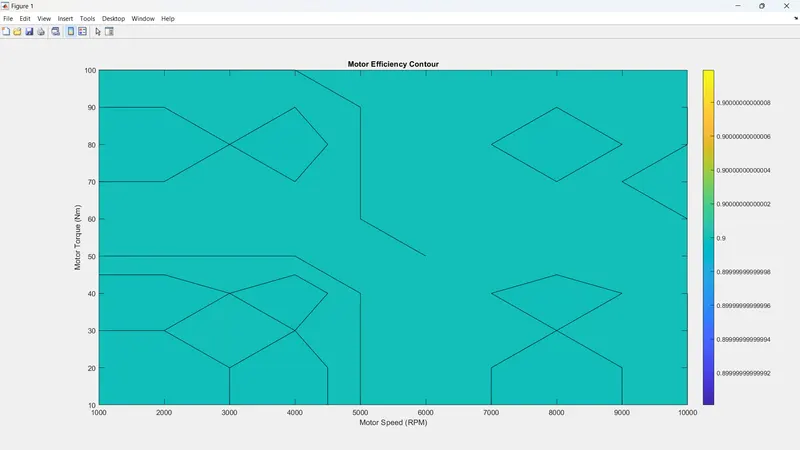
3. Make a MATLAB program which plots contour of given motor speed, torque and efficiency values. Attach the code as a .m file attach a screenshot of all the plots.
Here is a MATLAB program that plots the contour of motor speed, torque, and efficiency values:
% Define the range of motor speed and torque values
n = 1000:1000:10000; % RPM
T = 10:10:100; % Nm

% Initialize the efficiency matrix
eff = zeros(length(T),length(n));

% Calculate the efficiency for each combination of speed and torque values
for i = 1:length(T)
    for j = 1:length(n)
        % Calculate the power output and power input
        Pout = 2*pi*n(j)/60 * T(i); % W
        Pin = Pout/0.9; % W (Assuming 90% motor efficiency)

        % Calculate the efficiency
        eff(i,j) = Pout/Pin;
    end
end

% Plot the contour of efficiency values
contourf(n,T,eff,20);
colorbar;
xlabel('Motor Speed (RPM)');
ylabel('Motor Torque (Nm)');
title('Motor Efficiency Contour');
- This code generates a contour plot of motor efficiency values as a function of motor speed and torque values.
- The
nandTvectors define the range of values for the motor speed and torque, respectively. - The
effmatrix is initialized to zeros and is filled with the efficiency values calculated for each combination of motor speed and torque values. - The
contourffunction is then used to generate the contour plot of efficiency values, with thecolorbar,xlabel,ylabel, andtitlefunctions used to add labels and a title to the plot.
Note that the assumptions made in the efficiency calculation (such as the motor efficiency of 90%) may need to be modified based on the specific motor being analyzed.