Week-11 Challenge: Braking
1) For a defined driving cycle, calculate the energy required for braking.
The driving cycle are plotted in excel sheet with time vs speed of vehicle.
The Driving cycle graph is shown below:
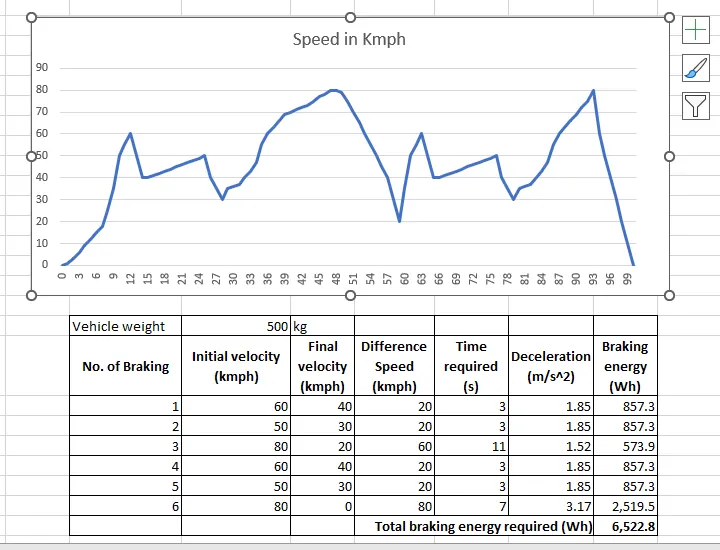
Braking energy required in Wh = 0.5*mass*velocity^2
Let us take vehicle mass with payload will be 500kg
by solving the avbove equation we get Total braking energy required (Wh) = 6522.8Wh
For a defined driving cycle required 6.5 units of energy required for braking.
---------------------------------------------------------------------------------------------------------------------------------
2) Why electric motor can’t develop braking torque at high speed similar to starting?
Electric motor can’t develop braking torque when the vehicle is at high speeds because the motor will be running at the constant power region.
In the constant power region, the torque of the motor reduces and so the motor cannot develop the braking torque which is equal to the torque that occurred during low speed at the constant torque range.
The torque vs speed plot of a vector control induction motor is given below.
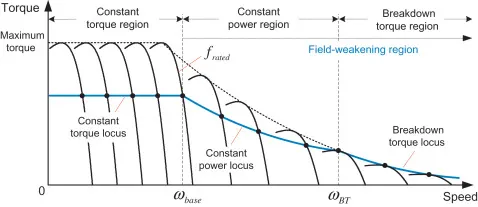
From the above characteristic curves, it seems that torque of the motor remains high at low speeds and reduces as the speed increases.
At braking, speed remains higher than the motor rated speed then motor will be acts as a generator. the stored kinetic energy will be fed back to battery. this mode is called regenerative braking.
So, electric motor cannot develop braking torque at a high speed similar to starting.
Mechanical braking : The working of a mechanical brake depends on the pedal. When the pedal is pressed, the brake shoes are pushed outwards and rotates against the drum which is connected to the wheels. Hence the machine or vehicle gets slow down and stopped. And when the pedal is released, it goes to a normal position due to the pullback action of spring shoes. the types of mechanical braking are as:
- Drum braking
- Pawl and Ratchet braking
- Band braking
- Disk braking
Electrical Braking is used to reduce the speed of the machine depending on flux and torque. This type of braking is mainly used for functional braking to control the speed of the machine. It is easy to handle and comfortable. But it cannot be used for emergency braking. the types of electrical braking are as follows:
- Plugging type braking
- DC injection type braking
- Eddy current braking
- Dynamic resistor type braking
- Regenerative braking
- Sharing DC bus type braking
How electric and mechanical brakes are coordinated?
A Regenerative Braking system is used to convert waste energy(heat) into useful energy(stored in battery) with the help of a motor which acts as a generator when reversed.
There are certain limitation with RBS i.e. the electric motor is unable to provide all the brake torque necessary for large decelerations.
In case of braking, if the braking torque is applied only one axle, there are chances stability issues can occur. So to avoid such situation regenerative braking is operated in conjunction with a friction(mechanical) brake system.
The RBS and Mechanical Brake sytem are used in strategic manner which is called as Brake Control Strategy
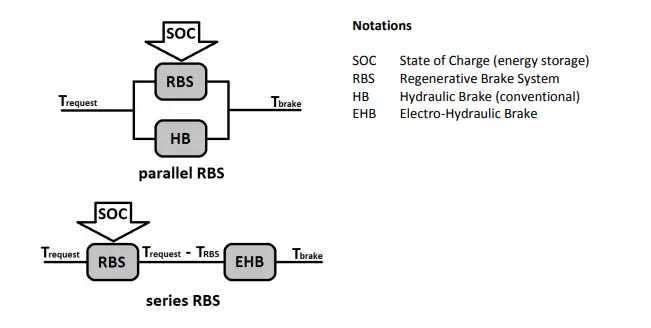
1. Series Brake Control or Series RBS:
In this type of control system the Mechanical Brakes and Regenerative(Electric) Brakes are applied one after the another. We can only apply one brake system at a time either RBS or Mechanical brakes based upon the situtation oof the travel.
The series brake system is further classified:
a. Comfort of the drive
b. Braking according to the energy efficiency
2. Parallel Brake Control or Parallel RBS:
In this type of brake control system both the Mechanical Brakes and RBS are applied simultaneously.
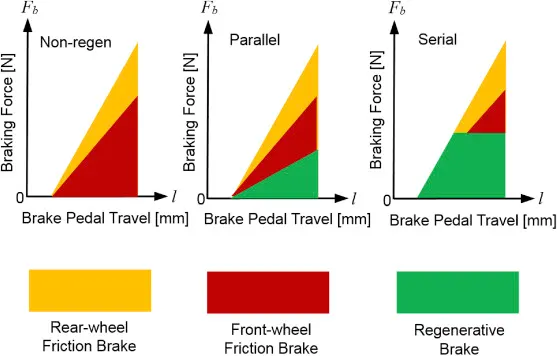
The following image shows the braking percentage applied in series and parallel types of braking.
Electric driven intelligent brake (EDIB)
EDIB is a brake control strategy which is developed by NISSAN. It is a type of parallel braking which can be seen in the below image.
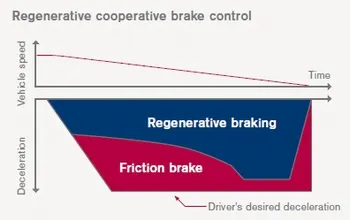
The above image shows that the frictional brake and the regenerative brake are used simultaneously at higher speeds of the vehicle.
At low speed the torque of the motor is high and so the regenerative brake has a higher braking part than the frictional brakes.
---------------------------------------------------------------------------------------------------------------------------------
3) Make a MATLAB program which plots contour of given motor speed, torque and efficiency values.
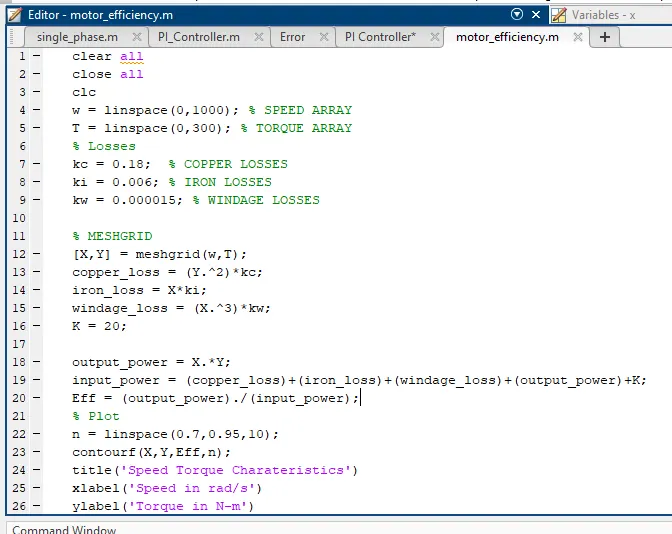
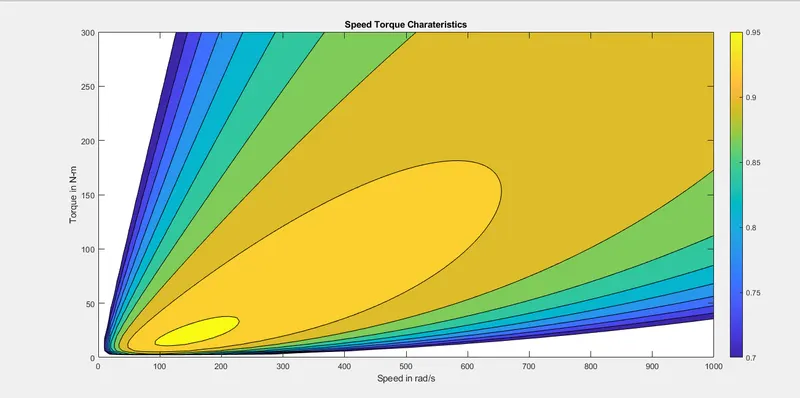
From the output , we can see that that only certain speed and torque has maximum efficiency i.e. 95 %.
Where, Speed x = 151 rad/s @ 24 N-m Torque. As the Speed increases, efficiency of the motor will be reduced.