Week-11 Challenge: Braking
Question 01 For a defined driving cycle, calculate the energy required for braking.
Solution:-
To calculate the energy required for braking in a defined driving cycle, we would need to know certain parameters such as the vehicle mass, the average speed of the cycle, the distance covered in the cycle, the coefficient of rolling resistance, the coefficient of aerodynamic drag, and the efficiency of the regenerative braking system (if applicable).
Once we have this information, we can use the following formula to calculate the energy required for braking:
E = (mv^2)/(2η) + Frrd + Fdrgd
where:
E = energy required for braking
m = vehicle mass
v = average speed of the cycle
η = efficiency of the regenerative braking system (if applicable)
Frr = force of rolling resistance,
which is equal to mgCrr, where g is the gravitational acceleration (9.81 m/s^2) and
Crr is the coefficient of rolling resistance
Fdrg = force of aerodynamic drag, which is equal to (1/2)ρCdAv^2, where ρ is the air density,
Cd is the coefficient of aerodynamic drag, and A is the vehicle's frontal area d = distance covered in the cycle
Note that the first term in the formula represents the kinetic energy of the vehicle that needs to be dissipated during braking, the second term represents the energy lost due to rolling resistance, and the third term represents the energy lost due to aerodynamic drag.
By plugging in the values for the relevant parameters, we can calculate the energy required for braking in the defined driving cycle.
To calculate the energy required for braking in a defined driving cycle, you would need to know the following information:
- The mass of the vehicle
- The initial and final velocities of the vehicle during each braking event in the driving cycle
- The distance over which the vehicle is brought to a stop during each braking event
Once you have this information, you can use the following formula to calculate the energy required for braking:
Energy = 0.5 * mass * (final_velocity^2 - initial_velocity^2)
For example, if a vehicle with a mass of 1000 kg is brought to a stop from an initial velocity of 50 km/h over a distance of 50 meters, the energy required for braking can be calculated as follows:
Initial velocity = 50 km/h = 13.89 m/s
Final velocity = 0 km/h = 0 m/s
Distance = 50 meters
Mass = 1000 kg
Energy = 0.5 * 1000 kg * (0 m/s^2 - 13.89 m/s^2)^2 = 966,050 J
Therefore, the energy required for braking in this example is 966,050 J. You would need to repeat this calculation for each braking event in the defined driving cycle and then sum the results to get the total energy required for braking in the cycle.
Question 02 :- Why electric motor can’t develop braking torque at high speed similar to starting? How electric and mechanical brakes are coordinated?
Solution:-
An electric motor can develop torque during both acceleration and braking, but the torque developed during braking is typically lower than the torque developed during acceleration, especially at high speeds.
During acceleration, the electric motor converts electrical energy into mechanical energy, which results in a torque output that can accelerate the vehicle. This torque output is limited primarily by the current carrying capacity of the motor windings and the available electrical power. As a result, electric motors can generate high torque at low speeds and moderate torque at high speeds.
During braking, the electric motor operates in reverse, where it converts the mechanical energy of the moving vehicle into electrical energy that can be stored in the battery or dissipated as heat. This is known as regenerative braking, and it can help to improve the efficiency of electric vehicles and extend their range. However, the torque output during regenerative braking is limited by the amount of electrical power that can be absorbed by the motor and the battery. At high speeds, the amount of power that can be absorbed by the motor and battery is limited, which limits the amount of torque that can be generated during braking.
In addition, at high speeds, the kinetic energy of the moving vehicle is very high, and the brakes may need to dissipate a large amount of energy to slow down or stop the vehicle. This requires a large amount of braking force, which may need to be provided by other braking systems, such as hydraulic brakes, in addition to regenerative braking.
Therefore, while electric motors can generate some braking torque at high speeds, the torque output is typically lower than during starting or acceleration, and additional braking systems may be required to slow down or stop the vehicle effectively.
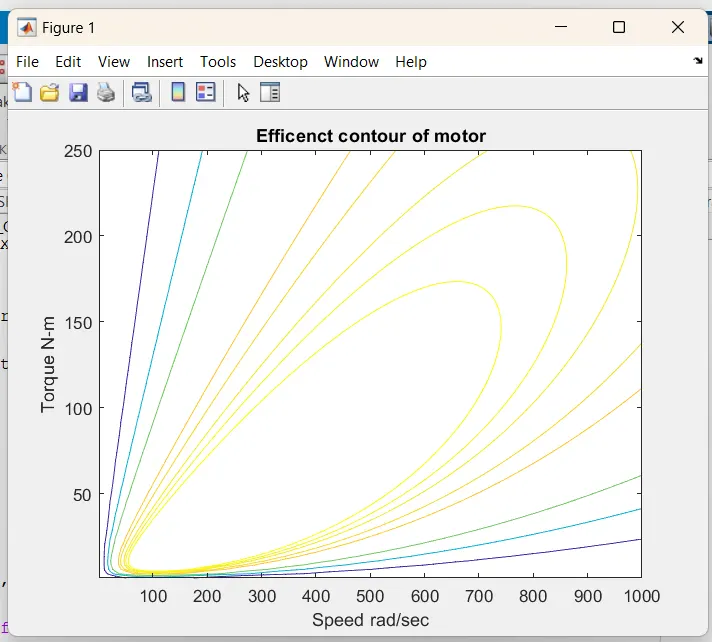
Question 03:- Make a MATLAB program which plots contour of given motor speed, torque and efficiency values. Attach the code as a .m file attach a screenshot of all the plots.
Solution:-
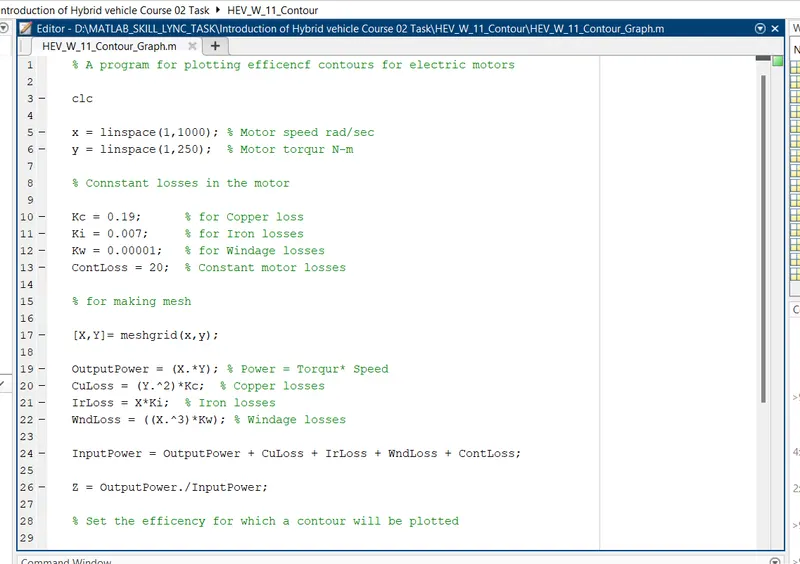
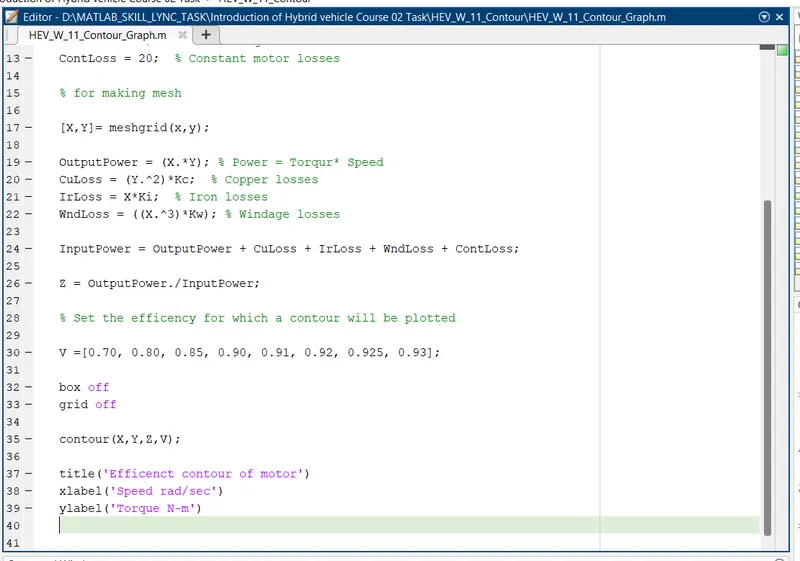
M scripting
% A program for plotting efficencf contours for electric motors

clc

x = linspace(1,1000); % Motor speed rad/sec
y = linspace(1,250);  % Motor torqur N-m

% Connstant losses in the motor

Kc = 0.19;      % for Copper loss
Ki = 0.007;     % for Iron losses
Kw = 0.00001;   % for Windage losses
ContLoss = 20;  % Constant motor losses

% for making mesh

[X,Y]= meshgrid(x,y);

OutputPower = (X.*Y); % Power = Torqur* Speed
CuLoss = (Y.^2)*Kc;  % Copper losses
IrLoss = X*Ki;  % Iron losses
WndLoss = ((X.^3)*Kw); % Windage losses

InputPower = OutputPower + CuLoss + IrLoss + WndLoss + ContLoss;

Z = OutputPower./InputPower;

% Set the efficency for which a contour will be plotted

V =[0.70, 0.80, 0.85, 0.90, 0.91, 0.92, 0.925, 0.93];

box off
grid off

contour(X,Y,Z,V);

title('Efficenct contour of motor')
xlabel('Speed rad/sec')
ylabel('Torque N-m')
Screenshots
Result:-