Week-11 Challenge: Braking
Question 1 Solution:
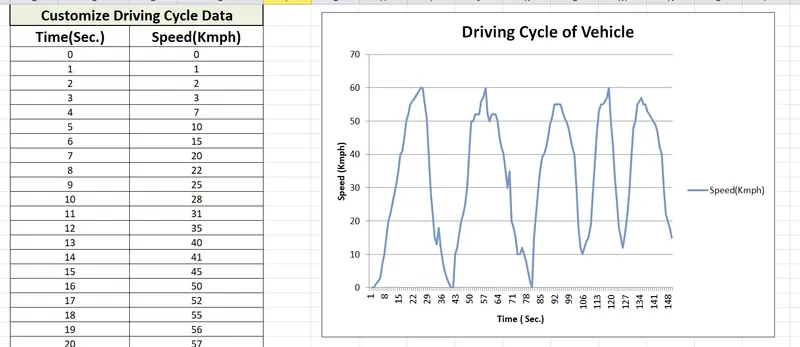
Calculation for acceleration & Decelearation both require define data to take as input for Mathematical computation.So I built my own pattern for driving cycle with Time vs. Speed data as per follow.
Barking power needed to decelerate the vehicle for each time period would be different. i.e. Lets say you are driving the vehicle at 90 kmph & in another scenario you are drving it at 20 kmph so the braking Energy required for both of the condition wolud different for same weight.This is because the energy stored in the form of moment of inertia is different also,The time taken by braking method employed plays prime role in the magnitude of barking power.If you want to decelerate the vehicle very quickly it will require more braking power compared to high braking time.This power developed by vehicle braking mechanism has to be distributed equally across the vehicle otherwise it may skid from the driving direction.
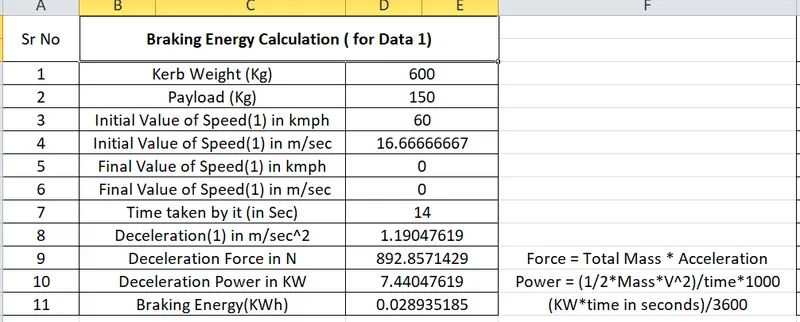
(Braking Power needed to stop vehicle)
(Braking Power needed to decelerate the vehicle)
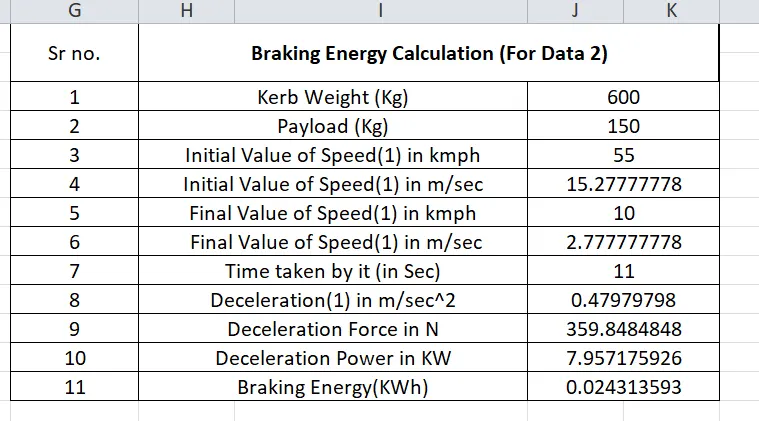
I have built the excel calculator(as shown above) for the decelration Braking power calculation.One can input data for desired deceleration instance & calculate it.Here I have taken highlighted data as input & calculated the Barking Power required for completely stop the vehicle & also for high speed to some low speed value.
In data : Vehicle kerb Weight = 600 Kg.
Pay Load = 150 Kg.
Question 2 Solution:
For DC Motor, The back Emf is proportional to the value of speed.Also 90% of the EV industry uses DC motor so considering this facts lets analyse the intresting
topic.
In Starting of Electric vehicle when the speed is very less or zero then the Back EMF of the Motor can be given by
Eb = k*Phi*w............ (1) as the value of speed is nearly equal to zero, Back EMF is negligible. So the Armature current of the motor at this perticaular instance
is given by
Ia = V-Eb/Ra ............(2)
where, V = Supply Voltage
Eb = Back EMF Voltage of Motor
Ra = Armature circuit resistance
Ia = Armature Current
w = Speed of the Motor
k = Motor Constant
phi = Flux of the Motor
Also the Torque of the Motor is given by T = k*phi*Ia ........(3)
as the (Eb) at initial is nearly equals to zero & the Armature winding resistance is too samll so the Armature current which is the prime component of the torque is too high. Starting torque of the motor is also becomes high.
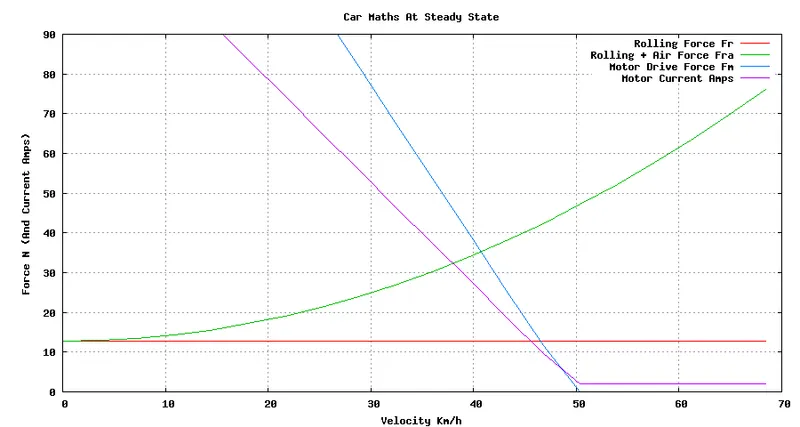
If we consider the Braking condition, the back EMF generated is high compared to less or standstill condition of motor.The Armature current at this condition is
given by as Ia = Eb-V/Ra.............(4) this phenomena is shown in below.
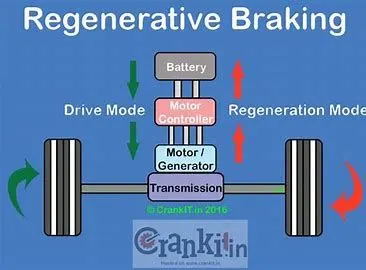
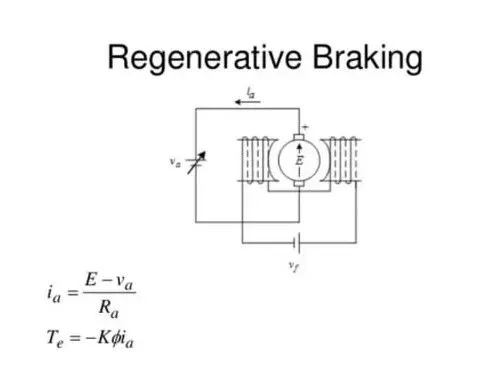
So the current would be difference of this voltages due to which the Torque developed by this current would be also less compared to zero speed condition.also,during High speed of motor the moment of inertia stored in form of kinetic energy.This opposes the toruqe which is produced by Motor for braking.In this case Aerodynamic force on the vehicle is also dominant. Thus the effective Torque developed by Electric motor is less compared to Starting acceleration Torque.
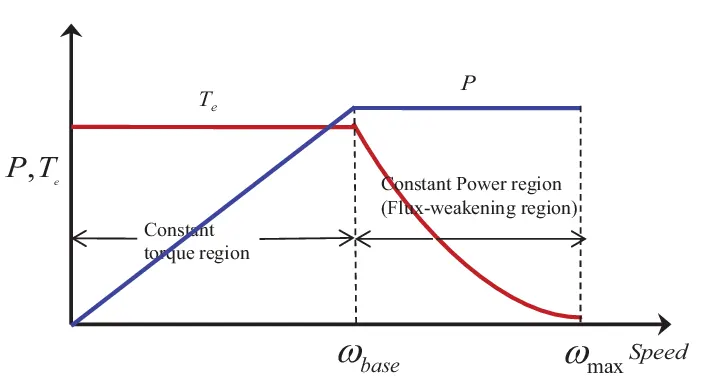
Another perspective to this low braking torque for electric motor would be because of, at speed above base speed The motor would be operating in Constant power region.
In this region to get maximum speed we are weakening the field & there by reducing torque. So at instant of braking due to lesser value of field the Torque would be low.
(i.e. T = K*phi*Ia). Thus the Torque would have lesser magnitude compared to starting acceleration Torque.
Proper Combination of Electric Braking & mechanical braking is very much important to stall the vehicle from high speed.If you have pure EV than all generated energy from regeneration can't be used to store.we consider braking phenomena here the speed of the motor is high.So Back EMF of the vehicle is also high due to high speed of vehicle.So at istant of braking we have to provide more Percentage of Mechanical (frictional) brake & less of electrical brake.When the Power generated by regeneration action of motor is within safe charging criteria we can increase the Braking percentage sharing by electrical.Also we can't let that energy beign wasted in friction & waer tear loss of brake plates so till battery SOC is less & withtin safe charhing conditions we must apply electric braking.
There are 2 possible ways to configure these brakes:
1) Serial Braking strategy : When you hit the brake pedal first the Battery state of charge is being cheked & if it is lesser than set maximum value than and than the regerative braking power is being used to charge the battery otherwise the mechanical brakes are applied directly. If the battery SOC is suffucient high percentage.i.e. In this strategy either of one kind of braking applied alone then another method implemented.But the preference is always given to electric braking which regenerates power and also have nil wear & tear loss.
2) Parallel Braking strategy : Here both mechanical & electrical brakes applied simultaneously but the Percentage sharing of these two adjusted accordingly to
safely battery charging conditions. (i.e. charging current within limit)
Question 3 solution:
Here for this question our prime aim is to plot the Speed vs. Torque and get those values for different efficiencies. So we can get the idea about Motor to operate within most optimum & efficient region.Note: here the Speed & Torque values are assumed this are not computed mathematically as our main aim is to plot contours efficiency.The Matlab code & plot for it is shown below.
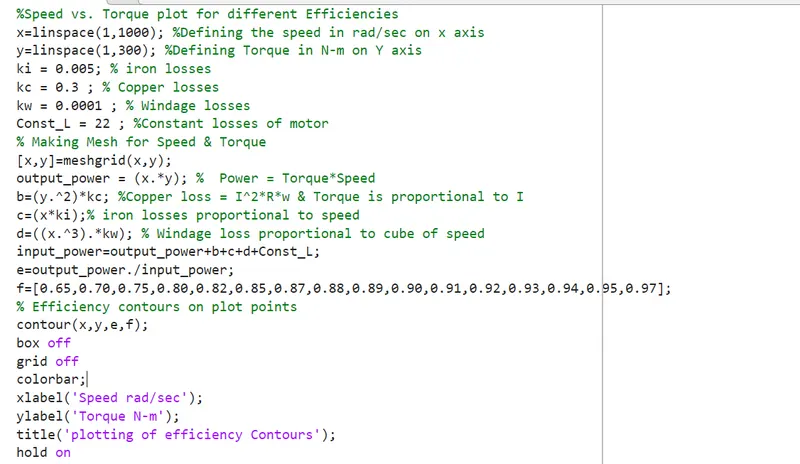
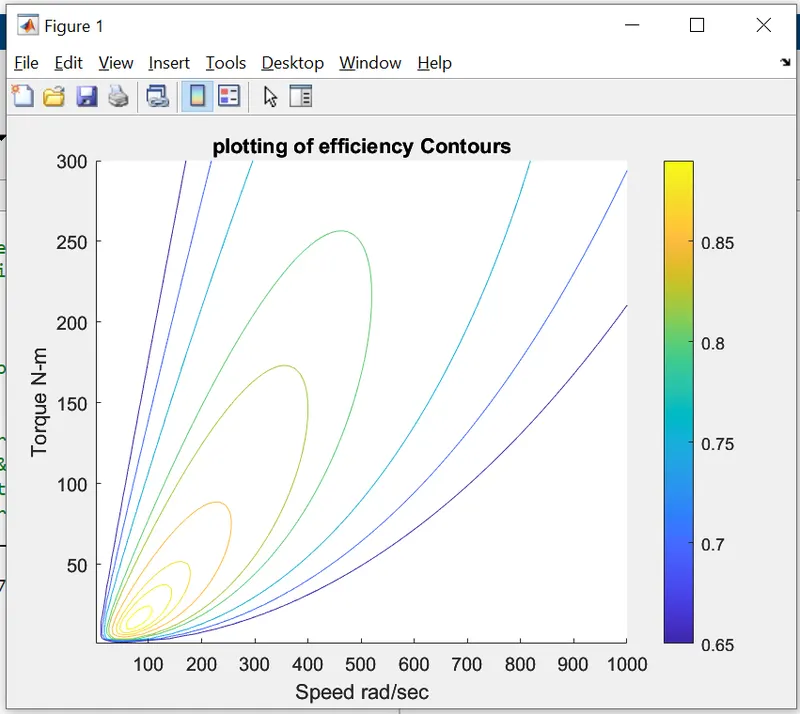
Formulae considered for the differrent kind of losses associated with Motor are :
1) Copper losses = kc*T^2
2) Iron losses = ki*w
3) Windage losses = kw*w^3
4) Consatant losses = C
where, kc = Copper loss constant
T = Trque of motor
ki = iron loss constant ( Magnetic loss)
w = speed of the motor
kw = Widage loss constant
C = Constant loss of the motor
Input_Power = Input Power + Copper losses + Iron Losses + Windage Losses + Constant losses
Ooutput_Power = Torque*Speed