Week-11 Challenge: Braking
1.For a defined driving cycle, calculate the energy required for braking.
ANS.
Calculating the energy required for braking of Drive Cycle
Driving Cycle: A driving cycle are a set of vehicle speed points versus time, it is used to calculate the fuel consumption of a vehicle, which is later on is compared with different vehicles. Main use of driving cycle are performance of a vehicle,analyze battery state and energy consumption in Electric Vehicles and simulate vehicle model prior to the actual development
A brake is a mechanicle device that inhibits motion by absorbing energy from a moving system. It is used for slowign or stopping a moving vehicle, wheel, axle, or to prevent its motion, most often accomplished by means of friction.
The process of braking follows the law of conservation of energy i.e. Energy cannot be created or destroyed it can only be converted into another form. i.e dissipates the kinetic energy as heat.
now kinetic energy is given by
K.E=1/2Mv^2
m= Total Mass of the Vehicle (Vehicle Mass + Pay Load) in unit of Kg. here assume 1000kg
v= (Initial Velocity-final Velocity) in unit m/s.
now velocity taken initial and finall velociyt
here assume initial is 20 and final is 10
1/2*(1000)*(20-10)=50000J=50KJ
similarly we have take different values and at different velocities
....................................................................................................................................
2.Why electric motor can’t develop braking torque at high speed similar to starting? How electric and mechanical brakes are coordinated?
ANS;
Eectric motor can’t develop braking torque at high speed similar to starting, because Braking torque is applied in the opposite direction of the rotation. We can use a mechanical brake to produce a braking torque. We can also do it electrically.
Regenerative Braking: It is a form of braking in which the kinetic energy of the motor is returned to the power supply system.Regenerative braking takes place whenever the speed of the motor exceeds the synchronous speed. This baking method is called regenerative baking because here the motor works as generator and supply itself is given power from the load
So Electric motor can’t develop braking torque at high speed similar to starting, because Braking Torque of an EV Motor is not as high as the Acceleration Torque. Therefore Regenerative braking is cannot happen so effectively that we can get all the power back to the battery.
sometime we use combination fo mechanical and regenerative braking. it takes takes as series and parallel
in serires machanical braking and regenarative brakings are appiled one after another
and parallel both regenarative and mechanical brakings are appiled simultaneous.
and some times intelligent braking appiled depends on the speed of vehicle whare at low speed regenarative braking is appied and at the high speeds both mechanicla regenarative braking are used.
................................................................................................................
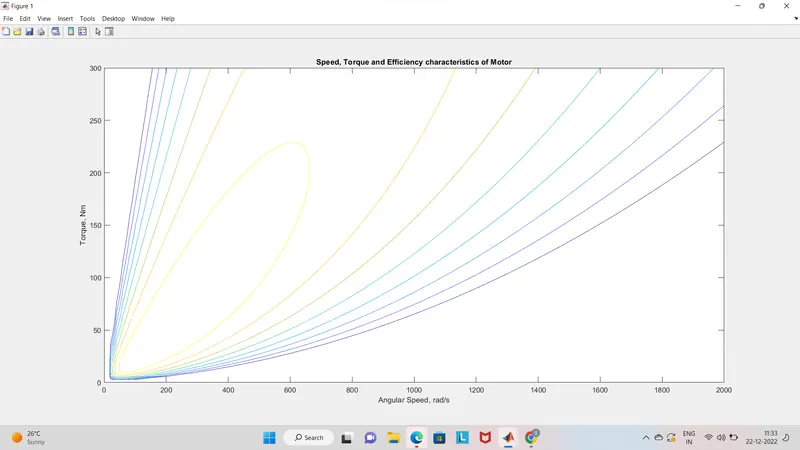
3.Make a MATLAB program which plots contour of given motor speed, torque and efficiency values. Attach the code as a .m file attach a screenshot of all the plots.
before calculating efficiency's of the motor are any thing we have to consider losse
i.e Iron Losses are nothing but Magnetic losses
Copper Losses
Windage Losses(This is a Mechanical or friction of Windage losses)
Constant Losses -
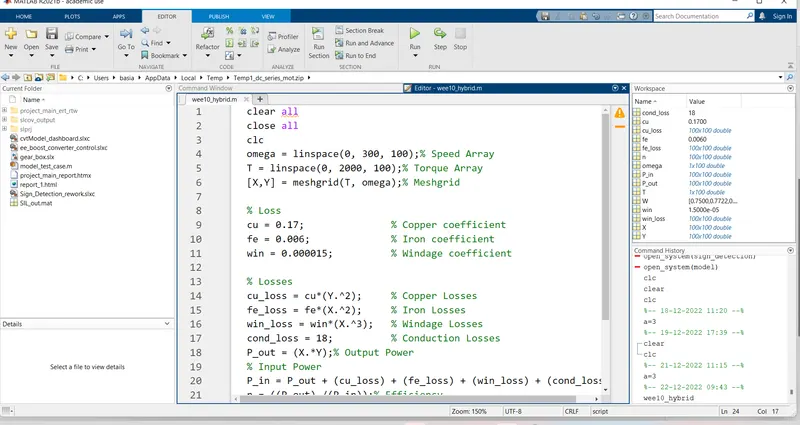
here assumed
cu coefficient -0.17
fe coefficient -0..006
windage coefficient -0.000015
constant loss=18
Copper Losses - I^2*R, where R is the Armature resistance and we say that Torque is proportional to Current, this copper loss can be consider askc⋅T2kc⋅T2.where kc is to take care of resistance of brushes and also take care of flux and its effect.
Copper losses = kc⋅T2
Iron Losses = ki⋅ω
Windage Losses = kw⋅ω3
relust are shown below