Week-11 Challenge: Braking
Answer:
1.
In an electric vehicle, energy is required by the vehicle for acceleration as well as deacceleration of the vehicle also. As we require to stop the vehicle in the stipulated time, we cannot allow the vehicle to stop as per its inertia value, for stopping the vehicle we require to apply brakes. Braking of a vehicle requires deaccelerate the vehicle to a lower speed within a given time.
Consider this drive cycle,
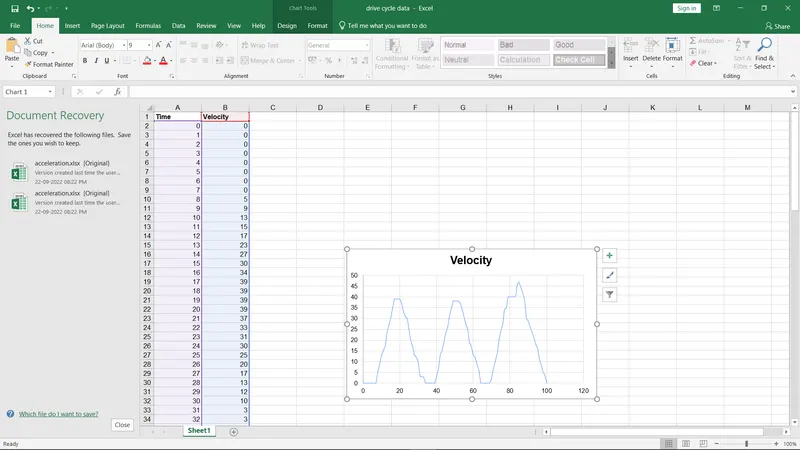
We can observe in this drive cycle that the vehicle needs to stop in a given time in some instances. For this, we will apply brakes.
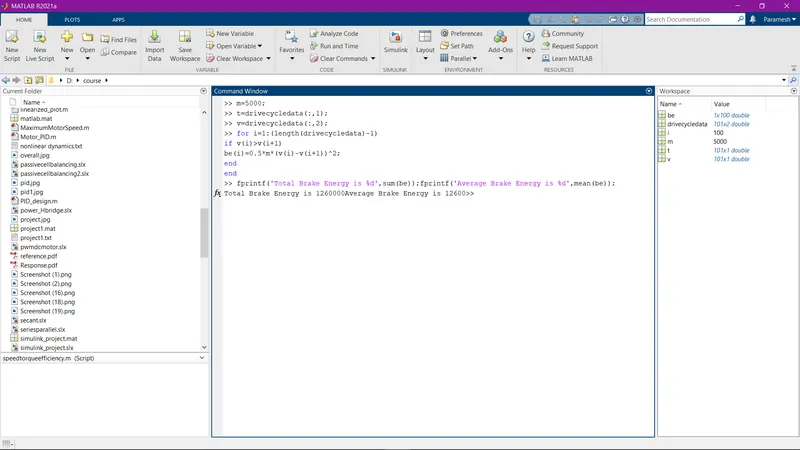
The drive cycle data file named 'drivecycledata' is imported into MATLAB.
MATLAB program for the calculation of braking energy:
>> m=5000;
>> t=drivecycledata(:,1);
>> v=drivecycledata(:,2);
>> for i=1:(length(drivecycledata)-1)
if v(i)>v(i+1)
be(i)=0.5*m*(v(i)-v(i+1))^2;
end
end
>> fprintf('Total Brake Energy is %d',sum(be));fprintf('Average Brake Energy is %d',mean(be));
The program is executed and the output is found to be the total braking energy is 1260000 J and the average braking energy is 12600 J.
2.
The electric motor can't develop braking torque at higher speeds similar to starting because once the electric supply is pulled off from the motor, it acts as a generator and due to the flux weakening effect of the electric generator, the generator produces low torque as expected.
Coordination of Electric and Mechanical Brakes:
In an electric motor, the Total Brake distribution is in two aspects which are the Electrical Brake which is called Regenerative Brake, and Mechanical Brake or Classical Brake with a hydraulic cylindrical system. Brake Force distribution must be uniform, If the Regenerative braking power requirement is more than the charging limit of the battery or more than the regenerative capacity of the machine we must apply Mechanical brakes as well. In a practical case, the combination of these two is applied. So usually it is a combined response of Mechanical brake and Regenerative brake. The reason for how this braking force is combined is that particular phenomena are called Brake Control Strategies. There are two Brake Control Strategies, which are Series - In the case of Series, we apply Mechanical brakes and Regenerative electric brake one after another. We can apply only one brake strategy at a time either apply Regeneratively or apply Mechanically brake. The Series Brake Control Strategy has a further classification, that is based on whether we want the comfort of driver or Brake behavior compared to energy efficiency. Parallel - In the case of Parallel, we apply both brakes simultaneously. This Particular Parallel braking is going to happen both at a time. Electric Driven Intelligent Brake (EDIB) is a combination of a Hydraulic brake or Mechanical brake along with a Regenerative brake. It is a Parallel braking technique. The Control criteria are such that at low speed use regenerative braking higher and at high speed or during the initial braking period we actually combine both.
3.
MATLAB script program:
clear all
close all
clc
omega=linspace(0, 300, 100);
T=linspace(0, 2000, 100);
[X,Y]=meshgrid(T,omega);
cu=0.17;
ir=0.006;
wind=0.000015;
culoss=cu*(Y.^2);
feloss=ir*(X.^2);
windloss=wind*(X.^3);
condloss=18;
Pout=(X.*Y);
Pin=Pout+(culoss)+(feloss)+(windloss)+(condloss);
n=((Pout)./(Pin));
W=linspace(0.75, 0.95, 10);
contour(X,Y,n,W)
xlabel('Angular Speed, rad/s')
ylabel('Torque, Nm')
title('Speed, Torque and Efficiency characteristics of Motor')
Result:
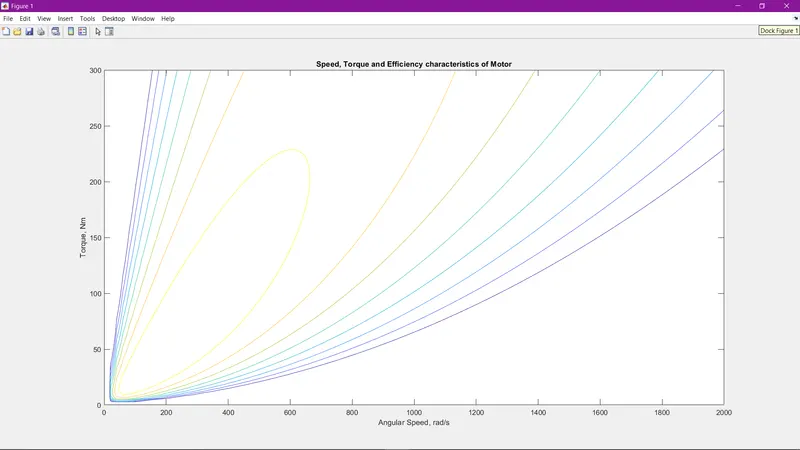
We can see that the highest level of efficiency arises in the innermost contour plot and this efficiency decreases as the contours increase in size from the innermost contour.