Week-11 Challenge: Braking
1.
- Braking is defined as slowing or stopping a vehicle, wheel, shaft, etc., or keeping it stationary, esp by friction.
- There are three types of braking: Mechanical, engine, and electrical.
- Mechanical braking transforms the kinetic energy of thermal energy.
- Engine braking is slowing down a vehicle without using the brake pedal. Gears are downshifted to reduce the speed of the vehicle. The wear & tear on brakes can be reduced. The efficiency of the vehicle can be improved.
- During electrical braking, the throttle connected to the motor is released and the power flow stops from the battery to the motor. Thus, the motor slows down and gets halted. In case, of high-speed operation or emergency braking, mechanical brakes are applied along with electrical braking.
- The deceleration of the vehicle requires the same amount of power as acceleration. This is called braking power.
- The energy lost in the deceleration process is given by
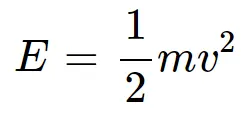
where E = Braking energy (kJ)
m = Total mass of the vehicle (kg)
v = Velocity of the vehicle (kmph)
- Now, I've defined a Drive Cycle which is given in the Excel Sheet.
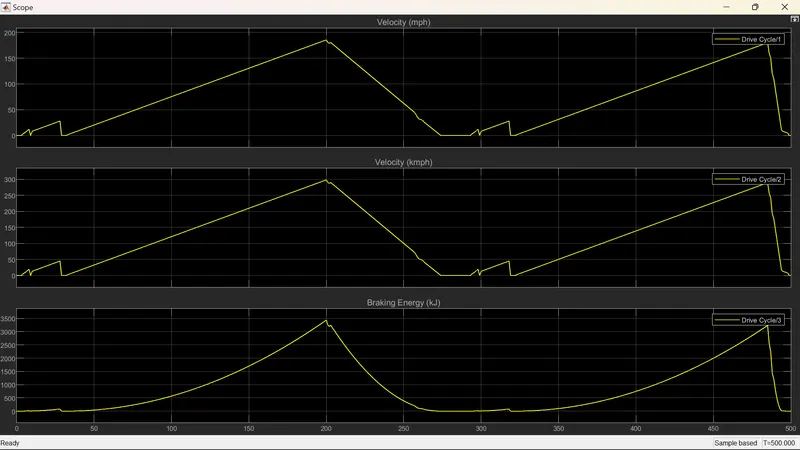
- From the Braking Energy graph, we can see the flow of energy during braking.
2.
- Electric motors can't develop braking torque at high speed similar to starting because braking torque is applied in the opposite direction of the rotation.
Electrical and mechanical brakes are coordinated with the help of regenerative braking.
- Regenerative brakes use electric motors rather than a traditional friction braking system to slow down and stop a car. HEVs and EVs typically use these types of brakes.
- With regenerative brakes, the braking system captures that kinetic energy and transfers it into the car’s batteries. The system wastes less energy than it would with friction braking. Using regenerative brakes helps preserve and replenish range in an electric or plug-in hybrid vehicle.
- In a conventional hybrid, the recovered energy from regenerative braking helps power some auxiliary functions in the car, such as the audio and climate control systems. This takes some of the load off the engine and electrical system and improves efficiency.
There are two brake control strategies:
Series: In the series, mechanical brakes are applied one after another.
Parallel: In parallel, both mechanical and electrical brakes are applied simultaneously.
3.
Code:
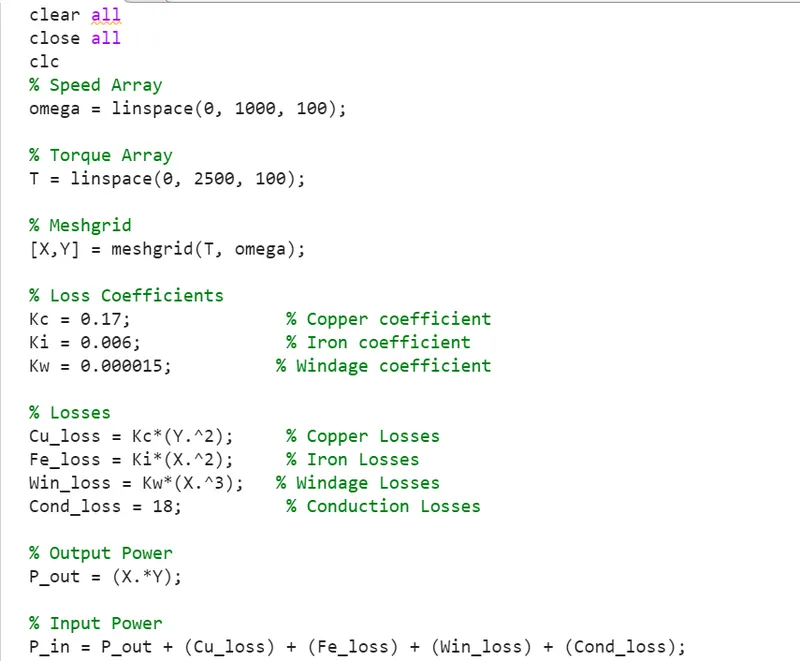
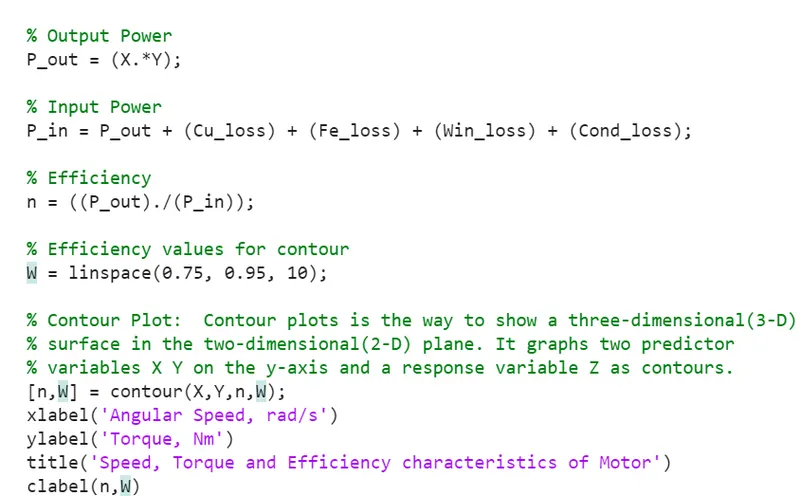
Output:
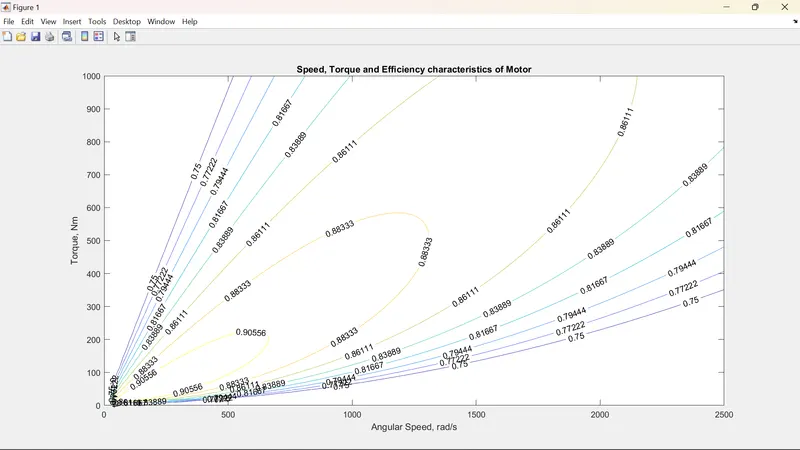
Conclusion: The plots inside the graph show the efficiencies of the motor with respect to Speed-Torque characteristics.