1) For a defined driving cycle,Calculate the energy required for breaking.
2) Explain why electric motor can not develop braking torque at high speed similar to starting and also explain how electric and mechanical brakes are coordinated.
3) Make a MATLAB program which plots contour of given motor speed,torque and efficiency values.Attach the code as a .m file attach a screenshot of all the plots.
Que 1) For a defined driving cycle,Calculate the energy required for breaking.
The braking is a state of dynamic that a vehicle decelerates from a certain velocity.The vehicle requires a certain period of time to move vehicle from one level to another level of velocity or to stop.the vehicle has a K.E. when it accelerates either in motion or from rest and during decelerates,the opposite occurs.
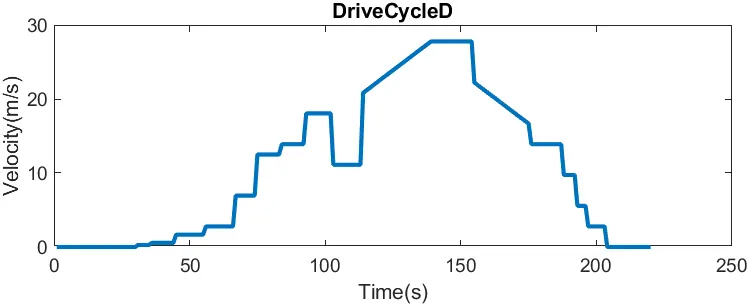
Driving cycle is a series of data point which represents the speed of a vehicle with respect to time.it has acceleration and deacceleration points means where velocity increases and decreases with respect to time.for deceleration points breaking is responsible and from that points we can calculate breaking energy also.
in different countries and organisations ,driving cycles are produced to easily access the performance of the vehicles in different ways for example, fuel consumption and polluting emissions.
braking energy (E) =1/2*m*v^2.
if the vehicle is decelerating from its initial velocity suppose (Vi) to final velocity (Vf),then the energy required for braking is given as :
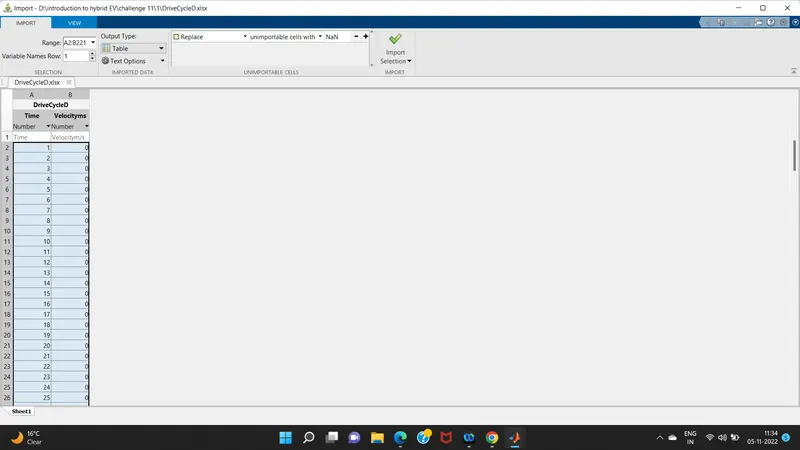
we are going to use 'DriveCycleD' for calculation of braking energy ,so for this MATLAB code is
clear all
close all
clc
% read DriveCycleD
d= readmatrix("DriveCycleD.xlsx");
% Time(s)
t=d(:,1);
% Velocity(m/s)
v=d(:,2);
% loop to calculate breaking energy
for j= 1:(length(d)-1)
if v(j)>v(j+1)
k(j)=0.5*1000*(v(j)^2-v(j+1)^2)/(3.6*10^6);
end
end
fprintf('total_beaking_energy is %f KWh',sum(k));
%plot
subplot(2,1,1)
plot(t,v,'linewidth',2)
xlabel('Time(s)')
ylabel('Velocity(m/s)')
title ('DriveCycleD')
subplot(2,1,2)
plot(t(1:203),k,'linewidth',2,'Color','m')
xlabel('Time(s)')
ylabel('Breaking Energy(KWh)')
RESULT RESPONSE
abobe response shows velocity vs time graph.
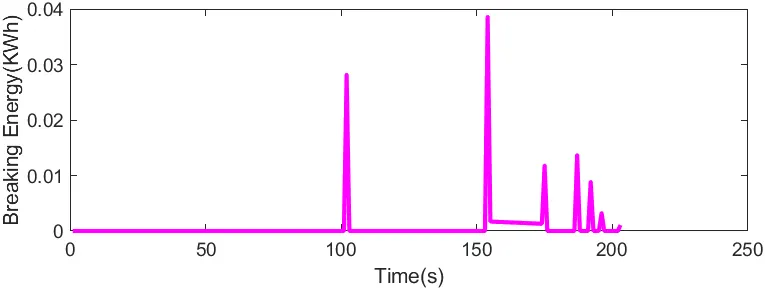
above response shows breaking energy vs time graph.
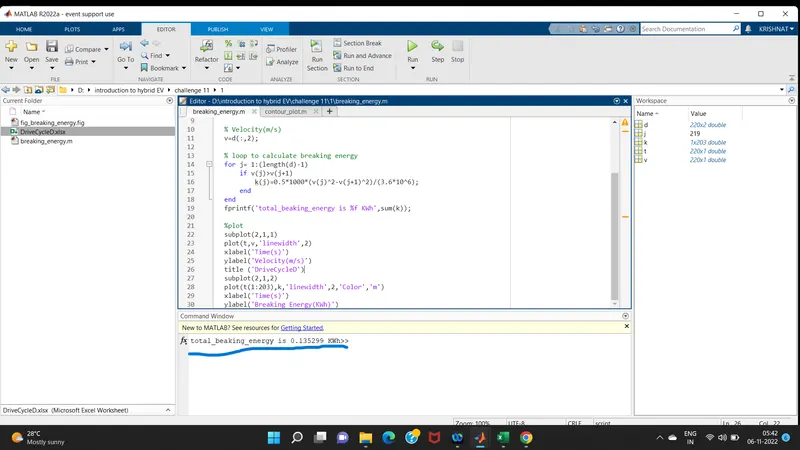
so for a defined drive cycle ,the total breaking energy is 0.135299 KWh.
Que 2) Explain why electric motor can not develop braking torque at high speed similar to starting and also explain how electric and mechanical brakes are coordinated.
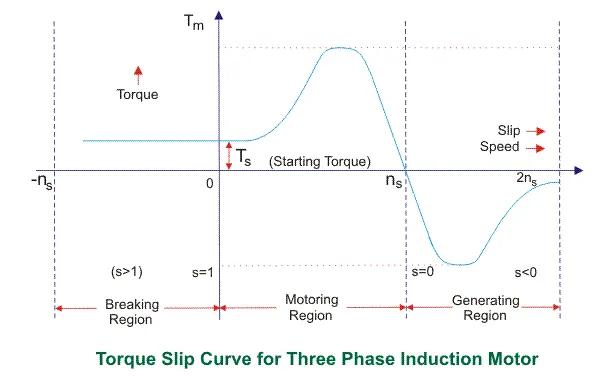
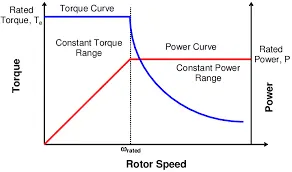
during acceleration the motor requires an initial torque raises from zero to higher speed but on the other hand during deceleration ,the motor which is already running at higher speed and also at higher torque will be again able to develop further torque ,above curve explains this.
at low speed ,the vehicle has constant torque region where higher acceleration is possible.
at high speed ,the vehicle has constant power therefore it is easily getting top speed.
for braking when compared with forward motoring,the power required varies,at peak the torque required for forward motoring isnt equal to reverse motoring therefore electric motors can not develop braking torque at high speed similar to starting.
when a cuttent flowing in the electric motor, a related electric charge causes armature to rotate.when this armature rotates then the electromagnetic field induces,this internal magnetic field called back-emf which opposes the supply voltage.
this back-emf to be equivalent to natural braking force,much like an IC engine.
from this above graph we can plot speed-torque characteristics of induction motor.
at low or zero speed .the torque is very high and called as constant torque region.so in this region for a typical speed of motor operation ,the torque produced is constant.
torque curve is gradually dropped at rated speed and enters the constant power region .so in this region the braking torque produced is very low so the motor is not able to create maximum torque while braking.
Co-ordination of mechanical and electric break-
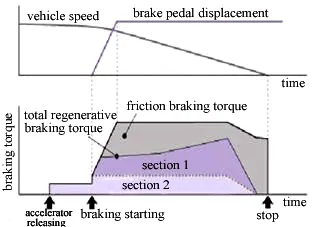
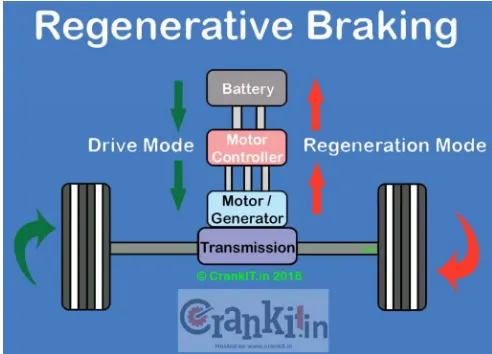
for smooth and easy braking experience ,blending of electric and mechanical break is essential.
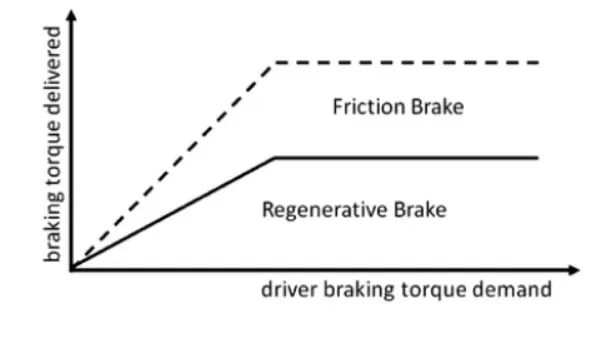
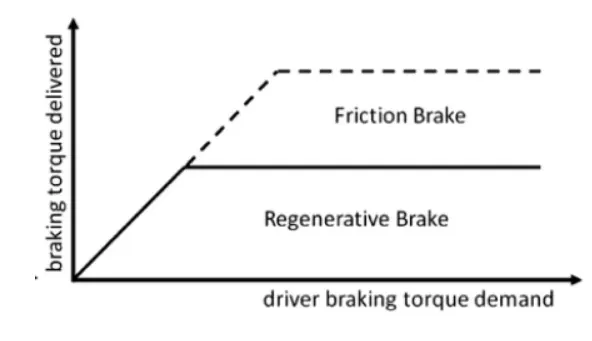
at lower deceleration levels,the required breaking can be achieved with electrical torque .
at higher deceleration levels the blending workload increases and there is sharp changes in electrical torque which causes friction so there is some difficulty happening in this.
so for desire breaking ,there is requirement of proper coordination of mechanical and electrical break is very important.
for that electric and mechanical break are connected in parallel or series connection.most hybrid vehicles uses an electrohyadraulic system for achieving required breaking.
pressure sensors reads applied force on break pedal which transmits a signal to break control unit.this control unit calculates desired friction to regenerative ratio.since when the control parameters is changing,feedback system is also provided.
According to friction to regenerative ratio,control unit generates return signal and breaks performs their individual task.
conventional braking=
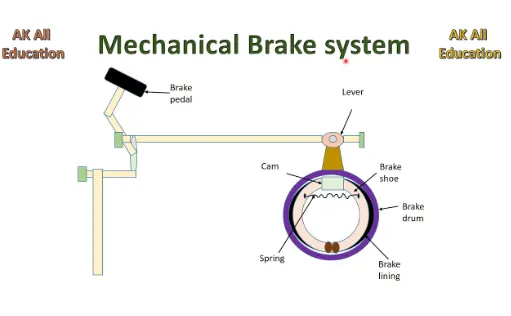
when the brake pedal is applied then conventional brakes consist of basic hydraulic system sends fluid to each wheel.
it is the combination of mechanical components to increase the force on the drums or the rotors.if we press the brake pedal to activate the brakes then vehicle goes to a stop.
Regenerative braking=
when electric motors runs as a generators that is used as a reverse function then it will convert mechanical energy into electrical energy.when motor using regenerative braking then the vehicles propelled by electric motors use them as a generators,braking by transferring mechanical energy from the wheels to an electrical load.
for better optimization ,these two brakes can be combined.so they are parallel regenerative braking and series braking system.
1) parallel regenerative braking system
in this braking,the frictional brakes and regenerative braking operating together. it has a lower ratio of recuperation that is regenerative braking is absorbed less.
this type braking system has both electrical and mechanical braking system which produces braking force in parallel and simultaneously this kind of braking system has a conventional mechanical braking which has a fixed ratio of brake force on front and back wheel.
electrical braking adds additional force on the front wheels.
2) series braking system=
series braking system consist of a brake controller which controls the braking forces on the front and rear wheel.
for minimizing the stopping distance and giving optimized feel to driver we use this strategy of series braking system and this requires brake force on the front wheel and rear wheel to follow ideal brake force distribution.
the principle of series braking system is to recover the braking energy as much as possible in the condition of meeting the total breaking force for a given deceleration.
in this before the frictional braking ,the regenerative braking starts to operate and as compared with parallel braking the regeneration is increased.
it is operated on passenger comfort and energy conversion efficiency.
Que 3) Make a MATLAB program which plots contour of given motor speed,torque and efficiency values.Attach the code as a .m file , attach a screenshot of all the plots.
ANS=
The losses in the motor are classified as follows=
1) copper loss-
it is also called variable loss and changes as load varies.
they are calculated by I^2*R loss.torque is proportional to the current .So the copper loss is
Copper loss= Kc*T^2
2) Iron loss-
it is also called constant loss and it occurs due to magnetic losses.
iron loss= Ki*w
3) Windage loss=
this loss occurs due to the friction between air and the rotor.
So, Windage Loss=Kw*w^3
4) Constant Loss=
this loss in the motor are considered as C.
Total Loss = (Kc*T^2) + (Ki*w) + (Kw*w^3) + C
Output power is nouthing but product of torque and velocity.
Po=T*w
So, output power + Losses = Input Power
therefore ,
Pi= Po +(Kc*T^2)+(Ki*w) + (Kw*w^3)+C
the MATLAB code is =
clc;
clear all;
V=linspace(1,1000); % Velocity
t=linspace(1,300); % torque
Kc=0.25; % Copper loss coefficient
Ki=0.007; % iron loss coefficient
Kw=0.00002;% Windage loss coefficient
C= 20; % Constant loss
[W,T]= meshgrid(V,t);% 2D array
Po= W.*T; %Output power
CL= Kc*(T.^2); % Copper loss
IL=Ki*W; % Iron loss
WL=Kw*(W.^3); % Windage loss
Pi= Po+CL+IL+WL+C; %Input power
Efficiency = Po./Pi ;
S=[0.7,0.74,0.78,0.82,0.86,0.90,0.91,0.92,0.93,0.94,0.95,0.96];%Efficiency scale range
% plot
contourf(W,T,Efficiency,S)
colorbar
xlabel("Speed(rpm)");
ylabel("torque(Nm)");
title("Motor efficiency");
output response=
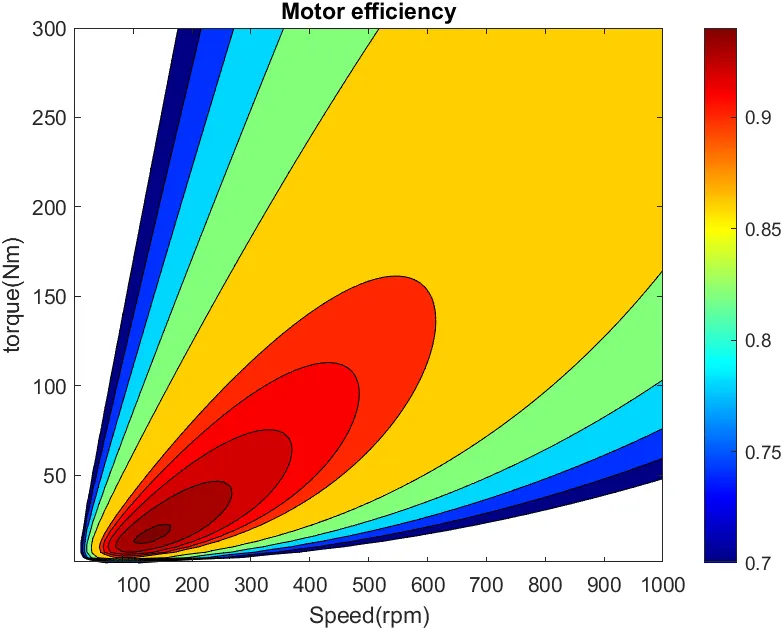
the motor efficiency is shown in below contour plot with speed and torque.
from this plot,it is clear that ,the efficiency of the motor is more in the center (red region),gradually decreases efficiency as to move away from the center.
Conclusion=
1) For a defined drive cycle ,the total breaking energy is 0.135299 KWh.
2) Explained why electric motor can not develop braking torque at high speed similar to starting and also explained how electric and mechanical brakes are coordinated.
3) From a MATLAB program ,Contour response plotted of given speed,torque and efficiency values.From this plot,it is clear that ,the efficiency of the motor is more in the center (red region)