Week-11 Challenge: Braking
Problem 1
AIM : For a defined driving cycle, calculate the energy required for braking
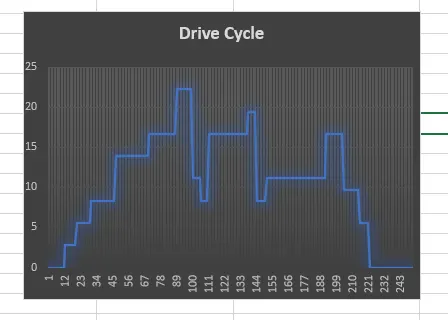
For the defined drive cycle with its time(s)and velocity(m/s).The driving time has took 250sec and with its velocity considaration .In the excel sheet the table as been shown
The equation for kinetic energy from braking is given as,
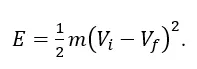
Where,
m = Mass of the vehicle in Kg.
Vi = Initial speed of the vehicle in m/s.
Vf = Final speed of the vehicle in m/s.
From the drive cycle 09 braking points were obtained. The mass is set at a constant 1500 Kg. The energy required for braking is given in the table below.
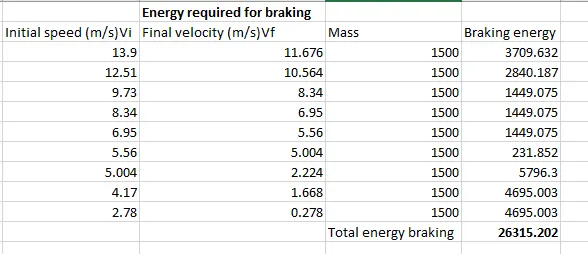
Therefore the total energy required for braking is 26.315 KW.
The excel sheet file of the drive cycle and braking data is the excel sheet.
Problem 2
Aim : To Know about why electric motor cant develop braking torque at high speed similar to starting
Here the electric motor cant develop brakingtorque at high speed similar to starting,because the braking torque of an ev motor is not as similar as the acceleration torque.
Therefore Regenerative breaking is cannot happened so effectively that we can get all the power back to the battery.
Brake torque in an electric motor
The brake torque is the force appiled at the brake wheel to stop the motion of the velhicle .Assuming that the operation conditions for the equipment are constant ,a brake having retarding torque equal to the full load torque of the motor to iwhich it is applied is usually satisfactory.
Brake torque is essentially the power of the braking system.The brake caliper acts on the disc at a certain distance from the hub center ,known as the effective radius.The force exerted by the caliper ,multiplied by the effective radius of the system equals the brake torque.
Braking torque is required to overcome the external forces additional braking torque is required to stop all the moving parts in the machine
Regenerative Braking
In the regenerative braking,the motor acts as a generator .The back emf is more than the terminal voltage in case regenerative braking.This type of breaking is the best electrical braking among all bracking techniques.
By connecting in the way of back emf Eb can be made greater than V and can run as a generator and torque geta reversed and speed falls till Eb becomes less than V. Hence in this way the regenerative breaking is done on dc series motor.
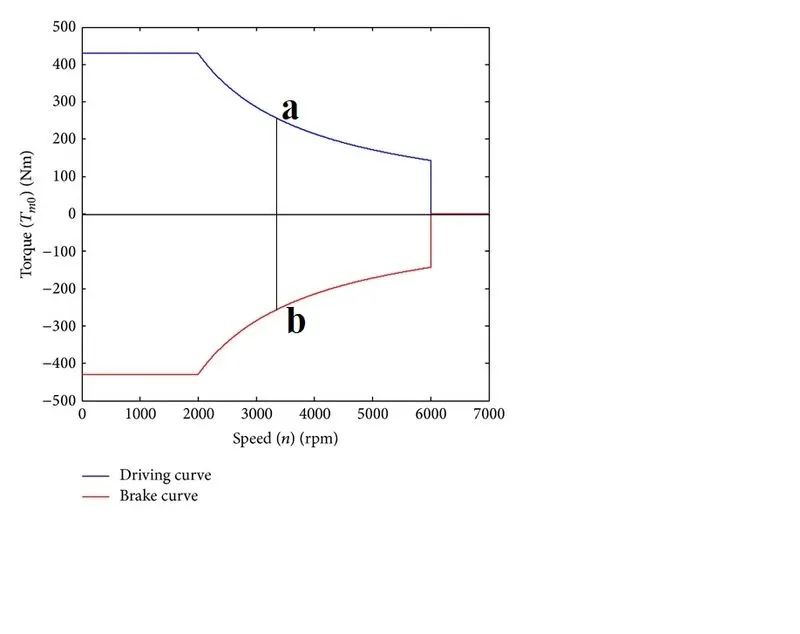
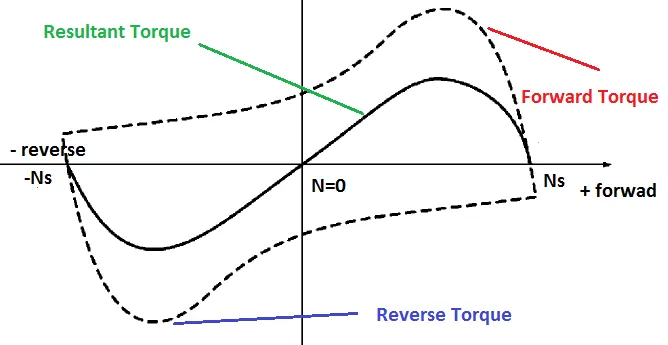
the below plot shows the speed-torque characteristics of the induction motor from the plot we can conclude the following results:
- when you observe the drive curve you can notice that starting torque is around 420(Nm) at speed= 0 (rpm), this indicates there is maximum torque supply during the staring of the vehicle.
- upto till 2000 rpm of speed the torque is maximum and constant because even the voltage is increasing with an increase in frequency beyond this point the voltage stops increasing beyond the rated value and hence the torque starts to decrease but with increasing frequency the speed increases.
- braking characteristics are just symmetrically opposite as shown below. we can observe that at higher speed the torque supply decreases from the motor i.e the torque is reduced to 300 (Nm) from 420(Nm) here the negative signs indicate that the torque is in opposite direction to the movement of the vehicle.
- the vertical line from 'a' to 'b' indicates that there is braking at 3200 rpm, here the torque demand is very high because the speed is more, and hence more force is required to stop the vehicle but from the plot, we can observe that the torque supply is low.
from the above points, we can conclude Why an electric motor can’t develop braking torque at a high speed similar to starting.
How electric and mechanical brakes are coordinated:
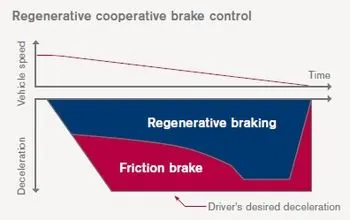
we now know that an electric motor can’t develop braking torque at a high speed and therefore an alternative as to be done to provide the required torque demand for the braking can be done using the mechanical brakes. and hence the electric and mechanical brakes are coordinated as follows:
- from the image given below, we can observe that whenever the speed is high in order to meet the torque demand for braking we are using mechanical brakes like frictional brakes to slow down the car.
- when the speed is low torque demand for braking is low and hence there will be no need for mechanical braking the whole torque is provided by the regenerative braking.
to implement the above idea there are two methods:
series: in this case at each instance there will be one kind of braking in use that is it can be mechanical or electrical depending on the speed of the vehicle.
parallel: in this case at each instance there will be both kinds of braking in use that is mechanical and electrical depending on the speed of the vehicle.
Problem 3
Aim In order to plot the contour of given motor speed, torque, and efficiency values.
We have the below motor losses coefficient
Copper losses coefficient (kc)= 0.2
iron losses coefficient (ki)= 0.008
windage losses coefficient (kw)= 0.00001
constant losses (C)= 20
The losses are given by
Copper loss = kc*T^2
Iron loss = ki*w
windage loss = kw*w^3
Where T = Torque; w = Speed
The total power loss is given by
Total loss = Copper loss+Iron loss+windage loss+constant losses
hence
Input power = output power+total losses
Efficiency is given by
Effeciency= output power/input power
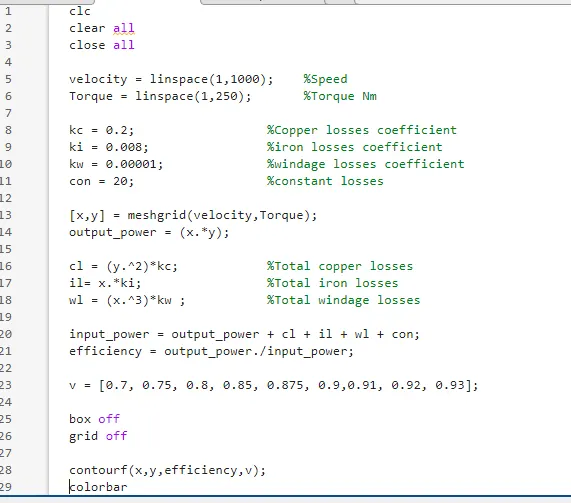
we have used all the above equations to plot the contour of the given motor.
The matlab Programme
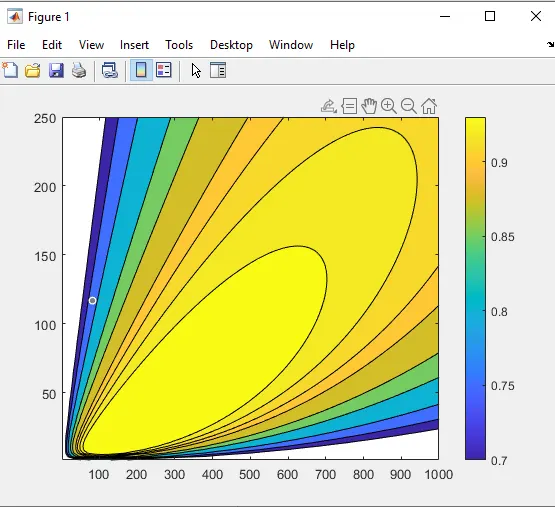
The above plot, it is clear that the max efficiency of 93% is achieved at Speed 691.2 rad/sec and Torque 126 nm.
The lowest efficiency of 69% is achieved at Speed 61.54 rad/sec and torque 131.768nm.