Week-6 Challenge: EV Drivetrain
Problem 1
Aim : The types of power converter circuits are employed in electric and hybrid electric vehicle
Introuction
About Electric Velhicle
Electric vehicle is a velhicle that uses one or more electric motors for propulsion.It have low running costs as they have fewer moving parts for maintenance and also very environmentally friendly as they use little or no fossil fuels(petrol or diesel). it can be powered autonomously by a battery (sometimes charged by solar panels.
While some Evs used lead acid or nickel metal hydride batteries,the standard for modern batterie electric velhicle its now considered to be lithium-ion batteries as they greater longitivity and excellent at retaining energy.
About Hybrid Electric velhicle
It is a type of hybrid velhicle that combines a conventional internal combustion engine (ICE) system with an electric propulsion system (hybrid electric velhicle drivetrain).
The presence of the electric powertrain is intended to achieve either better fuel economy than a conventional velhicle or better performance.
It's a type of automobile in which power to wheels is provided by both engine and eletric motor. Engine uses fuel (petrol/diesel) and electric motor uses electricity from traction battery to power the wheels.
Power converter circuits are employed in electric and hybrid electric vehicle
In the context of Hybrid Electric Vehicle, the DC-DC power converters are the electronic devices that condition the source voltage of one level to the output voltage of another level of different DC voltage based on the application provided for the electric vehicle for charging and discharging modes
In Electric and Hybrid Electric Vehicles (EV/HEV), the power electronic converters are considered as the key elements that interface their power sources to the drivetrain of the EVs. In order to design highly efficient converters for the EV’s power system, advanced DC/DC and DC/AC converters are required to adapt the output voltage and current levels with high power quality.
The 3 types of converters which are widely used in an Electric Vehicle are:
- AC-DC converter (on board charger)
- DC-DC converter
- DC-AC converter(inverter)
AC-DC converter (on board charger)
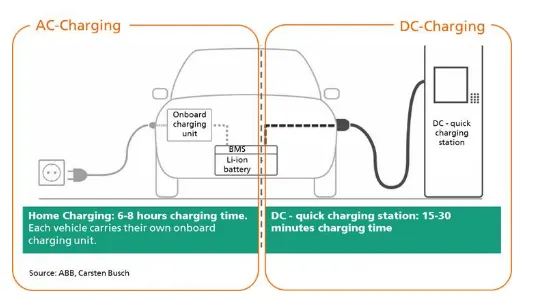
AC to DC converters are most commonly used in Plug-in Hybrid Electric Vehicles (PHEV) & Plug-in Electric Vehicles (PEV).
These vehicles get their propulsion power from an external electricity source (charging stations) which is alternating current.
The battery needs to be charged using a direct current source. For this purpose, AC to DC converter is employed in a PHEV & PEV.
DC-DC converter
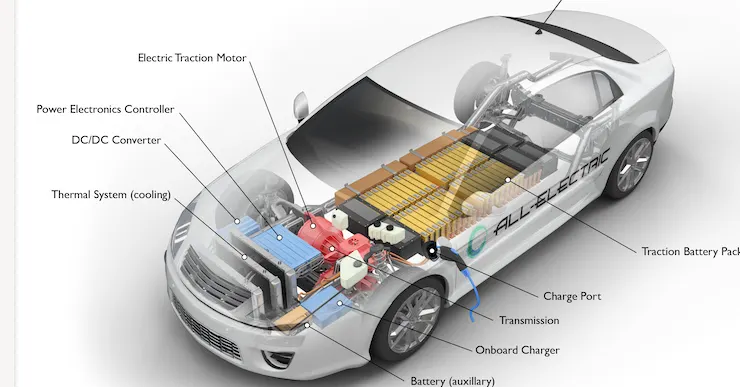
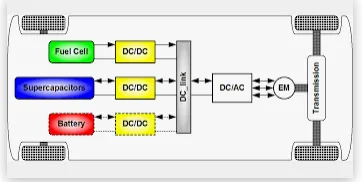
DC-DC converters can be used to interface the elements in the electric power train by boosting or chopping the voltage levels.
By introducing DC/DC converters one can choose the voltage variation of the devices and the power of each device can be controlled.
The power of the DC/DC converter depends on the characteristics of the vehicle such as top speed, acceleration time from 0 to 100 Km/h, weight, maximum torque, and power profile (peak power, continuous power).
While DC/DC converters can be based on a number of different designs, the underlying function remains the same. We might be talking about a step-up converter, which turns a low-voltage input into a high-voltage output, or a step-down converter, which does the opposite.
The batteries of an electric vehicle typically output several hundred volts of DC. The electric components inside the vehicle, however, vary in their voltage requirements, with most running on a much lower voltage.
Significance of DC-DC converter
DC-DC converters in an electric vehicle may be classified into unidirectional and bidirectional converters.
Unidirectional DC-DC converters cater to various onboard loads such as sensors, controls, entertainment, utility, and safety equipment.
They are also used in DC motor drives and electric traction. Bidirectional DC-DC converters find applications in places where battery charging, regenerative braking, and backup power are required.
DC-AC converter(inverter)
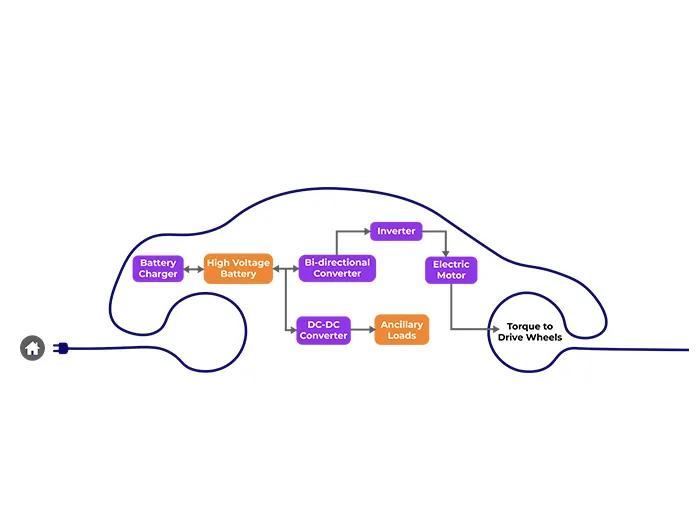
An inverter is a device that converts DC power from the battery to AC power in an electric vehicle motor. The inverter can change the speed at which the motor rotates by adjusting the frequency of the alternating current.
Significance of DC-AC converter (inverter)
The use of inverters can increase or decrease the power or torque of the motor by adjusting the amplitude of the signal.
It plays a significant role in capturing energy from regenerative braking and feeding it back to the battery. The key component is that it has a direct impact on on-road performance, driving range, and reliability of the vehicle also as a consequence of their weight and size.
The output voltage waveform of ideal inverters should be sinusoidal. However, the waveform of practical inverters is non-sinusoidal and contains certain harmonics.
Problem 2
Aim : To find out the EV steady state speed if duty cycle is 70%
The given data
The battery back up for an Electric velhicle=72V
Rated Armature voltage= 72 V
Rated armature current= 400 A
Armature Resistance Ra= 0.5Ω
KΦ= 0.7 Volt second
Chopper Switching frequency= 400 Hz
Vehicle Output Voltage (Vv) is given by: -
Vv = Battery Voltage (V) * Duty Cycle
Vv = 72 * 0.70
Thus, Vehicle voltage = 50.4V
Now, Equation for Vehicle torque is given by: -
Tv=(Vv−ω.K∅)⋅K∅/Ra
Where;
Tv= Vehicle Torque (N-m)
Vv= Vehicle voltage (Volts)
ω= steady state speed of vehicle (rps)
K∅= Motor constant
Ra= Armature Resistance
Substituting all these values in equation, we get:
Tv=(50.04−0.7⋅ω)⋅0.7/0.5
Tv=70.56−0.98⋅ω
Tv=24.7+0.0051⋅ω2
Solving these two equations,
70.56−0.98⋅ω=24.7+0.0051⋅ω2
We get a quadratic equation:
0.0051⋅ω2+0.98⋅ω−46.94=0
Since quadratic equation, we get two values of ;
ω= 38.85 rad/s and ω = -230.95 rad/s
We take the positive value;
Steady state speed of vehicle = 38.85 rad/s
Therefore EV steady state speed if duty cycle at 70 =38.85rad/s
Problem 3
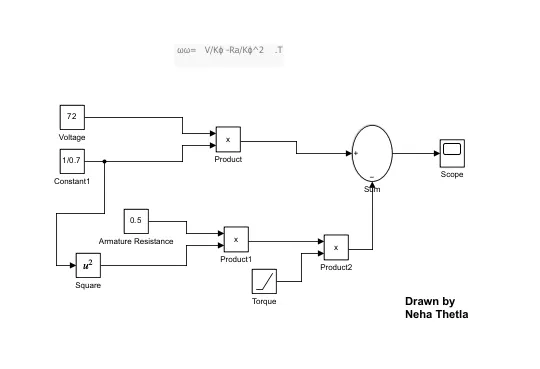
Given equation
ω= V/Kϕ -Ra/Kϕ^2 .T
Simulink Block
Voltage battery pack V=72v
Constant (k)=0.7
Armature Resistance =0.5ohms
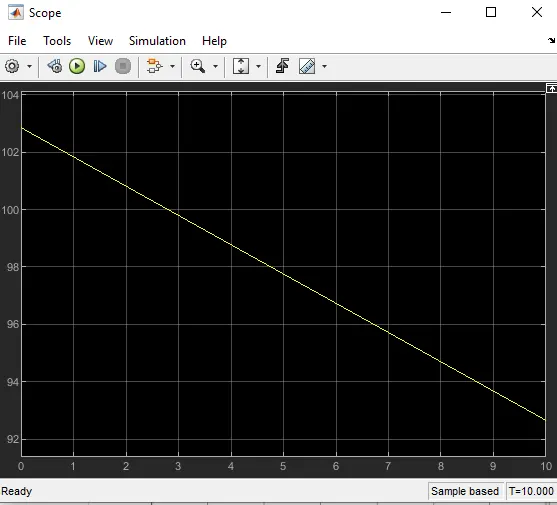
Torque speed
Problem 4
Aim To explain briefly about author’s perspective.
- In the beginning, author describes the dominance of Internal Combustion Engines (ICE) in the world of automobile industry and also discuss different types of engines.
- He explains that all engines were similar and it was up to the user to select according to their requirement.
- He also speaks about induction motor and brushless DC motors and presents his view that these two technologies will be widely used for the coming years.
- Then he explains the working of both 3-phase induction motor and a brushless DC motor .
- The author has done comparison between these two technologies and stated some advantages and disadvantages of each.
- Induction motor have some advantages like,it has no magnets. The motor has the ability to start under load. No inverter is needed. Some disadvantages of Induction motors are: They cannot operate from DC; AC is a must. Shaft speed is proportionate to line frequency. Hence, when used with utility power, they are constant speed machines.
- When operated from utility power, they have limited starting torque and somewhat limited running peak torque capabilities, when compared to DC type machines.
- Brushless DC motor have some advantages like: much less rotor heat is generated with the DC brushless drive. The peak point energy efficiency for a DC brushless drive will typically be a few percentage points higher than for an induction drive.
- Some disadvantages of Brushless DC motor are: as machine size grows, the magnetic losses increase proportionately and part load efficiency drops.
- Permanent magnets are expensive and difficult to handle due to very large forces that come into play when anything ferromagnetic gets close to them.
- Finally the author couldn’t choose which drive is better than the other but makes it clear that DC brushless drives will likely continue to dominate in the hybrid and coming plug-in hybrid markets, and that induction drives will likely maintain dominance for the high-performance pure electrics.
| DC brushless | Induction Motor |
| efficiency is low | efficiency is high |
| These are easy to control | The control laws are more complex and difficult to understand, so difficult to control |
| It has Less rotor heat is generated | It has higher than compared to Dc brushless |
| It operates at unity power factor | It operates power factor at about 85 % |
| Rotor cooling is easier and peak point efficiency higher. | peak point efficiency higher compare to DC Brushless |
| Permanent magnets are expensive | There is no magnet there is advantage in cost |
Conculsion
1 Have been explaned the types of power converter circuits are employed in electric and hybrid electric vehicle
2. By calculating with the help of Equation the Electric Velhicle steady state speed if duty cycle at 70%=38.85rad/sec.
3. Therefore by using the mathematical model of a DC Motor for the given equation has been shown using Simulink.
4.And finally expressed the brief information about author’s perspective(Induction Versus DC brushless motor).