Week-11 Challenge: Braking
1. Energy required for braking:
Indian drive cycle is created in excel using time(s) and speed(m/s) datas. The braking energy is calculated using,
Braking energy=1/2*m*(vi-vf)^2
where,
m-mass of the vehicle
vi-initial velocity
vf-final velocity
The mass of the vehicle is assumed as 1000kg.
Braking energy Calculation is performed using excel. The braking time and velocity of the IDC are highlighted.
Therefore, from the calculation it is found that the total braking energy required for 1 cycle of IDC(108 secs) is 5627.032J. Hence, interms of kwhr it is obtained as 0.0015631kwhr.
For 10 cycles of IDC it is obtained as 0.15631kwhr.
Excel file is attached for reference.
2.
Peak torque for acceleration and peak torque for deceleration are not equal in an electric vehicle motor. Therefore, the peak torque during acceleration is different from the peak torque during braking or deceleration. Acceleration is typically greater, and while the torque increases at low speeds, it decreases at high speeds. Therefore, the torque value is never compromised or reduced when operating the motor in a field-weakening region or over base speed. Since, the braking torque of an EV motor is lower than the acceleration torque, it cannot provide braking torque at high speeds equivalent to starting. As a result, regenerative braking cannot occur with a level of efficiency that allows us to fully recharge the battery.
Electric Braking
In electric braking, the kinetic energy of the moving parts of the motor is converted into electrical energy which is either dissipated in a resistor or returned to the supply source. Thus, electric braking is a system of braking in which a braking action is applied to an electric motor by causing it to act as a generator.
Mechanical Braking
Mechanical brakes are applied by brake shoes which are pressed with force against the wheel of the train. In mechanical braking, the braking force is generally produced by means of piston-cylinder arrangement. The movement of the piston is transmitted to the brake shoes through a system of levers.
Electrical and mechanical braking systems are coordinated by using a Brake strategy subsystem
1) Serial Braking Strategy
2) Parallel Braking Strategy
In case of Series, Mechanical brake and Regenerative electric brake are applied one after another. But in parallel, only one brake strategy is applied at a time either electric or Mechanical brake. The Series Brake Control Strategy is further classified based on the comfort of driver or Brake behavior compared to energy efficiency. Electric Driven Intelligent Brake (EDIB) is a combination of Hydraulic brake or Mechanical brake along with an electric brake. It is a Parallel braking technique, which uses Control strategy such that the electric braking is used at low speed and for high speed braking or during intial braking period, both the braking techniques can be combined.
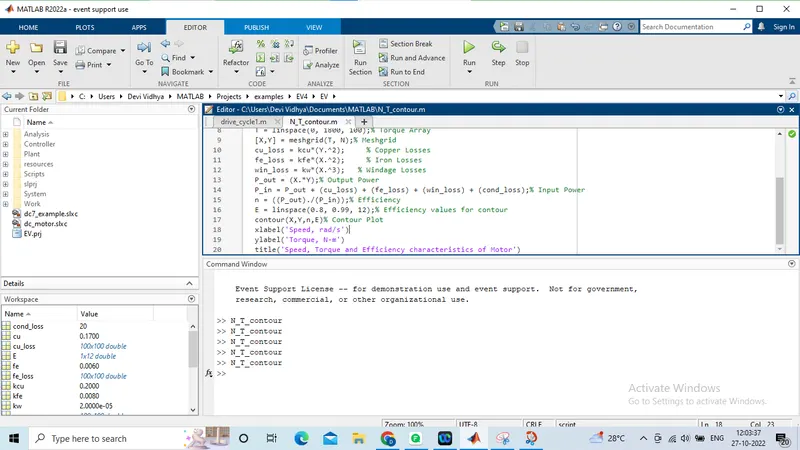
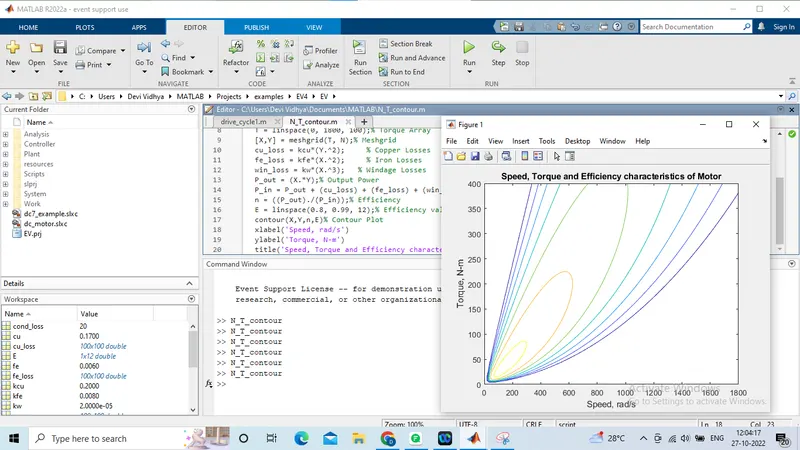
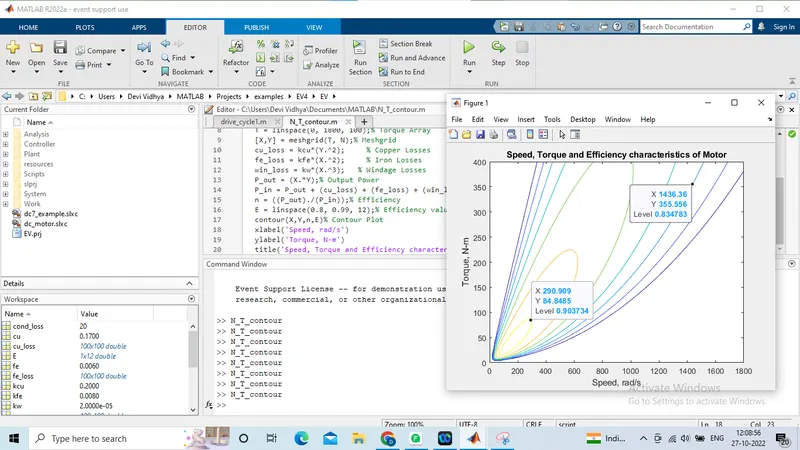
3. MATLAB program to plots contour of given motor speed, torque and efficiency values.
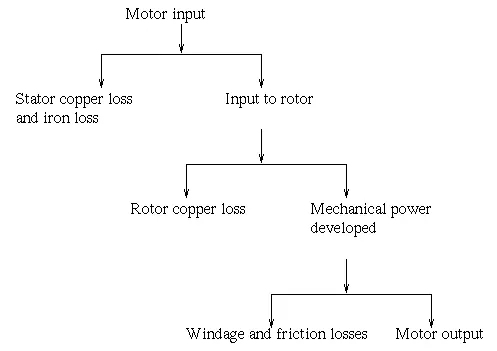
The efficiency of the motor is given by

The various losses that occur in the motor’s operation are
- Copper losses
- Iron losses
- Windage losses
- Conduction losses
These losses are dependent on the speed(N in rad/s) and the torque(N-m) of the motor and also have a characteristic constant of proportionality which is assumed as 'K'.
- Copper losses = KCu⋅N^2
- Iron losses =KFe⋅T^2
- Windage losses =Kw⋅T^3
Conduction losses are assumed as 18 J.