Week-11 Challenge: Braking
1.For a defined driving cycle, calculate the energy required for braking.
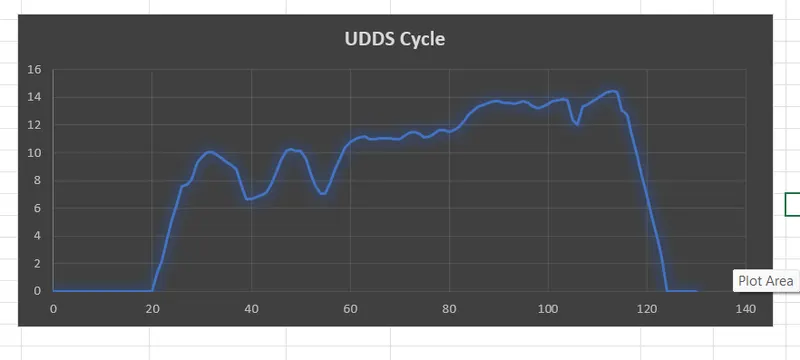
The driving cycle taken into consideration is the UDDS cycle which stands for Urban Dynamometer Driving Schedule. Although the data is taken for a total driving time for 130s is considered. The speed which is in miles per hour has been converted to meters per second.
The drive cycle is given below.
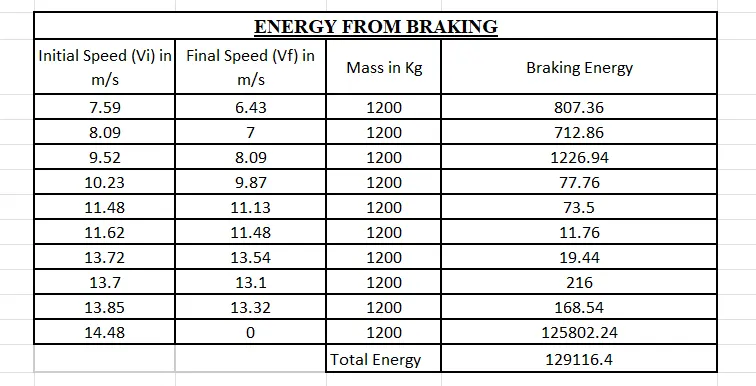
Therefore the total energy is consume for braking is 12.91kw.
The equation for kinetic energy from braking is given as,
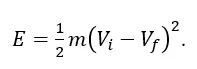
Where,
m = Mass of the vehicle in Kg.
Vi = Initial speed of the vehicle in m/s.
Vf = Final speed of the vehicle in m/s.
From the drive cycle 10 braking points were obtained. The mass is set at a constant 1200 Kg.
2.Why electric motor can’t develop braking torque at high speed similar to starting? How electric and mechanical brakes are coordinated?
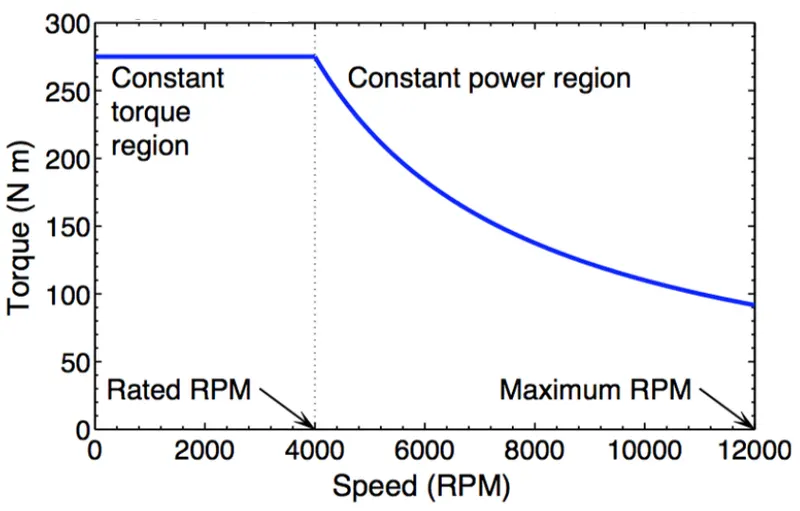
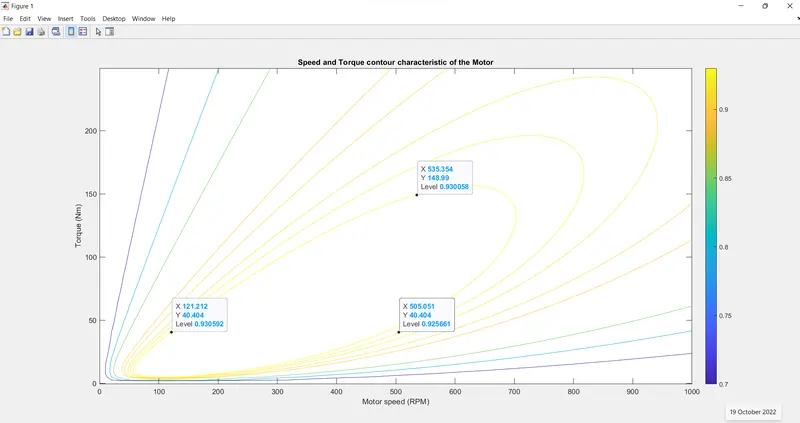
Above figure ahowa the speed torque characteristic of the motor. From this curve we have two region, constant torque and constant power region. At the start the motor achieves peak torque till it reaches a certain motor speed range from where it will rapidly drop. The reason due to the drop in torque is due to the motor shaft reaching critical speed and the area where the peak torque is constant is known as the constant torque region of the motor. The region where the torque decreases is known as the constant power region as the power generated by the motor will be at it's peak. From this we can concluded that as the speed incereases torque decreases after the critical speed region.
Since the torque produced at the constant power region is very low, it is not possible to develop enough braking torque in this region. The braking torque produced increases as the speed decreases.
Electric and Mechanical brake coordination:
There are mainly 2 ways by which the Electric Vehicles could be braked:
- Series- Regenerative braking and mechanical braking both are applied one after another.
- Parallel- Regenerative braking and mechanical braking both are applied simultaneously.
When brake pedal is pressed the hydraulic fluid reaches the brake pistons and created the braking pressure on the wheels and the same kinetic energy is been used by the Regenerative Braking for generating more power using the Bi-directional motor which operates as a generator while braking.
3.Make a MATLAB program which plots contour of given motor speed, torque and efficiency values. Attach the code as a .m file attach a screenshot of all the plots.
clear all
close all
clc
% The Torque and Velocity Range of the motor
Torque = linspace(0,250);
Velocity = linspace(0,1000);
% copper Loss constant
kc = 0.2;
% Iron loss constant
ki = 0.008;
% windage loss constant
kw = 0.00001;
% constant motor loss
c = 20;
% Creating 2D Array for torque & velocity
[X,Y] = meshgrid(Velocity,Torque);
output_power = (X.*Y);
% Loss calculations
copper_losses = kc*(Y.^2);
Iron_losses = (X).*ki;
Windage_losses = (X.^3)*kw;
% Power and Efficiency calculations
Input_power = output_power + copper_losses + Iron_losses + Windage_losses + c;
Efficiency = output_power./Input_power
% Efficieny curves values range
V = [0.70,0.80,0.85,0.90,0.91,0.92,0.925,0.93]
% Plotting the Contour for Speed, Torque and Efficiency
box off
grid off
contour(X,Y,Efficiency,V);
colorbar
xlabel('Motor speed (RPM)');
ylabel('Torque (Nm)');
zlabel('Efficiency');
title('Speed and Torque contour characteristic of the Motor' )
Here the speed torque contour characteristic of the motor shown below.