Week-11 Challenge: Braking
1. For a defined driving cycle, calculate the energy required for braking.
Kinetic energy is the energy an object possesses due to its motion. It's the energy that an object has because it's moving. This energy is directly related to the object's mass and its velocity speed and direction.
KE = ½ mv^2
KE – kinetic Energy
M-Mass
V-Velocity
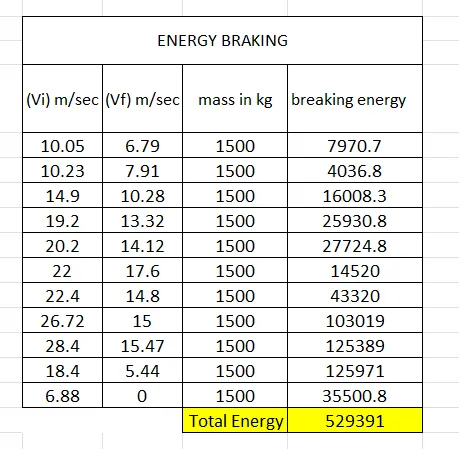
The total energy required for braking is 529.39 KWhr.
2. Why electric motor can’t develop braking torque at high speed similar to starting? How electric and mechanical brakes are coordinated.
Electric motors particularly those used in vehicles exhibit certain limitations when it comes to developing braking torque at high speeds compared to the initial or low speed scenarios.
Electric Motor Braking Limitations at High Speed
Back EMF (Electromotive Force):
In an electric motor, back EMF increases with speed. Back EMF is the voltage generated by the motor's rotation that opposes the applied voltage. At high speeds this back EMF can almost match or exceed the supply voltage reducing the effective voltage available to generate braking torque.
Torque-Speed Characteristics:
Electric motors are especially induction or permanent magnet motors typically generate maximum torque at lower speeds. As speed increases the available current for generating torque decreases due to factors like power electronics and inverter limits which can reduce braking performance at high speeds.
Regenerative Braking Efficiency:
Regenerative braking, a common form of electric braking is more efficient at moderate speeds where enough energy can be harvested. At very high speeds capturing energy becomes less efficient and the system might not be able to provide strong braking force.
Coordination of Electric and Mechanical Brakes
To provide effective braking across a wide range of speeds, modern electric and hybrid vehicles use a coordinated braking system that blends both electric regenerative and mechanical braking.
Brake-by-Wire System:
Many vehicles use brake-by-wire technology, where electronic signals control the braking force instead of a direct mechanical connection. This allows precise distribution between regenerative and friction brakes based on factors like speed desired braking force and available energy regeneration capacity.
Deceleration Control:
At lower speeds electric brakes regenerative braking are often prioritized to maximize energy recovery. As the vehicle speed increases the regenerative braking contribution gradually decreases due to the limitations mentioned earlier.
Transition to Mechanical Brakes:
When high braking forces are needed or regenerative braking is insufficient the mechanical brakes friction brakes take over. This transition is seamless ensuring the total braking force remains consistent with the driver's expectations.
Blended Braking Algorithms:
Modern systems use algorithms to decide how much of the braking should be regenerative and how much should be mechanical at any given moment. These algorithms consider factors like battery state of charge to prevent overcharging during regeneration vehicle speed brake pedal position and available motor torque.
Anti-lock Braking System (ABS) and Stability Control:
Mechanical brakes often integrate with systems like ABS and Electronic Stability Control (ESC) to maintain vehicle control. During emergency braking or low-traction situations the mechanical brakes can modulate more effectively than electric braking systems alone.
3. Make a MATLAB program which plots contour of given motor speed, torque and efficiency values. Attach the code as a .m file attach a screenshot of all the plots.
From the plot it can be observed that the speed and torque vary as the efficiency increases. This is due to the motor losses that occur. The dark blue line represents the contour 70% efficiency and the bright yellow line represents the contour 93% efficiency.
For example, at 70% efficiency, the torque reaches its peak value of 250 N-m when the vehicle is a very low speed but the torque decreases significantly as the speed increases for the same efficiency. And at a motor efficiency of 93% the speed and torque required is much less compared to an efficiency of 70%. Greater the motor efficiency, lower speed-torque combination is required to overcome the motor losses.