Week-11 Challenge: Braking
QUESTION 1:
AIM: To calculate the energy required for braking for a defined driving cycle?
In electric vehicle it is important to accelerate the vehicle and deacceleration also very important to stop the vehicle.If vehicle in a motion purticular speed we are unable to stop the vehicle beacuase of the moment of inertia so in that purpose we need break.In any vehicle the breaking is very important thing to stop the vehicle Braking of vehicle require to deaccelerate the vehicle to lower speed within a given time.
DRIVING CYCLE:
A driving cycle commonly represents a set of vehicle speed points versus time. It is used to assess fuel consumption and pollutants emissions of a vehicle in a normalized way, so that different vehicles can be compared.Driving cycles are important components for evaluation and design of vehicles. They determine the focus of vehicle manufacturers, and indirectly they affect the environmental impact of vehicles since the vehicle control system is usually tuned to one or several driving cycles.
TYPES OF DRIVING CYCLES:
Driving cycle is commonly classified in to two types they are,
1)Transient driving cycle
2)Modal driving cycle
ENERGY REQUIRED FOR BRAKING:
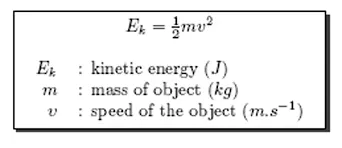
ENERGY FOR BRAKING=1/2*m*v^2
We all know that in vehicle the braking energy is the kinetic energy in units of jouls
WERE,
Ek=kinetic energy
m=total mass of the vehicle (vehicle mass+pay load) in unit of kg.
v=(intial velocity-final velocity) in unit m/s8
EXAMPLE:
for example if intial speed of a vehicle is 30 m/s and final speed is 25 m/s.the mass of the vehicle is 750 kg.then the required kinetic energy for braking is (1/2)*750*(30-25)^2=9375 J=9.375 KJ
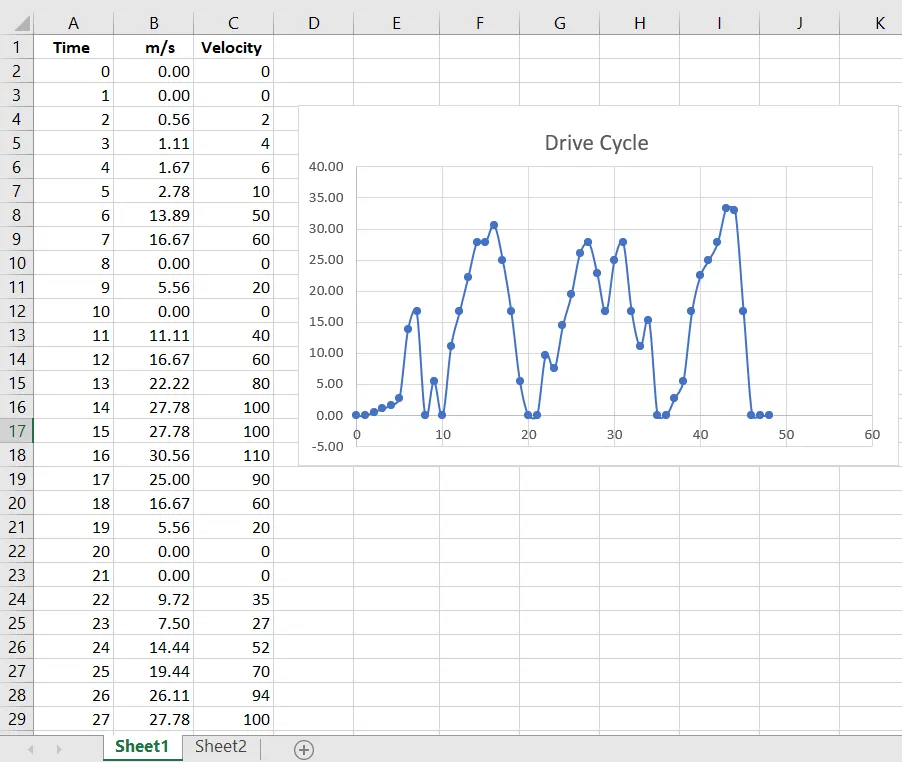
The above sheet is the energy requered for braking in each second of time for stop the vehicle or slowdown the vehicle for UDDS Driving cycle.
QUESTION 2:
AIM: Why electric motor can’t develop braking torque at high speed similar to starting? How electric and mechanical brakes are coordinated?
we know that electric motor cant develop the braking torque at high speed similar to starting of the motor.because Braking Torque of an EV Motor is not as high as the Acceleration Torque. Therefore Regenerative braking is cannot happen so effectively that we can get all the power back to the battery. The DC motor has high starting torque.In a series motor the same current flows through the armature and the field winding. The torque is therefore proportional to the square of the current. The current is set by the supply voltage and the back-emf generated in the armature.
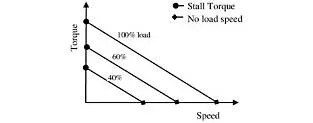
TORQUE VS SPEED CHARACTERISTICS OF MOTOR:
For observing the above torque speed characteristics we can unerstand that when a vehicle is in its maximum speed there is no choice of increase torque.for vehicle intial base speed the torque is maximum and in order to increase its speed the torque will be decrease the both characters in propotional in nature.The vehicle in its maximum speed we are unable to apply brakes according to the moment of inertia.the braking operation happens in the motion which is been distributed as per proportion in the brake energy and the regenerative braking.
TYPES OF BRAKES:
vehicle brakings are mainly classified in to two types they are,
1)Mechanical braking
2)electrical braking
MECHANICAL BRAKING:
The mechanical braking system is nothing but the hand brake or emergency brake. It is the type of braking system in which the brake force applied on the brake pedal is carried to the final brake drum or disc rotor by the various mechanical linkages like cylindrical rods, fulcrums, springs etc. In order to stop the vehicle.What are the types of braking systems? The mechanical braking system can be classified into the disc brake, hydraulic brake, power-assisted brake, air brake, and hand brake system.
DISC BRAKE:
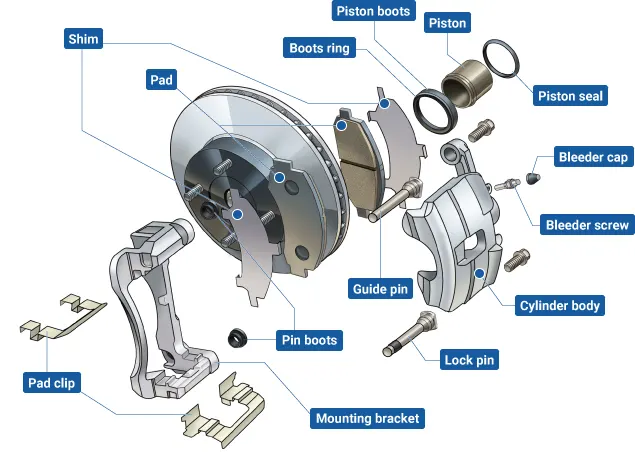
The brake rotor (disc) which rotates with the wheel, is clamped by brake pads (friction material) fitted to the caliper from both sides with pressure from the piston(s) (pressure mechanism) and decelerates the disc rotation, thereby slowing down and stopping the vehicle.
HYDRAULIC BRAKE:
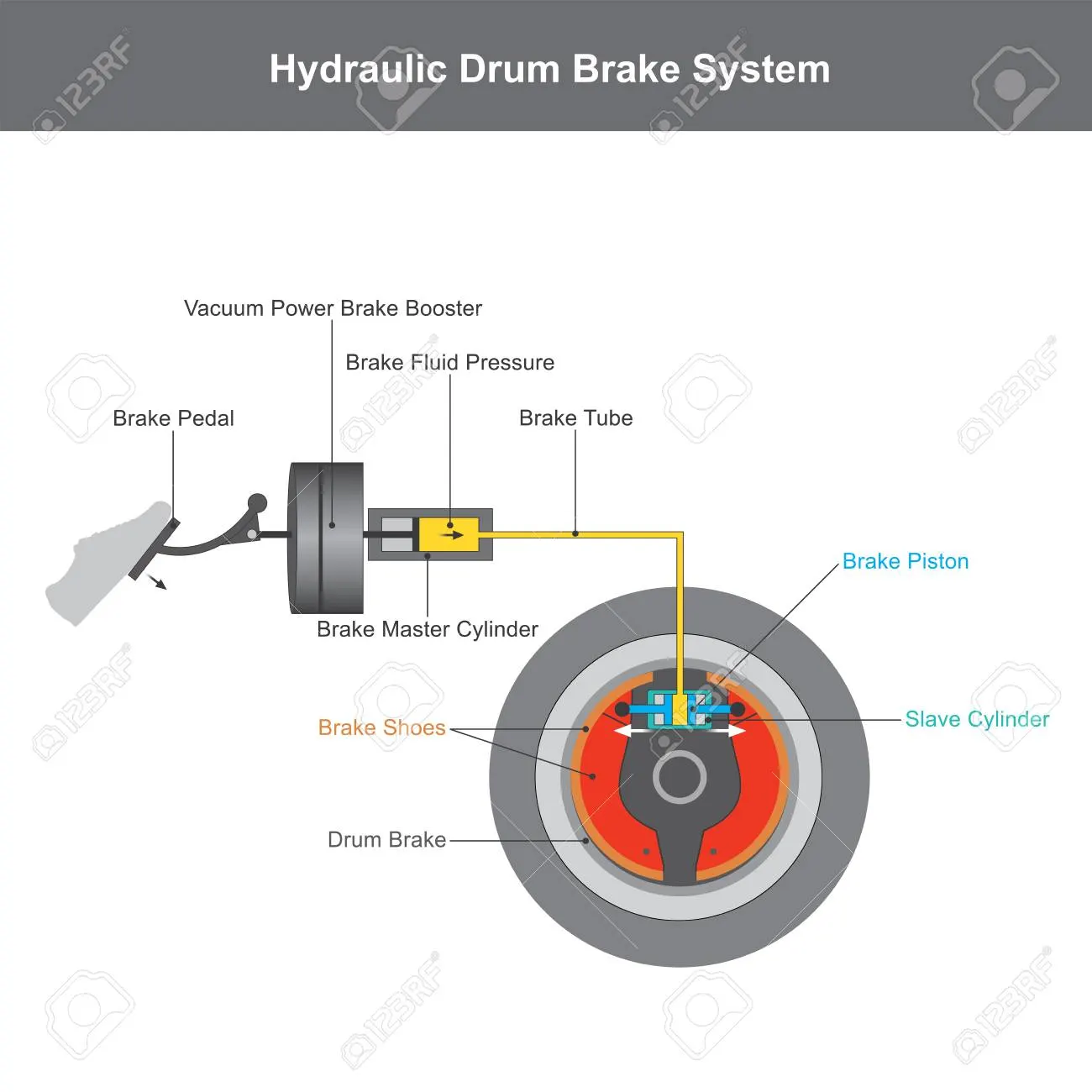
The hydraulic brake is an arrangement of braking mechanism which uses brake fluid, typically containing glycol ethers or diethylene glycol, to transfer pressure from the controlling mechanism to the braking mechanism.
AIR BRAKE:
friction brake for vehicles in which compressed air pressing on a piston is used to apply the pressure to the brake pad or brake shoe needed to stop the vehicle. Air brakes are used in large heavy vehicles, particularly those having multiple trailers which must be linked into the brake system, such as trucks,buses,trailers, and semi-trailers, in addition to their use in railroad trailers.
2)ELECTRIC BRAKING SYSTEM:
The braking is the process of reducing the speed of an induction motor. In braking, the motor works as a generator developing a negative torque which opposes the motion of a motor. The braking of an induction motor is mainly classified into three types. They are. Regenerative Braking.
The brake system takes the kinetic energy of your moving vehicle and converts it to thermal energy through friction. That energy is used to slow and stop your four-thousand-pound-plus metal machine. The concept is the same; the equipment, well that is a bit more complex
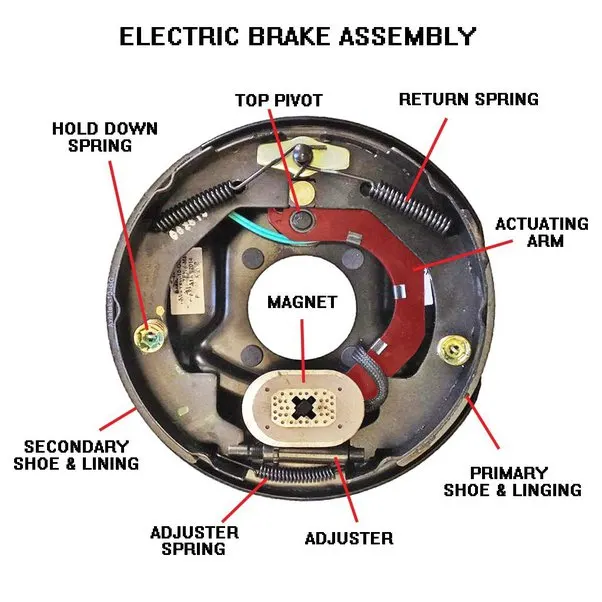
A system in which a braking action is applied to an electric motor by causing it to act as a generator.Electric brakes use a sensor controlled by the tow vehicle's brake lights. When the lights activate, so does the brake controller. This sends power down a separate heavy-duty circuit to the trailer brakes.
Electric braking of vehicle possible in two ways they are,
- series-regenerative braking and mechanical braking both are appiled one after another
- parallel-regenerative braking and mechanical braking both are appiled simultaneously.
When brake pedal is pressed the hydraulic fluid reaches the brake pistons and credited the braking pressure on the wheels and the same kinetic energy is been used by the regenerative braking for generating more power using the bi-directional motor which operates as a generator while braking.
QUESTION 3:
AIM: Make a MATLAB program which plots contour of given motor speed, torque and efficiency values. Attach the code as a .m file attach a screenshot of all the plots.
MATLAB CODE:
clear all
close all
clc
%speed array
omega=linspace(0 ,300 ,100);
%torque array
T=linspace(0 ,2000 ,100);
%meshgrid
[X,y]=meshgrid(T,omega);
%loss coefficient
cu=0.17; %copper losses
fe=0.006; %iron coefficient
win=0.000016; %windage coefficient
%losses
cu_loss=cu*(y.^2); %copper losses
fe_loss=fe*(X.^2); %iron losses
win_loss=win*(X.^3); %windage losses
cond_loss=18; %conduction losses
%output power
p_out=(X.*y);
%Inputpower
p_in=p_out+(cu_loss)+(fe_loss)+(win_loss)+(cond_loss);
%efficienc
n=((p_out)./(p_in));

%efficiency values for contour
w=linspace(0.75 ,0.95 ,10);
%contour plot
contour(X,y,n,w)
xlabel('angular speed,rad/s')
ylabel('torque, Nm')
title('speed,torque and efficiency characterictics of motor');
In this MATLAB script,we create arrays for the speed aand the torque of the motor.they each also have a characteristics constant of proportionality which are all assumed for the following calculations and represnted as 'K' .in each calculation ,the speed and the torque are represented respectively as w&T.
copper losses=K.cu.w2
iron losses=K.Fe.T2
windage losses=Kw.T3
the values of coefficient are taken as general values.conduction losses are assumed to be 18 joules
OUTPUT RESULTS:
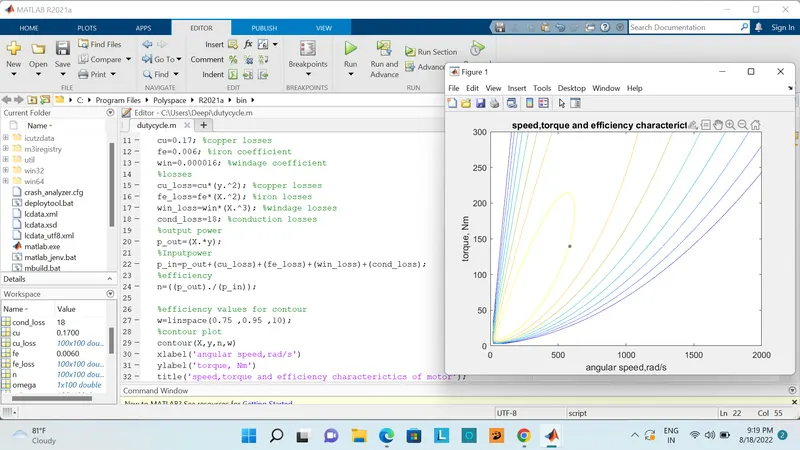
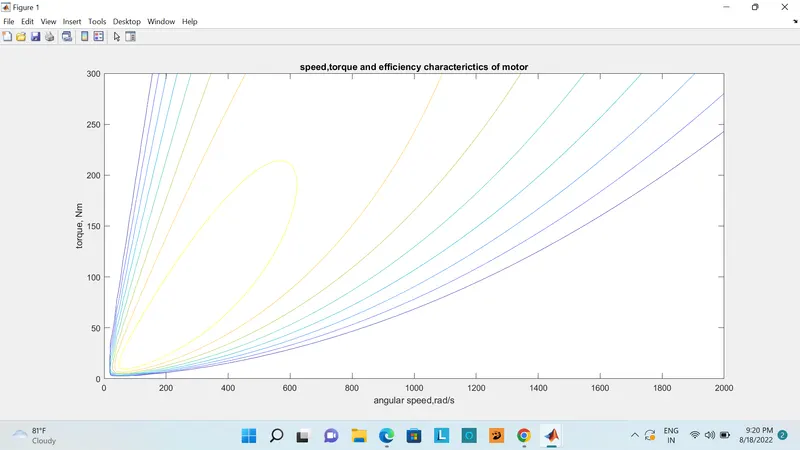
We plot the contour with the 'contour' command.in condition ,an array for the efficency values we want to plot for is created called 'W' and is assigned for values ranging from an efficiency level of 0.65 to 0.95 .this array is used in the creation of the contour.axis labels and a title also made for better reliability. From this contour plot we can see the highest level of efficiency arises in the ineermost contour plot and this efficiency decreses as the contours increses in size from the innermost contour.
CONCLUSION:
we have successfully complete the given tasks
case-1:we have find the energy required for the braking for defined duty cycle
case-2:we discussed about the electric motor cant develop the braking torque at high speed similar to starting
case-3:we develop a MATLAB program which plots contour of given motor speed, torque and efficiency values