Week-11 Challenge: Braking
1) For a defined driving cycle, calculate the energy required for braking.
Braking is nothing but kinetic energy
kinetic energy of the motor is K.E = 0.5 MV^2
where M - mass of vehicle
V - velocity of the vehicle
we assume the mass of the vehicle is 500 kg
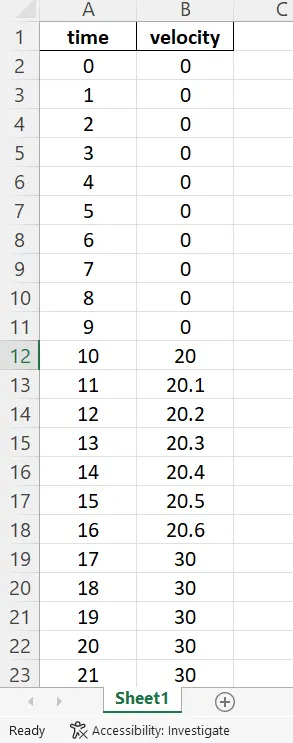
then create a excel file for driving cycle
created a drive cycle for 60 sec and velocity in mps and also plot graph for time vs velocity
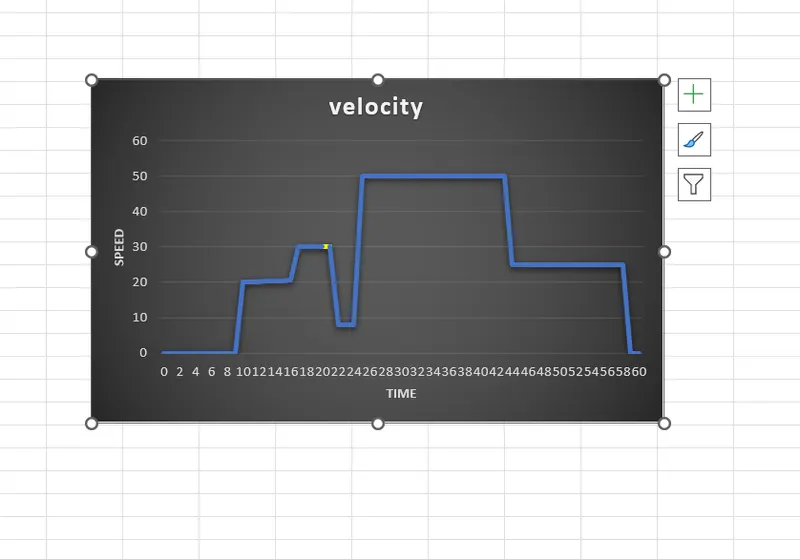
In above plot the speed reduced in 3 points that is brake applied for 3 times in a 60 sec drive cycle
therefore calculate the braking energy for three points
brake 1 :
vehicle speed reduced from 30 mps to 8 mps
KE = 0.5*500*(8-30)^2
= 121000 J (OR) 121 KJ
KE = 121 KJ
brake 2 :
vehicle speed reduced from 50 mps to 25 mps
KE = 0.5 * 500 *(25-50)^2
=156250 J
KE = 156.25 KJ
brake 3 :
vehicle speed reduced from 30 to 0
KE = 0.5 * 500 * (30-0)^2
=2,25,000 J
KE = 225 KJ
2) Why electric motor can’t develop braking torque at high speed similar to starting? How electric and mechanical brakes are coordinated?
In above curve have two region constant torque and constant power
the starting torque is high when the motor increase the speed then torque is reduced rapidly
only motor speed reach the rated speed when constant torque is decreased rapidly
at the high speed of motor torque is very low so regenerative brake is not applied at the moment
brake system have two types they are
1. electrical braking
2. mechanical braking
ELECTRIC BRAKING :
in electric braking , the winding of the motor is used to produce a braking torque. A braking torque is developed during the braking operation. This braking torque opposes the motion of the rotating member or shaft. This is achieved by suitably changing the electrical connections of the motor. The motor operates on a speed–torque characteristic, depending upon the method of braking employed.
MECHANICAL BRAKING
In mechanical braking, the frictional force between the rotating parts and the brake drums produces the required braking. To achieve this, mechanical equipment, such as brake linings and brake drums, are required. Whether electrical or mechanical, the braking of the drive should stop the motor at the specified point of time and position.
electric and mechanical brakes are coordinate
Since the braking torque is very less at high speeds, mechanical brakes are applied to slow down the vehicle. As the motor reaches the constant torque region the regenerative braking system takes effect where the motor acts as a generator and the negative torque produced charges the battery pack.
3) Make a MATLAB program which plots contour of given motor speed, torque and efficiency values
contour map of efficiency related to motor speed and torque
motor have a different losses they are
copper loss , iron losses , windage losses , constant losses.
copper losses - KcT^2
iron losses - Kiw
windage losses - Kww^3
constant losses - c
MATLAB SCRIPT :
%efficiency contour map
clear All
clc
X = linspace(1,1000); %speed
Y = linspace(1,250); %torque
%losses
Kc = 0.2; %copper loss
Ki = 0.008; %iron loss
Kw = 0.00001; %windage loss
CONL = 20;
[X,Y] = meshgrid(X,Y);
B = Kc * (Y.^2);
C = Ki * X;
D = Kw * (X.^3);
outputpower = (X.*Y);
inputpower = outputpower+B+C+D+CONL;
Z = outputpower ./ inputpower;
V = [0.70,0.80,0.85,0.90,0.91,0.92,0.925,0.93];
box off
grid off
contour(X,Y,Z,V);
xlabel('speed') , ylabel('torque');
hold on
in above matlab script file is efficiency of contour map
we defined speed is x and torque is y and the limits are (1,1000) and (1,250) respectively
all losses values are entered and the losses are defined as B,C,D and CONL
plot the contour of X,Y,Z,V
OUTPUT :
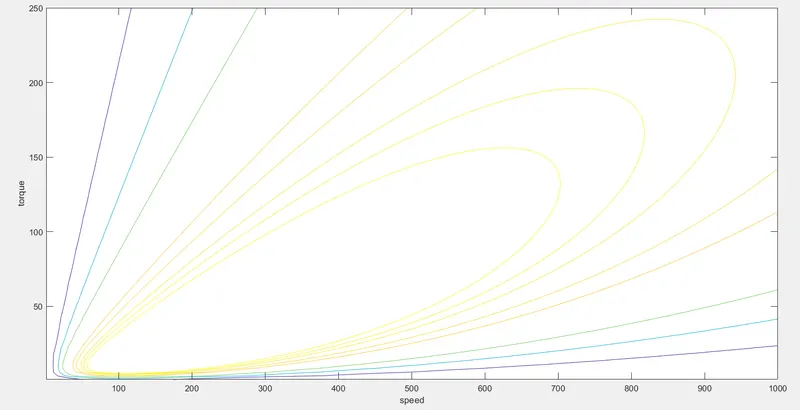
from output :
when motor run at high speed the value of torque is low and speed of motor is decreased then torque is increased