Week-11 Challenge: Braking
OBJECTIVE:
- For a defined driving cycle, calculate the energy required for braking.
- Why electric motor can’t develop braking torque at high speed similar to starting? How electric and mechanical brakes are coordinated?
- Make a MATLAB program which plots contour of given motor speed, torque and efficiency values. Attach the code as a .m file attach a screenshot of all the plots.
OBJECTIVE-1:
What is the Driving cycle?
A drive cycle is typically represented by a series of data points that plots vehicle speed against time. Driving cycles are produced to assess the performance of vehicles in various ways, including fuel consumption and pollutant emissions. The use of drive cycles is in vehicle simulations. More specifically, they are used in propulsion system simulations to predict the performance of internal combustion engines, transmissions, electric drive systems, batteries, fuel cell systems, and similar components.
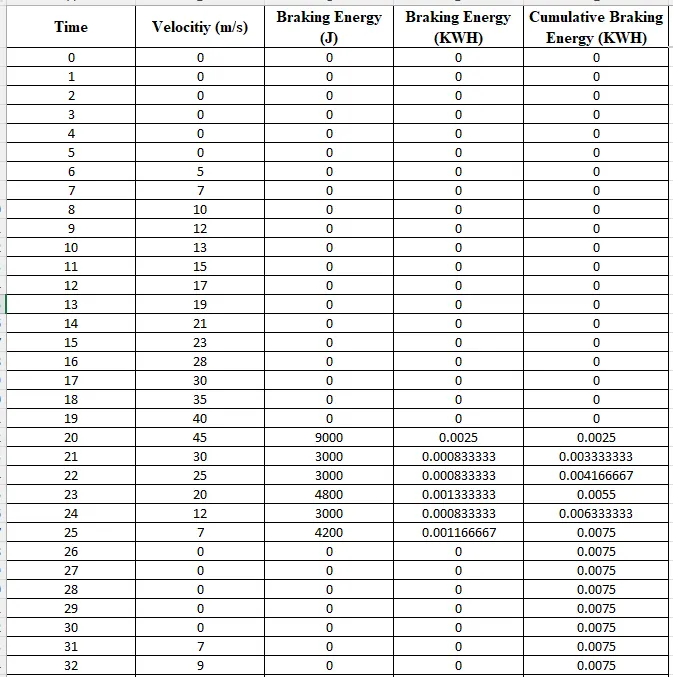
In this challenge, the Energy required for braking is calculated by using an excel calculator.
Firstly, a drive cycle is created on my own values with time in seconds and velocity in m/sec.
The Mass of the vehicle is taken as 1000 kg.
Then the energy was calculated in units of Joules.
Here we required the power in Kwh, so the energy is converted from Joules to Kwh by using the below formulae.
`Energy in Kwh=(energy in Joules)/(1000 x 3600)`
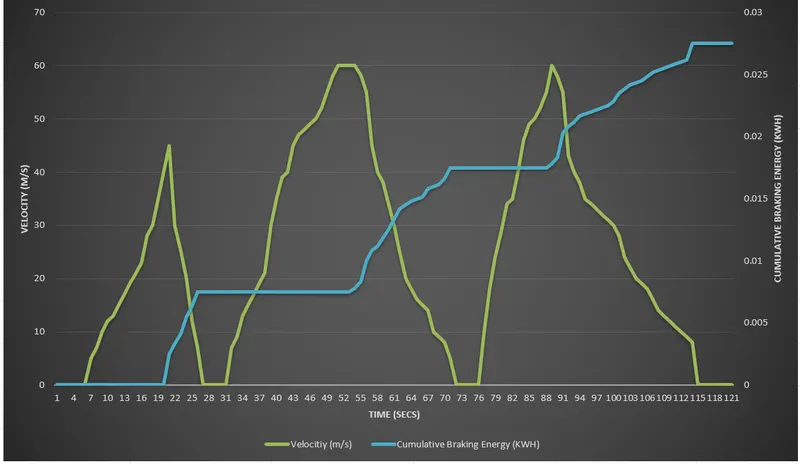
After the energy conversion plot is drawn for cumulative energy and velocity.
Here the excel calculator is shown below figure.
The plot between the cumulative braking energy and velocity is shown below figure.
The Excel calculation file is attached below.
OBJECTIVE-2:
The electric motor can’t develop braking torque at a high speed similar to starting because when the motor supply is cut off, after then it acts as a generator. This generator operation produces less torque as compared to the motor’s starting torque.
Regenerative Braking:
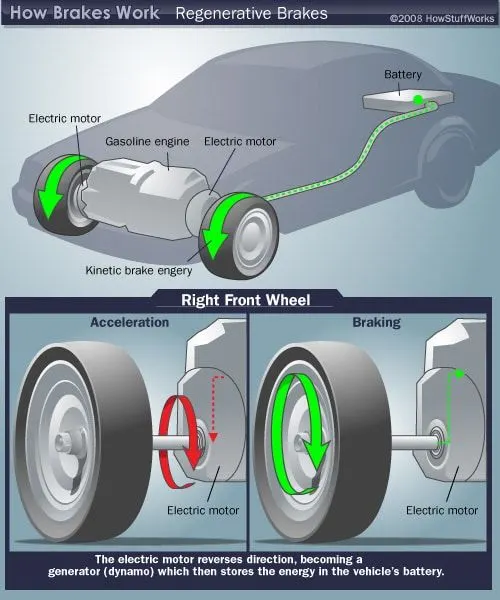
Regenerative braking is used in vehicles that make use of electric motors, primarily fully electric vehicles and hybrid electric vehicles. One of the more interesting properties of an electric motor is that, when it's run in one direction, it converts electrical energy into mechanical energy that can be used to perform work (such as turning the wheels of a car), but when the motor is run in the opposite direction, a properly designed motor becomes an electric generator, converting mechanical energy into electrical energy. This electrical energy can then be fed into a charging system for the car's batteries.
In a regenerative braking system, the trick to getting the motor to run backward is to use the vehicle's momentum as the mechanical energy that puts the motor into reverse. Momentum is the property that keeps the vehicle moving forward once it's been brought up to speed. Once the motor has been reversed, the electricity generated by the motor is fed back into the batteries, where it can be used to accelerate the car again after it stops. Sophisticated electronic circuitry is necessary to decide when the motor should reverse, while specialized electric circuits route the electricity generated by the motor into the vehicle's batteries. In some cases, the energy produced by these types of brakes is stored in a series of capacitors for later use. In addition, since vehicles using these kinds of brakes also have a standard friction braking system, the vehicle's electronics must decide which braking system is appropriate at which time. Because so much is controlled electronically in a regenerative braking system, it's even possible for the driver to select certain pre-sets that determine how the vehicle reacts in different situations. For instance, in some vehicles, a driver can select whether regenerative braking should begin immediately whenever the driver's foot comes off the accelerator pedal and whether the braking system will take the car all the way to 0 mph (0 kilometers per hour) or will let the car coast slightly.
Working Principle of Regenerative Braking System:
- The law of conservation of energy states that the total energy of an isolated system cannot change, it is said to be conserved over time. Energy can neither be created nor destroyed. But can be changed, for example, by converting chemical energy into kinetic energy in the detonation of a stick of dynamite.
- The most common form of regenerative brakes involves using an electric motor as a power generator. The generated electricity is fed back into the Supply system, while in battery electric and hybrid electric vehicles, the energy is stored chemically in the battery.
Coordination Control Strategy for Mode Switch:
According to whether or not the hydraulic braking system is involved in braking, the braking mode-switch type is divided into two categories. Braking mode-switch coordination control strategies are developed for the different braking mode-switch types.
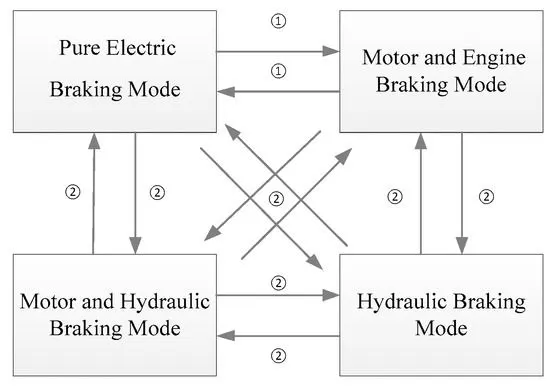
(1) Type one: braking mode switch without hydraulic braking system participation. In this type of mode switching, it is necessary to control the engagement of the clutch and the change rate of the motor torque. Thus, the fluctuation caused by the mode switch can be reduced.
(2) Type two: braking mode switch with hydraulic braking system participation. Due to the different dynamic response characteristics of the motor and the hydraulic braking systems, this switch mode is difficult to coordinate. The idea of coordinating control is to take full advantage of the characteristics of the braking systems. The hydraulic system can provide large and stable torque, and the motor braking system’s torque response is quick and accurate, reducing the fluctuation of the vehicle.
The overall coordination control flow chart is shown in the figure. Tbm_req, Tbh_req, and TbICE_req are the target motor, hydraulic, and engine braking torques allocated by the braking force control strategy.
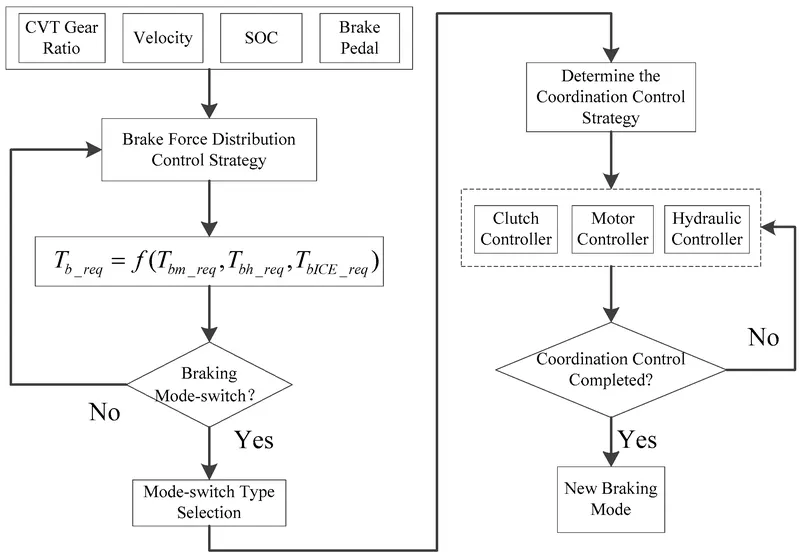
Flow chart of overall coordination control.
First, according to current speed, SOC, CVT ratio, and brake pedal, the braking force distribution control strategy allocates the target motor, hydraulic, and engine braking torques; then, according to the braking mode boundary conditions the vehicle controller determines whether the braking mode should switch or not. If mode switching happens, the vehicle controller determines the type of mode switch and then selects the corresponding coordination control strategy and controls the clutch, motor, and hydraulic torques to reduce the mode switch fluctuation. Finally, the vehicle controller determines whether the coordination control is completed, and if it is completed, the vehicle will enter a new braking mode.
OBJECTIVE-3:
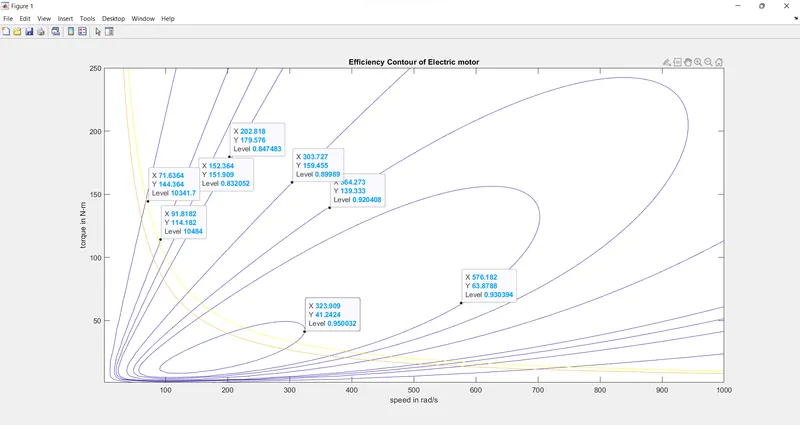
In this challenge, a MATLAB program was written for plots the contour of motor speed, torque, and efficiencies.
for copper losses cu *T^2
for Iron losses Ir * w
for windage losses = wd * w^3
for constant losses = cl
Total Losses = cu *T^2 + Ir * w + wd * w^3 + cl
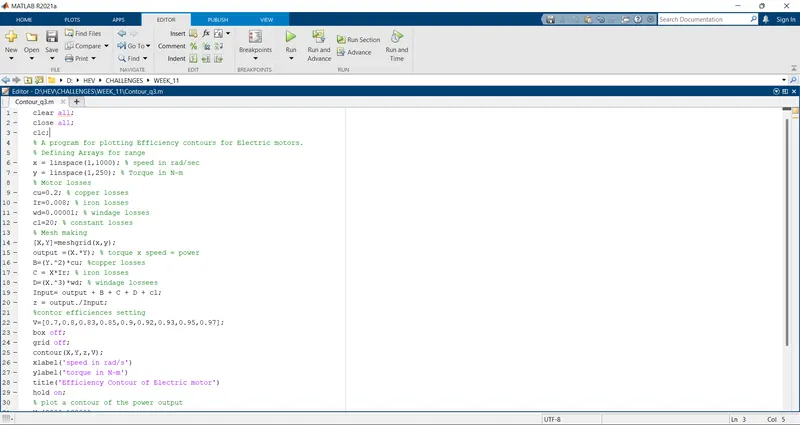
M-script:
clear all;
close all;
clc;
% A program for plotting Efficiency contours for Electric motors.
% Defining Arrays for range
x = linspace(1,1000); % speed in rad/sec
y = linspace(1,250); % Torque in N-m
% Motor losses
cu=0.2; % copper losses
Ir=0.008; % iron losses
wd=0.00001; % windage losses
cl=20; % constant losses
% Mesh making
[X,Y]=meshgrid(x,y);
output =(X.*Y); % torque x speed = power
B=(Y.^2)*cu; %copper losses
C = X*Ir; % iron losses
D=(X.^3)*wd; % windage lossees
Input= output + B + C + D + cl;
z = output./Input;
%contor efficiences setting
V=[0.7,0.8,0.83,0.85,0.9,0.92,0.93,0.95,0.97];
box off;
grid off;
contour(X,Y,z,V);
xlabel('speed in rad/s')
ylabel('torque in N-m')
title('Efficiency Contour of Electric motor')
hold on;
% plot a contour of the power output
V=[8000,10000];
contour(X,Y,output,V);
x=linspace(1,1000); % speed in rad/s
y=linspace(1,250);
cu=0.2; % copper losses
Ir=0.0008; % ironn losses
wd=0.00001; % windage losses
cl=400; % constant losses
by running the above m-script we can see the contour plot.
Plot: