Week-11 Challenge: Braking
1. BRAKING: braking is the process of controlling the velocity of an object by inhibiting its motion . an pobject in motion passes kinetic energy and to bring the object to a stop this kinetic energy must be removed.removing the kinetic energy can be accomplished by disipating the energy to the atmostphere through friction or by converting into another form of energy. the most commojn type of braking is a mechanical brake which inhibits motion through friction brake padfs.a mechanical brake applies a friction force to convert kinetic energy of the vehicle into thermal energy, which then disipates into atmostphere. braking system which dont use friction are refered as regenerative breaking , the kinetic energy is conerted into other forms of useful stored energy,
energy present in a object motion is given by following eqn:
Ke= 1/2MV^2
for calculating the braking energy the driving cycle is required.
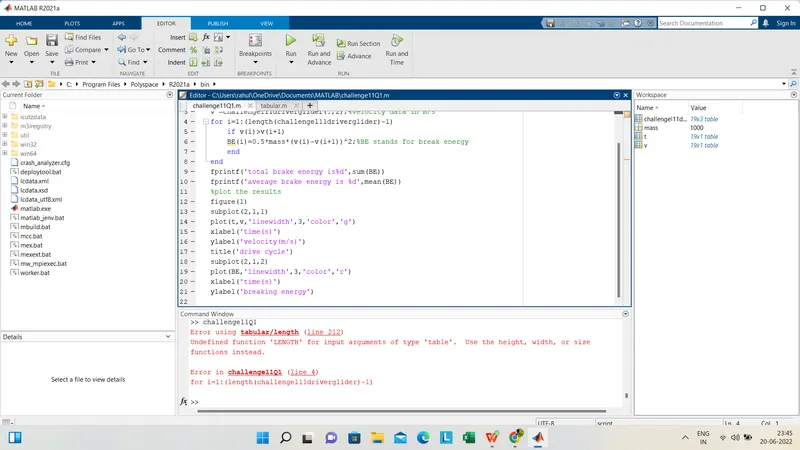
mass=1000;%mass of the vehicle in kg
t = challengel11driverglider(:,1);%time period
v =challengel11driverglider(:,2);%velocity data in m/s
for i=1:(length(challenge11driverglider)-1)
if v(i)>v(i+1)
BE(i)=0.5*mass*(v(i)-v(i+1))^2;%BE stands for break energy
end
end
fprintf('total brake energy is%d',sum(BE))
fprintf('average brake energy is %d',mean(BE))
%plot the results
figure(1)
subplot(2,1,1)
plot(t,v,'linewidth',3,'color','g')
xlabel('time(s)')
ylabel('velocity(m/s)')
title('drive cycle')
subplot(2,1,2)
plot(BE,'linewidth',3,'color','r')
xlabel('time(s)')
ylabel('brake energy')
the energy is calculated by using the formula
E=m.(Vi-Vf)^2/2
2. the electric motor can’t develop braking torque at high speed similar to starting because when the brake is applied to the electreic vehicle it acts as an generator so due to flux weaking effect of the genrator the generatror produces low torque. thus torque is low .
REGENRATIVE BRAKING: Regenerative braking is an energy recovery mechanism that slows down a moving vehicle or object by converting its kinetic enegy into a form that can be either used immediately or stored until needed. In this mechanism, the electric traction motor uses the vehicle's momentum to recover energy that would otherwise be lost to the brake discs as heat. This contrasts with conventional braking systems, where the excess kinetic energy is converted to unwanted and wasted heat due to friction in the brakes, or with rheostatic brakes, where the energy is recovered by using electric motors as generators but is immediately dissipated as heat in resistors.. In addition to improving the overall efficiency of the vehicle, regeneration can significantly extend the life of the braking system as the mechanical parts will not wear out very quickly.
3.
the matlab script has been attached