Week-7 Challenge: DC Motor Control
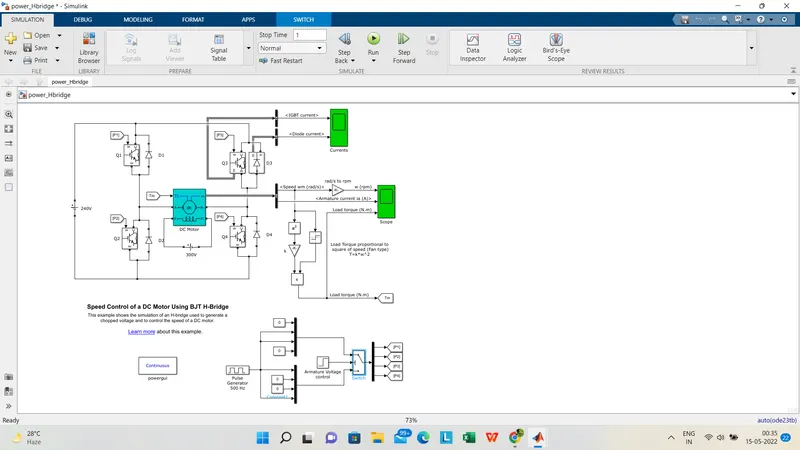
1. an H bridge consist of four switching elements as BJT and dioded and a load at its center.
the speed control of a dc motor is
model description:
the Bipolar Junction Transistor (BJT) when used for power switching applications, operates as an IGBT. When it is conducting (BJT operating in the saturated region), a forward voltage Vf is developed between collector and emitter (in the range of 1 V). Therefore, the IGBT block can be used to model the BJT device.
The IGBT block does not simulate the gate current controlling the BJT or IGBT. The DC motor uses the preset model (5 HP 24V 1750 rpm). The armature mean voltage can be varied from 0 to 240 V.
in this as we cannot switch all the switches at atime due to short circiut will happen , so the switches IGBT q1 and q4 are on
The H-bridge consists of four BJT/Diode pairs (BJT simulated by IGBT models). Two transistors are switched simultaneously: Q1 and Q4 or Q2 and Q3. When Q1 and Q4 are fired, a positive voltage is applied to the motor and diodes D2-D3 operate as free-wheeling diodes when Q1 and Q4 are switched off.
When Q2 and Q3 are fired, a negative voltage is applied to the motor and diodes D1-D4 operate as free-wheeling diodes when Q2 and Q3 are switched off.
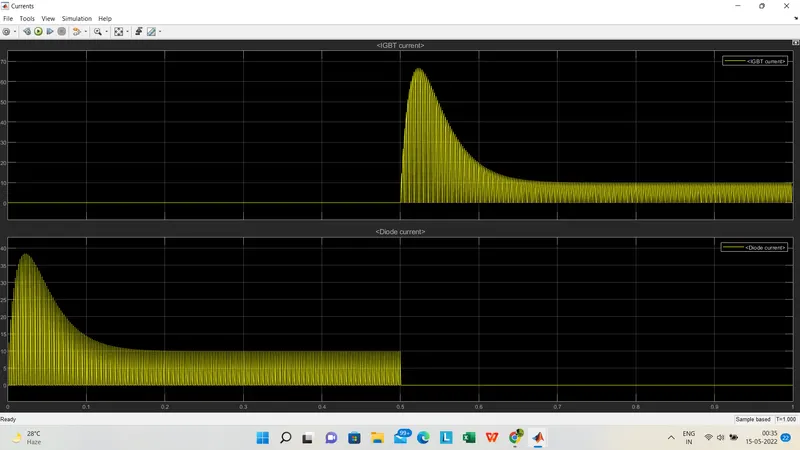
then in foreward bias as shown in the graph the IGBT current is getting high at 75% duty cycle at 180v
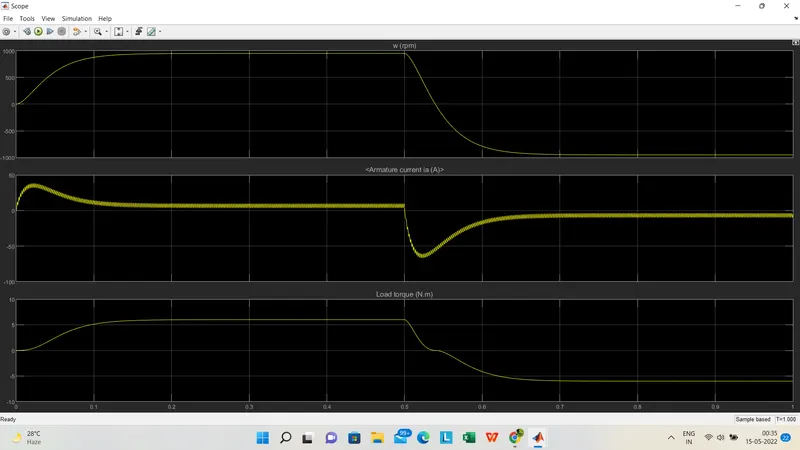
B . then the scope shows the armeture current, speed of motor , load torque
in that the armeture current therte is a sudden spike at 0v at 0.5 sec torque
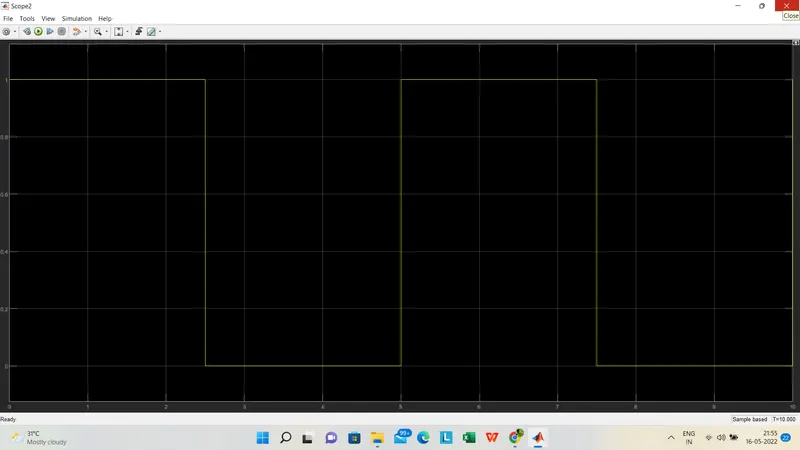
where we can see the transition in 2cycles , the possitive transsition for the forward bias switching and negetive transition also due to the swityching ocuuring as per the input
C. the difference3 between four quadrant chopper comparing to H bridge model is
1. in four quadrant chopper it works in 4 modes
1.forward motoring
2.revrese motoring
3.forward regenration
4.reverse regention
2.while in H bridge model operates in two modes only
forward motoring
reverse motoring
3.4quadrant chopper high switching frequency
but H brige model jhave low switching frequency
4. the aremeture current of four quadrant chopper have little spike in the transition from one switchg to other due to hight frequency but H bridge model have high spike in current.
3. the explation of the BLDC motor
when compared to normal motor and BLDC motor , in the normal brushed DC motor the armetiure current is comminicated by the brushes to rotor to rotate
A brushless DC electric motor also known as an electronically commutated motor or synchronous DC motor, is a synchronous motor using a (DC) electric power supply. It uses an electronic controller to switch DC currents to the motor windings producing magnetic fields which effectively rotate in space and which the permanent magnet rotor follows. The controller adjusts the phase and amplitude of the DC current pulses to control the speed and torque of the motor. This control system is an alternative to the mechanical commutator (brushes) used in many conventional electric motors.
The advantages of a brushless motor over brushed motors are high power-to-weight ratio, high speed, nearly instantaneous control of speed (rpm) and torque, high efficiency, and low maintenance. Brushless motors find applications in such places as computer peripherals (disk drives, printers), hand-held power tools, and vehicles ranging from model aircraft to automobiles. In modern washing machines, brushless DC motors have allowed replacement of rubber belts and gearboxes by a direct-drive design.
4. the two quadrant model has been attached