Week-11 Challenge: Braking
Problem 01:
Aim:
To calculate the energy required for braking, with a defined driving cycle.
Formula:
To find the enery required for braking, we have
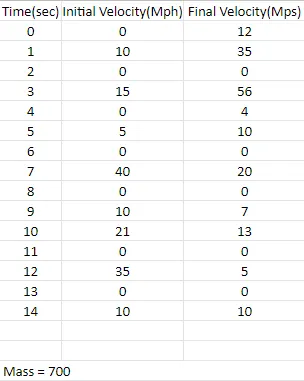
Ke = 1/2 x mass x (Final velocity - Initial Velocity)^2
Drive Cycle:
For the calculation of energy produced while breaking in the vehicle, we need to create a drive cycle with time and velocity.
Result in Graph:
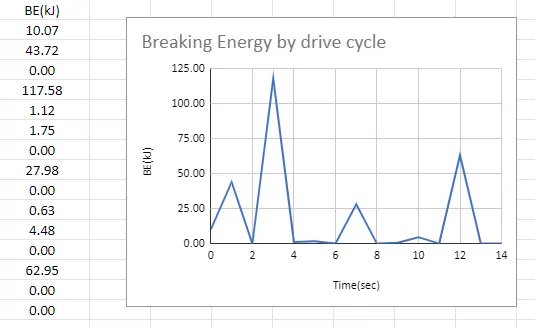
From the calculations made from 14 entries, the braking energy required is 270.27kj
Excel Sheet link: https://docs.google.com/spreadsheets/d/1ClG60MGFqRc48cD3Mhx2NyIP2V1vObe2/edit?usp=sharing&ouid=114376097321448935503&rtpof=true&sd=true
Problem 02:
Aim:
To analyze that electric motor can’t develop braking torque at high speed similar to starting and electric and mechanical brakes coordination.
Electric Motor:
For all the dc motors, torque is directly proportional to the flux and armature current. In case of the dc series motor, the flux produced by the field winding is directly proportional to the armature current. Because, the same current flows through both of the windings as they are series connected in nature. Therefore, torque is proportional to the square of the armature current whereas in other motor it is not.
Torque of a DC shunt motor decreases as speed increase.
Here's a graph for DC series motor. Here the torque decreases exponentially as speed increases.
Let's have a look at the favorite motor of the industry, the Induction motor.
An Induction motor does not generate max torque at zero speed but at certain speed much like a internal combustion engine. These characteristics are obtained when we run the motor directly from a rated supply. Fortunately, we do not run motors directly from supply. We use Motor Controllers in-between the motor and the supply.
Motor Controllers provide lots of advantages over running from from direct supply, Speed Control, regenerative breaking, smooth starting to name a few.
Motor controllers emloys one of several control techniques like PWM, space vector modulation, variable frequency etc etc to control motor torque, speed, power output. They can also make a motor produce max torque at any speed below rated speed.
Here's a graph showing the operating region (how a motor can be operated) of any electric motor.
The dashed line represent torque output and X axis represent rotational speed.
As evident from the graph, maximum torque output can be maintained upto the rated speed. When rated speed is reached, motor hits it's power limit, so further increase in speed requires torque to be decreased.
Types of Braking system:
There are two types of braking used in the electrical drives namely
- Mechanical braking
- Electrical braking
Mechanical Breaking:
In this method, the stored energy is dissipated as heat by a brake shoe or brake lining which rubs against a brake drum.
Electric Breaking:
- In this method of braking, the stored energy of ratating part is converted into electrical energy and dissipated by the resistance in the form of heat or returned to the supply.
- The motors used for electric braking should have suitable braking characteristics.
- The three types of electric braking are Plugging, Rheostat or dynamic braking, and Regenerative braking.
Coordination:
Electric braking is fast and cheap. In electric braking there is no maintenance cost like replaced brake shoes periodically. By using electic braking the capacity of the system( like higher speeds, heavy loads) can be increased. A part of energy is returned to the supply consequently the running cost is reduced. In electric braking negligible amount of heat is generated whereas in mechanical braking enormous heat is produced at brake shoes which leads to failure of brakes. Electric braking can not be used for hold the machine after coming to the rest. So a mechanical braking is required additionally.
- For example in the case of the train going up hill, after the train has been stopped using electric braking, it has to be prevented from moving down hill.
In such cases mechanical brakes also should be provided for holding.
During the braking period, the motor has to function as generator. So it must have suitable braking characteristics. ie, the choice of motor is limited.
Problem 03:
Aim:
To make a MATLAB program which plots contour of given motor speed, torque and efficiency values.
we have,
motor speed = 1000 rad/s
torque = 300 Nm
windage loss = 0.0002
copper loss = 0.3
iron loss = 0.09
motor constant loss = 22
Matlab Program:
Result:
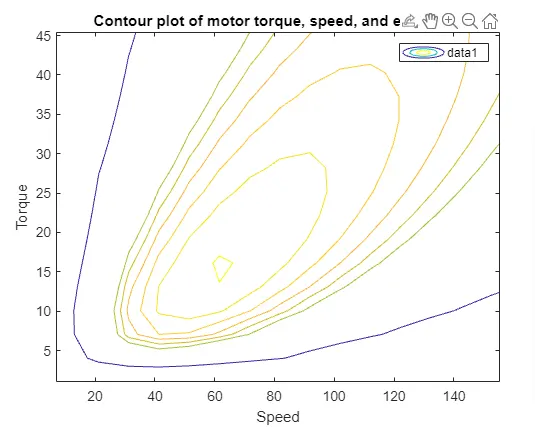
From the result the speed of the motor increases the efficiency also increases, the contour mapping of motor speed, torque and efficiency is successfully gained.