Week-11 Challenge: Braking
AIM:
- For a defined driving cycle, calculate the energy required for braking.
- Why electric motor can’t develop braking torque at high speed similar to starting? How electric and mechanical brakes are coordinated?
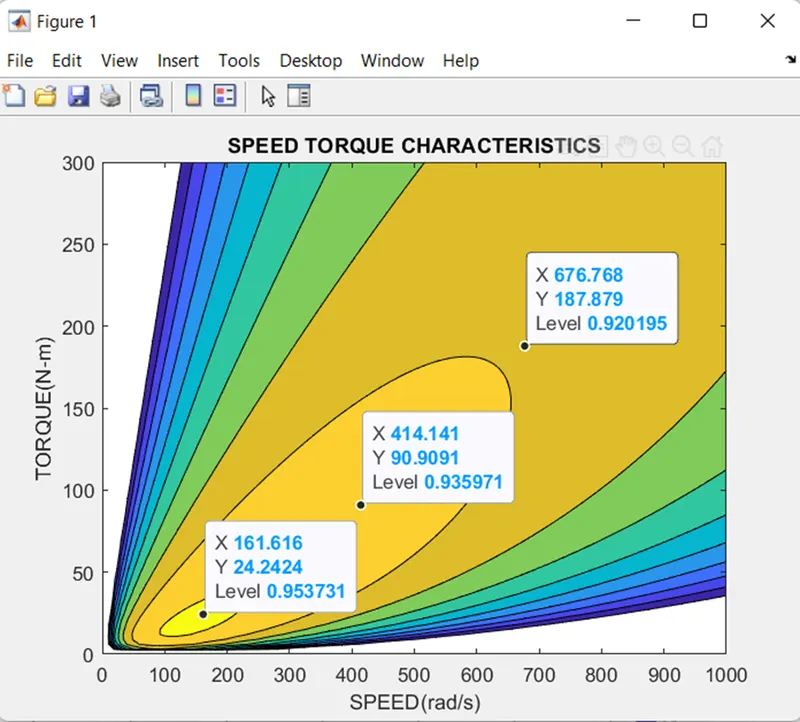
- To Make a MATLAB program which plots contour of given motor speed, torque and efficiency values. Attach the code as a .m file attach a screenshot of all the plots.
Solution 1: For a defined driving cycle, calculate the energy required for braking.
Braking System
The function of the braking system is to retard the speed of the moving vehicle or bring it to rest in a shortest possible distance whenever required. The vehicle can be held on an inclined surface against the pull of gravity by the application of brake. Brakes are mechanical devices for increasing the frictional resistance that retards the turning motion of the vehicle wheels. It absorbs either kinetic energy or potential energy or both while remaining in action and this absorbed energy appears in the form of heat. While moving down a steep gradient the vehicle is controlled by the application of brakes. In this case brakes remain in action for a longer period making it imperative to dissipate the braking heat to atmosphere as rapidly as possible.
Automobiles are fitted with two brakes; the service or foot brake and the emergency or hand brake. The foot brake is used to control the speed of the vehicle and to stop it, when and where desired, by the application of force on the brake pedal. The hand brake, applied by a lever, is used to keep the vehicle from moving when parked. Hand brakes are called emergency brakes because they are applied when the service brake fails. Virtually all vehicles are now equipment with 4-wheel brakes. The front brakes must operate without interfering with the steering action.
The brakes must be capable of decelerating a vehicle at a faster rate than the engine is able to accelerate it. Normally brakes have to absorb three times the amount of engine horsepower energy in its equivalent form.
Braking Fundamentals
Energy of Motion.
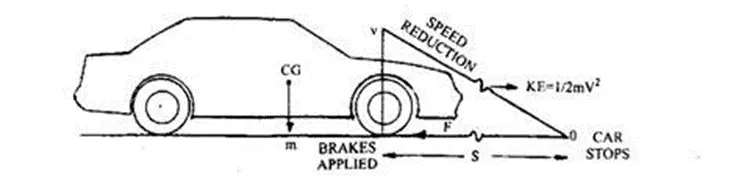
Kinetic energy is the force that keeps the vehicle moving. This energy is provided by the engine in order to accelerate the vehicle from a standstill to desired speed. Kinetic energy is dissipated as heat by the brakes during application of breaks. The kinetic energy of a vehicle during braking is given by
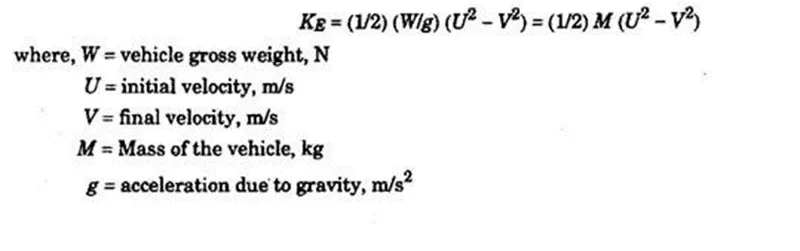
Thus, the kinetic energy doubles as the weight doubles, but it increases four times as speed doubles.
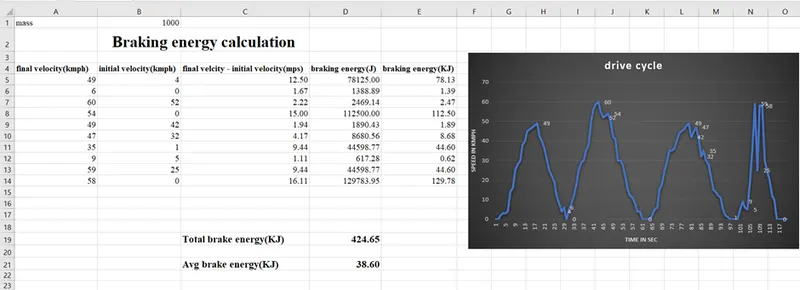
Here have take the drive cycle data from excel sheet attached below.
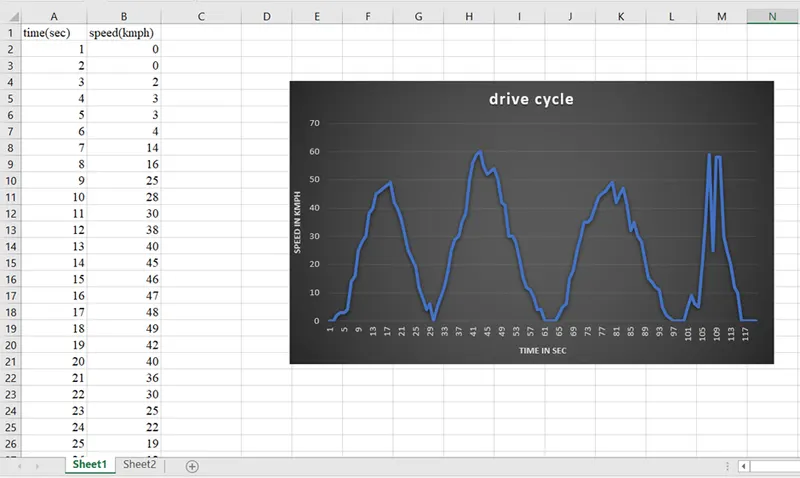
This excel file is also attached below for better reference. And with this data we have plotted a graph between time and speed which is kilometer per hour. Which is converted into meter per sec for calclulation purposes.
Parameres:
M : mass : 1000kg
Vf : final velocity : here the minimum velocity obtained after braking is considered as final velocity.
Vi : initial velocity : here the maximum velocity obtained before braking is considered as initial velocity.
Formula:
Braking energy = [1/2]* mass * (final velocity – initial velocity)^2
10 deceleration were made during this driving cycle, so 10 braking energy is to be calculated and sum it up to get the total braking energy.
The calculation takes in excel file and it attached below
Solution 2: Why electric motor can’t develop braking torque at high speed similar to starting? How electric and mechanical brakes are coordinated?
The electric motor cannot develop braking torque at high speed similar to starting because once the electric supply is pulled off from the motor, it act as a generator and due to the flux weaken effect of the electric generator, the generator produces low torque as expected.
Regenerative braking
Regenerative braking (also called regen) is a way in which vehicle captures kinetic energy that is normally lost during braking by using electric motor as a generator and storing the captured energy in the battery. Without Regenerative braking this kinetic energy would be lost mainly in the form of heat due to the friction of brake pads against brake disc on the wheels.
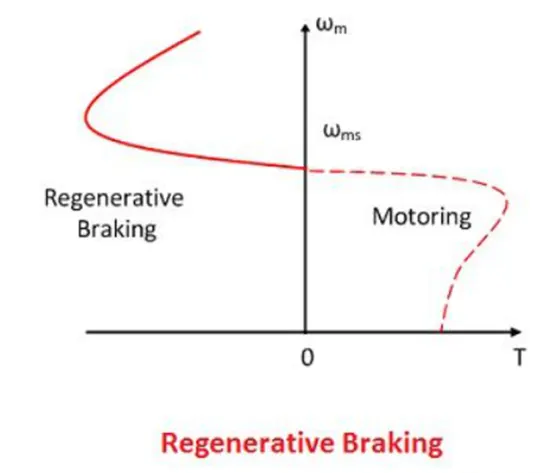
It is called regenerative because the energy is recaptured in the battery which can be used again and Braking because it slows down the vehicle.
working:
In Electric vehicles, the electric motor supplies power to drive the wheels. When you remove your foot off the accelerator pedal and onto the brake, electric motor stops supplying power to wheels. The electric motor reverses in direction and acts like a generator. When this process kicks in vehicle slows down. The wheels transfer kinetic energy through the drivetrain to generator. This kinetic energy is converted to electricity and stored in battery which can be used later.
In addition to regenerative brakes, all vehicles are equipped with conventional friction brakes which can be used when rapid deceleration is required. As Regenerative braking is just not enough to stop a vehicle in every situation, especially when driving at higher speeds.
Coordination of electric and mechanical brake:
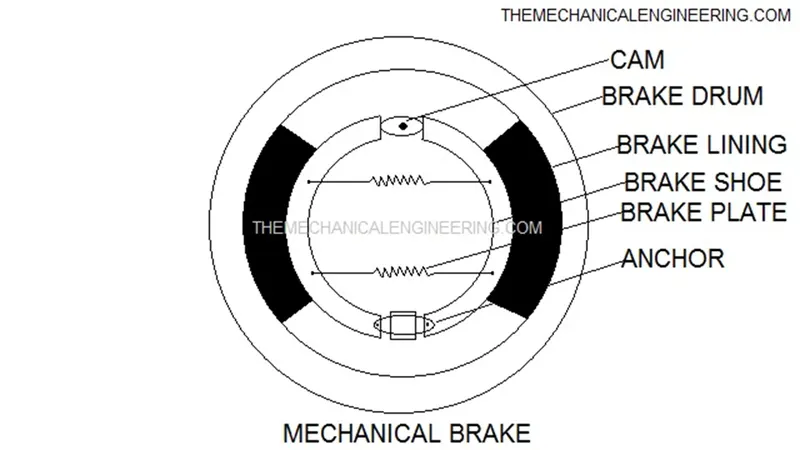
Mechanical Brake System:
- This mechanical braking system is the hand brake or the emergency brake, it generates friction between two surfaces as they rub against each other.
- In this braking system, a particular force is applied to the pedal and it’s carried to the final drum by mechanical components such as a fulcrum, springs, and that are used as linkages to transmit force from one point to another, for slowing down the vehicle.
- The slowing down of the speed or capacity of a brake depends on the surface friction as well the actuation force applied to it.
Advantages of Mechanical Braking System:
- Mechanical brakes are simpler and easy to be maintained.
- It is less expensive than a hydraulic brake system.
- It provides great uses for emergency and parking brakes.
Electrical braking system:
It is mainly used in electric vehicles in which braking is produced using electric motors, and it’s the main power source in electric vehicles. It basically categorized into three types.
Plugging or Counter current Braking:
- It is the simpler form of braking runs when gets connected to motor windings for the reverse direction of rotation at a particular time when the armature still rotates in the forward direction under control of the action of an external torque or due to inertia.
- Plugging reconnects the power source with the motor, so it moves to drive in the opposite direction. It is generally obvious for the system to come at rest as it’s mostly required and then to accelerate in the reverse direction.
- It is important to introduce a special device and to cut off the supply exactly at the time when the motor stops.
- This method produces a greater braking torque. It’s beneficial to get a quick reversal or to get a more rapid stop in an event of the control.
- It is mostly used in rolling mills, elevators, machine tools, etc. This method can be used in both direct current and alternating current and also in induction and synchronous motors.
Dynamic Braking system:
- In this particular method, the motor power is cut from the supply and it operates as a generator carried by the kinetic energy of the rotating parts of the motor and its driven machines.
- Thus, the kinetic energy gets converted into the electrical energy of the rotation.
- Which is then dissipated and connected at the breaking instant. Using this method, the exact amount of energy required for the power supply to break the motor has been removed as compared to the plugging method.
- And this is one of the advantages of dynamic Braking: It applies to direct current motors, synchronous motors, and induction motors.
6.3 Regenerative Braking:
- In this method, the mechanical energy is converted into electrical energy. Some parts of energy are returned to the supply and the rest of the energy is lost as heat in the windings and bearings
- of the electrical machines. It did not involve any switching method unless a change of speed is required at which it becomes more efficient.
- Most of the widely electrical machines pass smoothly from motoring to operations generating, when getting overdriven by the load.
Necessities For Regenerative Brake System:
- Lesser Supply voltage.
- The motor to be a little more excited.
- The motor to be running at a higher speed than no-load speed.
- In all of this process, the retarding torque is produced and the armature current is reversed, decreasing the speed of the motor until the armature back emf becomes the same as a voltage source.
- Regenerative braking does not stop the motor. It is only efficient for handing braking hauling loads, they also vehicle increased the motor due to the work of lowering load or in the motor of an electric locomotive moving downgrade.
Advantages of Electric Braking:
- It’s more efficient than the mechanical braking system which needs costly and frequent replacement but no such replacement is required in electric braking hence it’s cheaper and works efficiently.
- By using of electric braking, speed capacity of the system increases way higher with haulage of heavy loads.
- It helps in saving energy, as a small amount of energy returns to supply offering a considerable saving in the operating cost.
- Metal dust is produced in mechanical braking, but no such dust is produced in electric placement of the mechanical brakes may result in harsh effects in the discomfort to occupants. On the other side electric braking is way more safer, smoother and without shock.
Solution 3: To Make a MATLAB program which plots contour of given motor speed, torque and efficiency values. Attach the code as a .m file attach a screenshot of all the plots.
Matlab program:
clear all
close all
clc
w=linspace(0,1000);
T=linspace(0,300);
kc=0.18;
ki=0.006;
kw=0.000015;
[X,Y]=meshgrid(w,T);
copper_loss=(Y.^2)*kc;
iron_loss=X*ki;
windage_loss=(X.^3)*kw;
k=20;
output_power=X.*Y;
input_power=(copper_loss)+(iron_loss)+(windage_loss)+(output_power)+k;
Eff=(output_power)./(input_power);
n=linspace(0.7,0.95,10);
contourf(X,Y,Eff,n);
title('SPEED TORQUE CHARACTERISTICS')
xlabel('SPEED(rad/s)')
ylabel('TORQUE(N-m)')
output plot: