Week-11 Challenge: Braking
- For a defined driving cycle, calculate the energy required for braking.
- Why electric motor can’t develop braking torque at high speed similar to starting? How electric and mechanical brakes are coordinated?
- Make a MATLAB program which plots contour of given motor speed, torque and efficiency values. Attach the code as a .m file attach a screenshot of all the plots.
ANSWERS:
1)
The energy required for vehicle braking is nothing but to neutralise the kinetic energy of the vehicle which it acquired during acceleration phase.
The kinetic energy of the body is KE=0.5*m*v^2
We all know that power is equal to ratio of work done with respect to time.
P=Work done/Time
Below shown excel sheet is the driving cycle data which tells about the speed of the vehicle w.r.t. time.
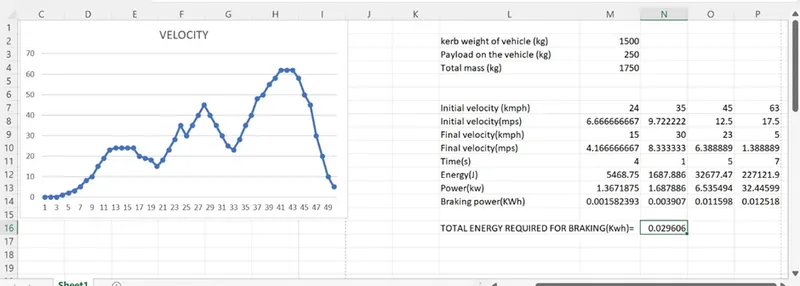
The detailed answer along with the duty cycle excel sheet is updated in the google drive link section.
Total braking energy required=106.5kJ
2)
Electric Motor can’t develop braking torque at high speed similar to starting:
Before going to discuss about this we have to know how the starting torque is developing by the motor (DC/AC).
MOTOR OPERATING REGIONS:
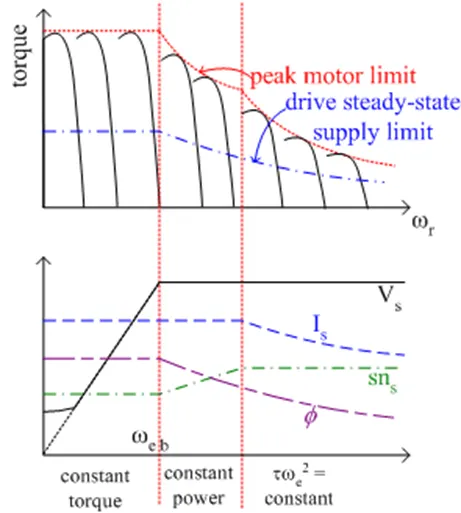
The above image talks about the motor operating regions like constant torque and constant power, not every motor works on same operating regions where it depends on the power of the motor. We can see that the motor below the critical speed works under the constant torque, above critical speed it works under the constant power condition.
P=T*W
T=Torque
P=power
W=speed
By increasing the speed of the motor, torque is going to reduce. This condition is to maintain the constant power. We know that by supplying the variable frequency to the AC motor we can get the variation in speed and torque of the motor. When we supply the voltage more than the rated voltage the motor doesn’t take to run at higher torque, but the motor will take the higher frequencies that leads to be decrease in the torque, increase in the speed.
Decrease in torque and increase in speed results in the constant power condition. When the supply is given to the motor, it starts under high torque. During acceleration phase it reaches to the constant power phase. When the driver releases the throttle, the vehicle moves under deceleration phase, during this phase the direction of current become reverse and the motor acts as a generator and negative torque is generated and the generated torque is in counter to the direction of rotation, because of this reason the generated torque is not similar to the starting torque because of the motor running at constant power region while the negative torque generation.
HOW ELECTRICAL AND MECHANICAL BRAKES ARE COORDINATED?
While applying the brakes for EVs we need to consider so many conditions like charging of the battery during deceleration phase, and simultaneously to apply mechanical brakes during charging.
To avoid massive braking of the vehicle because of generated negative torque while the motor is acting like a generator, we need a strategy to apply both electric and mechanical brakes, to avoid this kind of problems we need to obtain the coordination between electric and mechanical braking strategy.
This can be done by using two strategies:
- Series strategy
- Parallel strategy
SERIES STRATEGY:
Both electric and mechanical brakes are applied one after another. The regenerative braking is applied first to charge the battery and then the mechanical/friction brakes are applied. This type of control strategy is completely depending on the energy recovery of the battery. By applying this series type we can store more energy to the battery and offers good braking feel but need some modifications in hydraulic brake line.
PARALLEL STRATEGY:
Both the mechanical and electrical brakes are applied simultaneously. In this system, the brake pressure is applied on the brake pedal, the brakes are applied according to the movement of brake pedal. Regenerative braking system is directly coupled to the mechanical brakes which are operated through the brake pedal. This results in low regeneration power and poor brake comfort.
The undertaking the parallel strategy Nissan developed EDIB system to increase the coordination between both electric and mechanical brakes. This leads to improve braking comfort and high regenerative power.
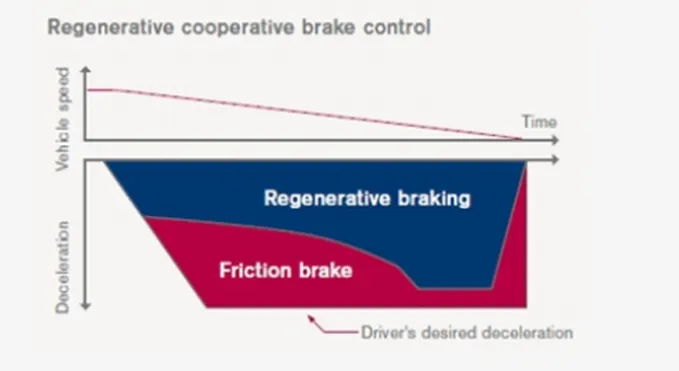
During starting phase of braking movement of brake pedal make controller to create the operating percentage of both braking systems. By observing the above image, we can say the application of friction brakes are more during high speeds and slowly decreases w.r.t time. In the case of regenerative braking, the negative torque increases w.r.t time which leads to increase charge in the battery as well as it increases the comfort.
3)
Before we make a MATLAB model, we need to know about various losses which occur in the motor during acceleration phase decides the performance of the motor. Increase in the performance can increase the efficiency of the motor.
Various losses are are totally depending on number of armature winding and other electrical parts which exhibits heat during running.
COPPER LOSS= I*I*R
COPPER LOSS=Kc*T*T
R=Armature Resistance
I=current passing through it.
IRON LOSSES=KI*w
WINDAGE LOSSES= Kw*W^3
Total loss= Copper loss + Iron loss + Windage loss + constant
Total power input=power output + total loss
MATLAB PROGRAM:
clc
%to plot the contour lines
%windage losses
Kw=0.0002;
%copper losses constant
Kc=0.2;
%iron losses constant
Ki=0.001;
%constant losses
Cl=20;
%x axis will represent the speed(red/sec)
X=linspace(1,1000);
%y axis will be torque(Nm)
Y=linspace(1,200);
%meshing the speed and torque va;ues in 2d array
[x,y]=meshgrid(X,Y);
%copper loss
A=Kc.*(y.^2);
%windage loss
B=Kw.*(x.^3);
%iron loss
C=Ki.*(x);
%output power
Op=(y.*x);
%input power
Ip=Op+A+B+C+Cl;
%efficiency
Z=Op./Ip;
% efficiencies will be plotted with the references of v values
v=[0.70,0.72,0.75,0.80,0.82,0.85,0.90,0.92,0.95];
box off
grid off
contourf(x,y,Z,v)
xlabel('speed rad/sec')
ylabel('Torque Nm')
hold on
v=[8000,9000];
contourf(x,y,Op,v)
RESULT:
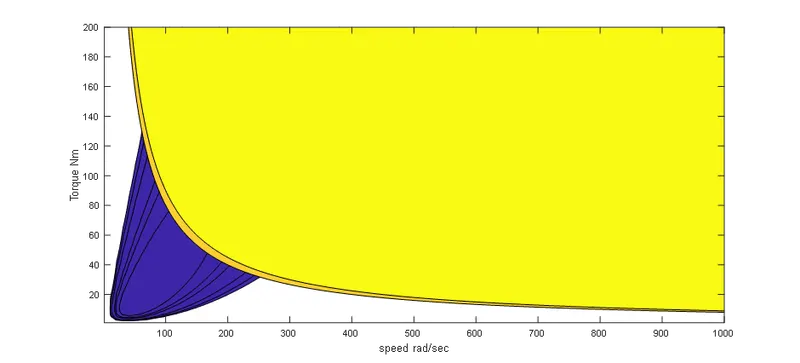
RESULT AND OBSERVATION:
The above questions are answered successfully and the obtained results are satisfactory.