Week-11 Challenge: Braking
1. For a defined driving cycle, calculate the energy required for braking.
Considering UDDS driving cycle,
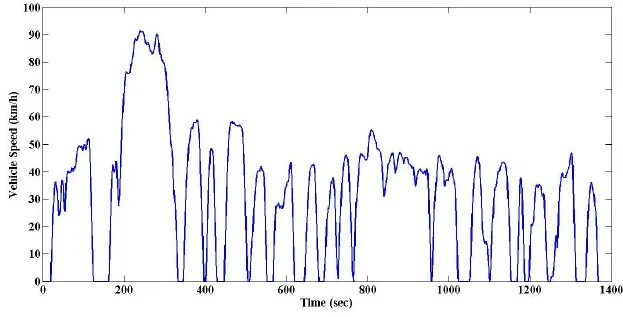
3 different cases were considered from the above drive cycle in order to calculate the energy required for braking.
Case 1 : 20 m/s to 0 m/s : Energy required for braking was calculated as 200 KJ
Case 2 : 12 m/s to 9 m/s : Energy required for braking was calculated as 4.5 KJ
Case 3 : 7 m/s to 4 m/s : Energy required for braking was calculated as 4.5 KJ
Link to Spreadsheet: https://drive.google.com/file/d/15HPosfxdiEDDBqahiDgqWo2xh8kMPnMe/view?usp=sharing
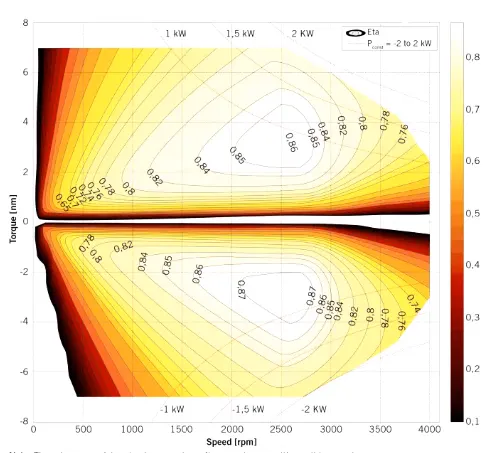
2. Why electric motor can’t develop braking torque at high speed similar to starting? How electric and mechanical brakes are coordinated?
Torque is the turning force through a radius. Sometimes after accelerating you can't reach the maximum torque. The reason is that no matter how much the current loop wants to increase current (proportional to torque) by increasing the PWM duty cycle of the power stage, the Vmotor is too close to Vbemf and therefore current can't increase more.
Whenever Friction torque + Additional loads = Motor Torque, the load remain in equilibrium (does not move, or moves under constant speed). Whenever Friction torque + Additional loads < Motor Torque, the load accelerates (Motor torque - Friction torque - Additional loads = Acceleration torque > 0). Al high speeds, the BEMF is so close to Vbus that the applicable Motor torque gets limited. Then, the bigger the Friction torque + Additional load is, the smaller the Acceleration torque becomes.
This situation does not occur at the beginning of an acceleration because most of the torque is used to increase the kinetical energy of the load (and motor). But when the speed is already high and no extra load is applied it is not possible to increase the torque.
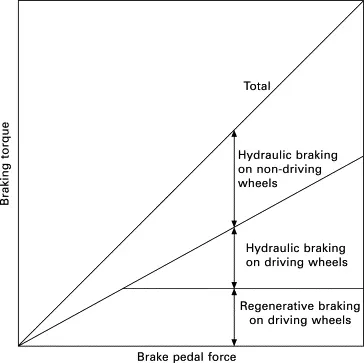
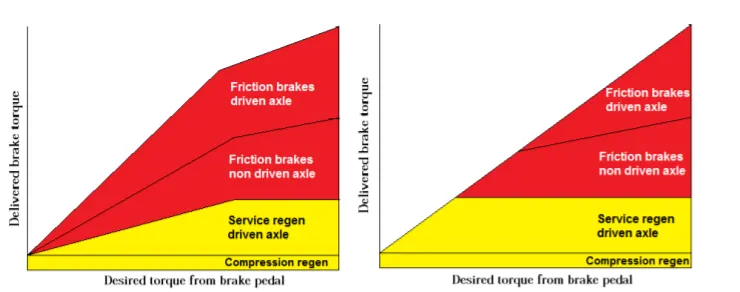
Braking systems are done by using two different methods - Serial braking and parallel braking
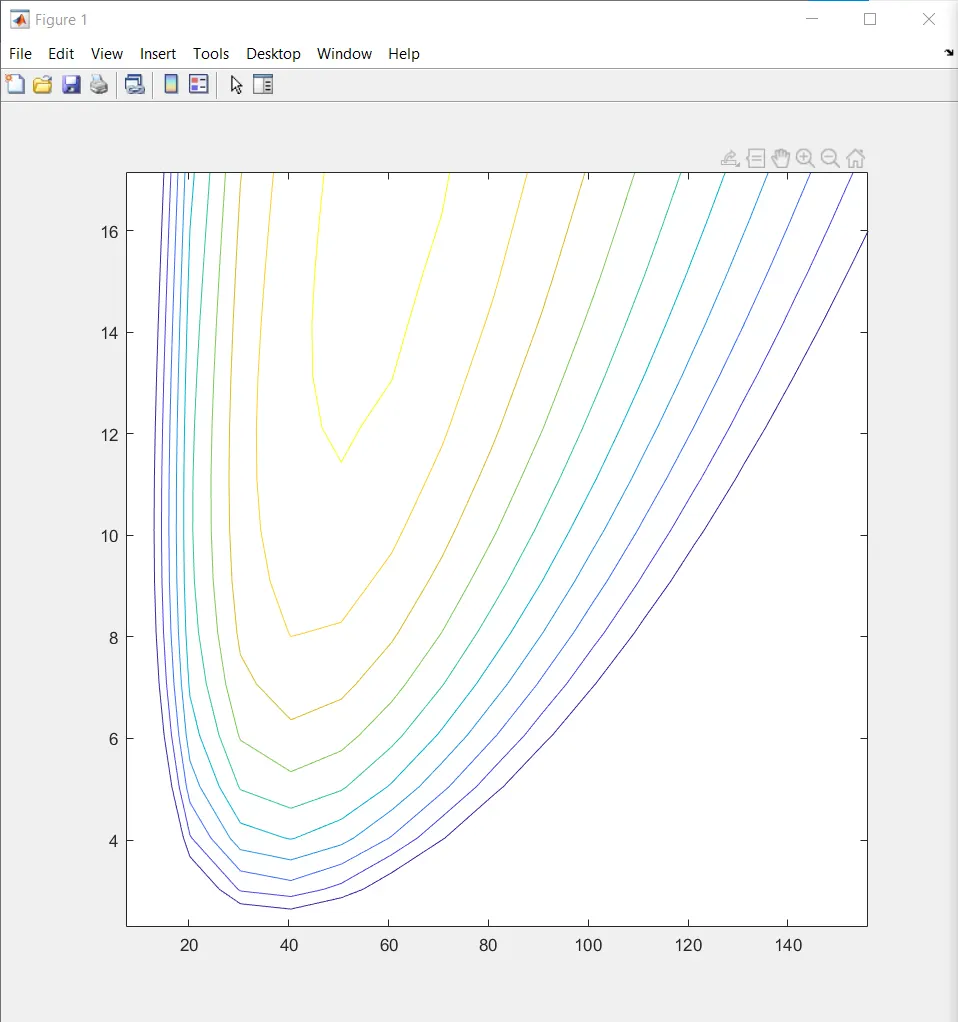
3. Make a MATLAB program which plots contour of given motor speed, torque and efficiency values. Attach the code as a .m file attach a screenshot of all the plots
w=linspace(0,1000);
t=linspace(0,100);
kc=0.4;
ki=0.008;
kw=0.0004;
[Y,Z]=meshgrid(w,t)
c_loss=(Z.^2)*kc;
i_loss=Y*ki;
w_loss=(Y.^3)*kw;
conl=40;
o=Y.*Z;
power=(c_loss)+(i_loss)+(w_loss)+(o)+conl;
efficiency=(o)./(power);
x=linspace(0.6,0.8,10);
grid off
box off
contour(Y,Z,efficiency,x)