Week-11 Challenge: Braking
1.Calculating the required energy for braking of a EPA Urban dynamometer driving schedule:
In electric vehicle os require by vehicle for acceleration as well as deacceleration of vehicle also.As we require to stop vehicle in stipulated time, we cannot allow vehicle to stop as per its inertia value, for stopping vehicle we require to apply brake.Braking of vehicle require to deaccelerate vehicle to lower speed within a given time.
For UDDS cycle:
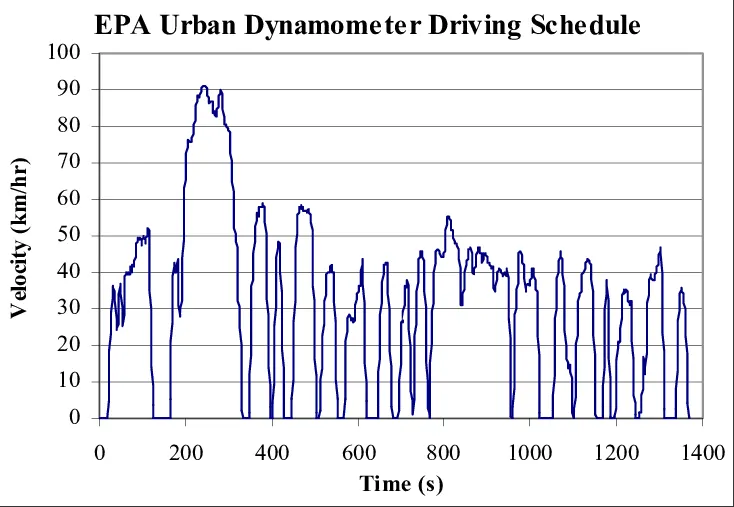
we can observe in this test cycle vehicle needs to stop in given time at some instance also for this we will apply brakes. we will calculate the power require for braking operation.
- To reduce speed from 80 to 40 kmph in 20 sec = 292 KJ
- To reduce speed from 80 to 0 kmph in 10 sec = 560 KJ
2.
The torque-speed characterstic of motor is not exact same in the braking and motoring region.
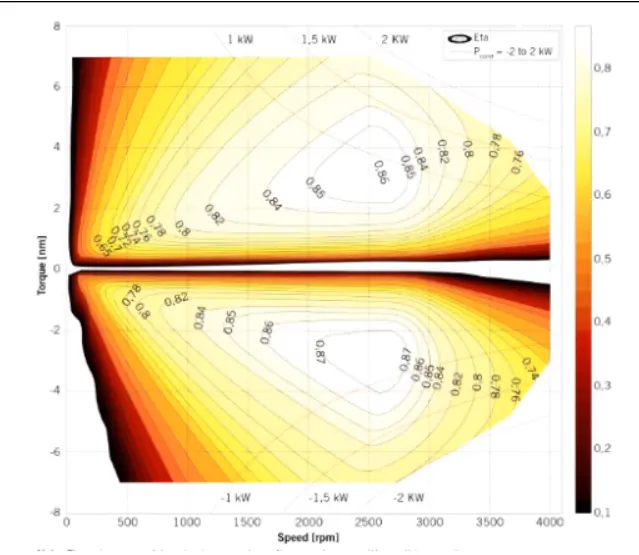
This is torque-speed contour plot of motor with efficiency.
We can see that, at the time of accelerating vehicle at starting the maximum torque available motor is operating at constant torque region, in that motor will have maximum torque available, but as motor starts deaccelerating motor characterstics are shifted towards braking region, in this we don't have max torque available for braking as motor is already running at higher speed.
Due to this operation, electric motor can't develop braking torque at high speed similar to starting
Electrical and mechanical braking systems can are coordinated by using brake startegy subsystem
1)Serial braking strategy
2)Prarallel braking strategy
Implementation od serial braking strategy
Once the brake pedal is pressed and depending on the level od depression, a brake torque is sent.Now this brake torque passes into the brake control strategy block.Here, firstly it is checked if battery state-of-charge is below 80% which is set as the maximum permissible level of charge.The brake torque requested is compared to the maximum regenrative torque limit of the motor-generator.If the overall brake torque requested is less than or equal to the maximum regenerative torque, then the vehicle brakes purely on regenrative torque and the battery is charged. The amount of charge ultimately put in depends also on the motor-generator operation efficiency and the battery charging efficiency.If the overall brake torque requested is greater than what the motor-generator can provide, then the friction brakes kick-in.Now since the vehicle is front driven, it is checked if the total brake torque requested from front is less than or equal to maximum regenerative torque capability of motor-generator.If yes, then front braking is provided purely by regenration and rear by friction.Once the total brake torque request increases further, then front friction brakes comes into play in combination with rear friction brakes and front regenrative braking, to satisfy the overall brake torque demand.
Parallel braking:
Once the brake pedal is applied and a desired overall brake torque request is sent from the driver block.This brake torque on passing through the brake control strategy gets divided between regenration and friction braking at all times.The startegy is so modeled with the comfort and brake pedal fee in mind.As a parallel regenrative braking is an add-on to the conventional systems, it is devoid of any integrated control.So to make the transition and co-performance of regenrative braking with friction smooth, it is assigned in such a way that, there is a clear division between the amount of brake torque that will be achieved from regeneration and friction braking.On application of brakes and in keeping with the design of the motor-generator, it is designed to operate generator in a constant generator torque region. Motor-generator can provide a maximum of 322 Nm of generator torque at or under the base speed.The generator is scaled such that the base speed of the generator corresponds to velocity of 124 [kmph], which is the maximum speed limit on most highways. Hence regenration works, as long as the vehicle is braking from a speed of under 124 [kmph] and the requested brake torque on the front driven wheels, after the gront-rear brake split is greater than or equal to maximum generator torque.If that condition is satisfied, then regenrative and friction braking operates in tandem else its just the driction brakes at the driven and non-driven axle.
3.Making a MATLAB program which plots contour of given motor speed, torque and efficiency value:
syntax:
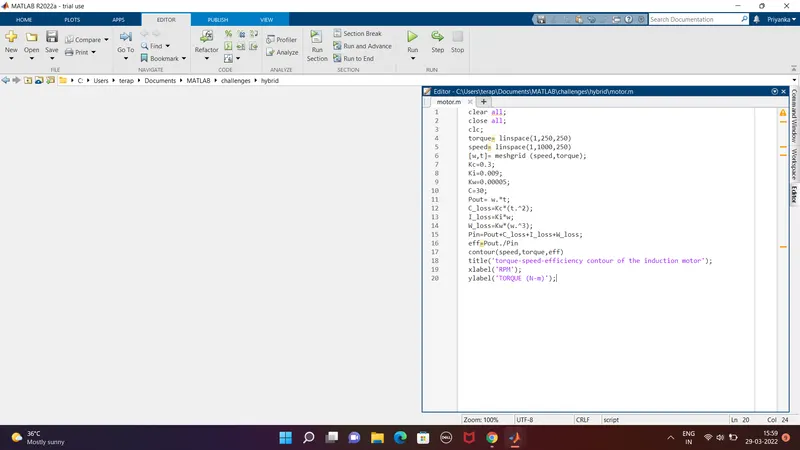
output: