Week-11 Challenge: Braking
AIM: To study the braking characteristics of an Electric Vehicle.
1. For a defined driving cycle, calculate the energy required for braking.
It involves the conversion of kinetic energy to thermal energy by applying friction to the moving parts of a system. The friction force resists motion and in turn generates heat, eventually bringing the velocity to zero. The energy is calculated by the difference of final velocity and initial velocity. The braking energy is given by,
Braking Energy = `1/2*"M"*(V_i^2-V_f^2)`
where,
`M="Mass of the vehicle = 2000kg"`
`V_f="Final velocity"`
`V_i="Initial velocity"`
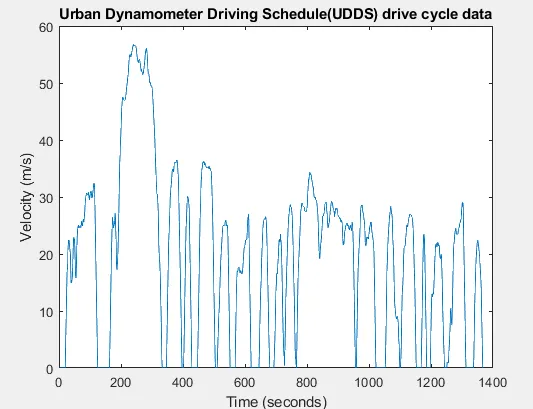
Program code for calculating the braking energy for any cycle, here UDDS drive cycle:
clear all
close all
clc

mass = 2000+0.5*(2000);
g = 9.8;
time_period = 1370; %the UDDS data file consists readings for 1370 seconds
filename = 'udds.xlsx'
num = xlsread(filename);
time = num(1:time_period,1);
velocity = num(1:time_period,2);
instantaneous_braking_energy = zeros(1,time_period);

for i = 1:(length(velocity)-1)
    if velocity(i)>velocity(i+1)
    instantaneous_braking_energy(i) = 0.5*mass*0.001*((velocity(i))^2- (velocity(i+1))^2)/3600;
    end
end

figure

subplot(1,1,1)
plot(time,velocity)
xlabel('Time (seconds)')
ylabel('Velocity (m/s)')
title('Urban Dynamometer Driving Schedule(UDDS) drive cycle data')

figure
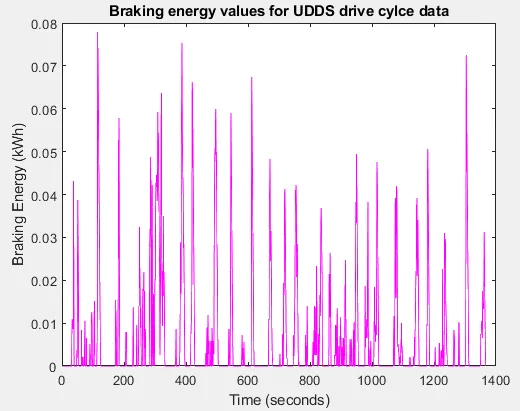
plot(time,instantaneous_braking_energy,'m')
xlabel('Time (seconds)')
ylabel('Braking Energy (kWh)')
title('Braking energy values for UDDS drive cylce data')

fprintf('The total braking energy for the UDDS driving cycle of %d seconds is %.3f kWhn',time_period,sum(instantaneous_braking_energy))
Braking energy displayed as output in the command window:

PLOTS:
2. Why electric motor can’t develop braking torque at a high speed similar to starting? How electric and mechanical brakes are coordinated?
An electric motor requires a high current at starting to make a motor run which produces the high torque at the time of starting. The speed-torque characteristics of an electric motor show us that the torque of a motor will be high and constant for speed below critical speed whereas the torque starts reducing once it reaches the critical speed and maintains the constant power at high speeds, hence EV motors can't develop braking torque at high speeds.
Brake control strategies:
- These strategies are used in order to apply the brakes. As the acceleration torque is higher than deceleration torque, only electric braking is not sufficient to stop the vehicle. Also while reducing the speed, the speed is not directly reduced, as a process, the regeneration takes place, where the curve enters into 2nd quadrant and again enter to 3rd to a reduced speed.
- In such cases to obtain the reduction in speed, series and parallel strategies are used.
- In series, mechanical and electric brakes are applied one after another, whereas, in parallel brakes, these are applied at a time.
- In order to control the system, Electric Driven Intelligent Brake System is used in order to control the vehicle. For low-speed generally, only one braking system is used, as a regenerative brake system, whereas for high-speed operations combination is used.
3. Make a MATLAB program that plots the contour of given motor speed, torque and efficiency values. Attach the code as a .m file attach a screenshot of all the plots.
Program code:
clear all
close all
clc

x = linspace(1,1000); %speed
y = linspace(1,300); %torque

kc = 0.2;
ki = 0.008;
kw = 0.00001;
ConL = 20; %for constant motor loss

[X,Y] = meshgrid(x,y);
outputpower = (X.*Y); %power=torque*speed
B = (Y.^2)*kc; %copper loss
C = X*ki; %iron loss
D = (X.^3)*kw; %windage loss

inputpower = outputpower+B+C+D+ConL;
Z = outputpower./inputpower; %efficiency
V = linspace(0.70,0.95,10);

%plotting
box off
grid off
contour(X,Y,Z,V);
title('Speed vs Torque');
xlabel('Speed(rad/s)');
ylabel('Torque(N.m)');
Graph:
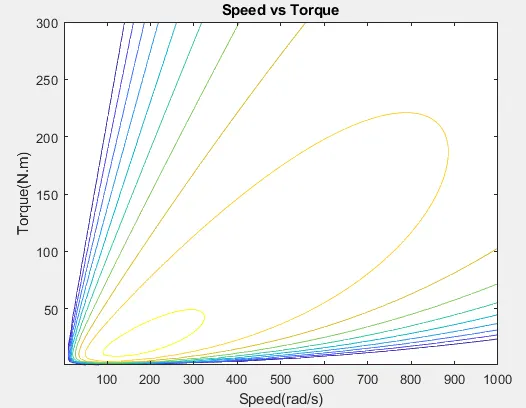
From the above speed vs torque graph, we can identify the yellow regions which are the high-efficiency region. The characteristics must operate in this region for high performance and high durability.