Week-11 Challenge: Braking
1.
FTP75 drive cycle:
Work done =K.E =0.5*m*v^2
m=mass of vehicle =1000kg
v= velocity of vehicle =Vf (100)- Vi (0) (vehicle decelarating from 100-0)
t=10 sec
Power required is P=E/t
P=(0.5*1000*(100*0.278)^2)/(10)
=38.36kw
Energy required for braking from 100-0 speed in 10 sec
E=0.0106 Kwhr
Energy required for braking from 100-0 speed in 1 sec
E=0.106 Kwhr
2.
Braking is as important as acceleration for acceleration and braking the vehicle certain amount of energy required. When considering the electric motor application in EV vehicles the braking of electric motor itself is braking the vehicle, electric braking is where the motor inherently apply brakes and the propulsion source itself provides the braking power.
Consider the case where electric vehicle operated by electric motor took 10 sec to reach O to 100 kmph speed and also took 10 sec to reach 100 to O speed.
We analyse this case to understand why electric motor can't develop braking torque at high speed similar to starting.
Case 1: Electric motor took 10 sec to reach O to 100 kmph :
When the vehicle is starting from zero speed at this stage the torque maintained by electric motor is almost constant. so, at low speed characteristics of motor the torque produced is constant hence the motor operates in constant torque region therefore the vehicle has higher acceleration power possible at low speed the motor torque is high. So it is easier for the motor to readh O to 100 speed. At this stage the both the speed and torque are positive this also called the first quadrant operation of motor here power is also positive this stage is called forward motoring stage.
Case 2 : Electric motor took 10 sec to reach 100 to O kmph :
When it comes to braking part where the torque is negative and the speed is positive therefore the power is negative this is called second quadrant operation of motor or forward braking stage. When this stage compared with the first quadrant operation of motor the peak acceleration torque and peak deceleration torque are not equal for electric motor vehicle because at high speed the value of the torque is lower. Here we are operating the motor in field weakening region or we are operating the motor above base speed we must know that the torque value is compromised.
Conclusion:
So the breaking torque of an EV motor is not as high as acceleration torque because of this the regenerative braking is not as effective. So, we cannot get all the power back to the battery while in regenerative braking because of deceleration torque is lesser compared to acceleration torque which is higher in electric motor.
2.
How electric and mechanical brakes are coordinated?
This is explained by the brake force distribution between electric(regenerative braking) and mechanical brakes. The brake forces are distributed keeping the safety in consideration here there are two axels of the vehicle where the brake force is distributed not equally but almost same. When the vehicle is running with low speed the electric brakes can be applied but when the vehicle is at high speed we have to apply both electric and mechanical brakes to make the vehicle come to zero speed in less time otherwise if we only apply electric brakes the time taken for the vehicle to come to rest is large and more this can happen if we allow the vehicle to run in coasting or free wheeling mode.
Keeping the 1) moment of inertia of vehicle
- vehicle speed
- kinetic energy stored in the vehicle
- forces acting on the vehicle
- time required for braking
- Mechanical losses like friction and wind-age losses.
The above all factors decide the type of braking needed for the vehicle at that particular instant of time based on that the electric and mechanical brakes are coordinated.
There are two brake control strategies developed they are:
1)Series braking. Here we apply the mechanical brakes and electric brakes one after another.
2)Parallel braking: Here we apply both mechanical brakes and electric brakes brakes simultaneously at a time.
Motor of electric vehicle is able to be used to brake regeneratively, so braking energy can be recycled. Braking stability of electric vehicles with electro-hydraulic hybrid braking system can be influenced by braking force distribution between hydraulic braking force and regenerative braking force. In order to research on braking stability and braking energy recovery, simulation platform of electro-hydraulic hybrid brake system based on Carsem and Matlab/Simulink is built, and a control strategy of electro-hydraulic hybrid brake were proposed. The vehicle simulation models with electro-hydraulic hybrid brake system and with conventional hydraulic braking system were applied the brake on different adhesion coefficient separately. The simulation results show when electric vehicle is in the conditions of low braking intensity, all vehicle braking force is provided by regenerative braking force, and braking energy can be not only recycled, but brake performance requirement can also be satisfied; when electric vehicle is in the conditions of moderate braking intensity, regenerative braking anf hydraulic braking are co-ordinated with each other , electro hydraulic brake cannot only satisfy the same and better brake performance , but also brake energy can be recycled and demand of hydraulic pressure can be reduced.
3. code are as folows:
clear all
close all
clc
speed= linspace(0,1000);
torque= linspace(0,500);
kc= 0.2;
ki=0.006;
kw=0.000010;
k=20;
[x,y] = meshgrid(speed,torque);
copper_loss= (y.^2)*kc;
iron_loss= x*ki;
windage_loss= (x.^3)*kw;
output_power= x.*y;
input_power= (copper_loss+iron_loss+windage_loss+output_power+k);
efficiency=(output_power./input_power);
n=linspace(0.7,0.95,10);
contourf(x,y,efficiency,n);
title('speed-torque efficiency')
xlabel('speed (rad/s)');
ylabel('torque (Nm)');
colorbar
Plot received is attached below:-
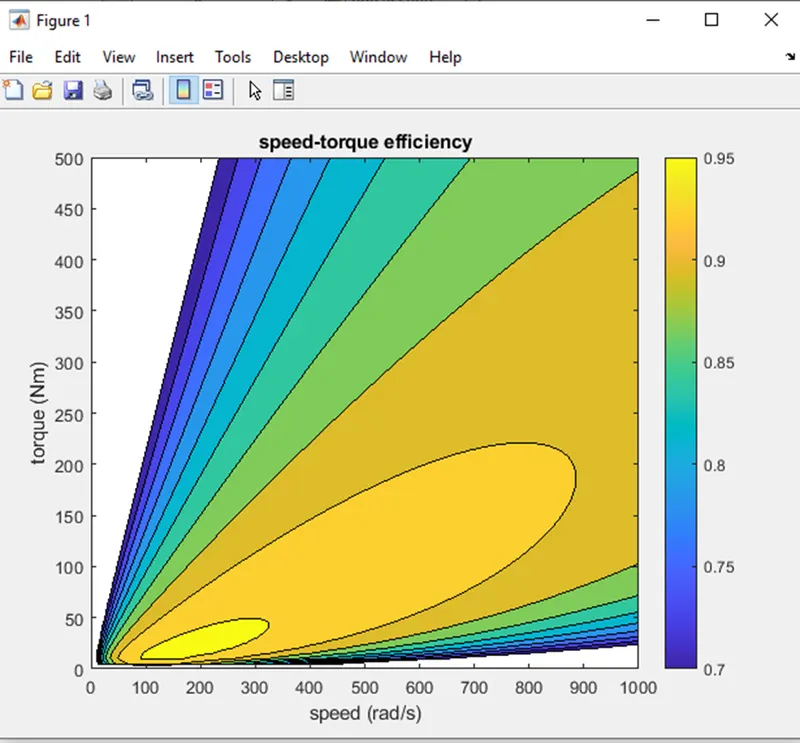
From this contour plot we observed that, the maximum efficiency is at the centre where speed ranges from 100-300 rad/sec & torque ranges from 0-50 Nm. The Minimum Efficiency is at outer side of the contour where speed is about 900-1000 rad/sec & torque is about 150-500 Nm. So we say that maximum efficiency is at the lower speed and low torque.