Week-11 Challenge: Braking
1.Energy required for the braking :
The thing is, the amount of energy required for vehicle to accelerte is the same amount of energy is required to braking the vehicle.
The energy required for acceleration =1/2*m*(Vf-Vi)^2
where m - mass of the vehicle (kg)
v- velocity of the vehicle(m/s)
The energy reuqired for the braking = 1/2*m*(VI-Vf)^2
where
Vf - final velocity
Vi- intial velocity
This is the drive cycle that i assumed :
The drive cycle is consists of 5 braking conditions ie,
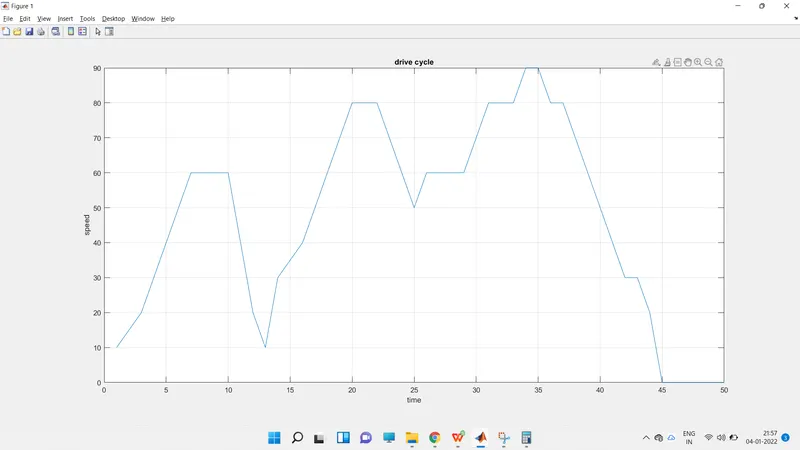
Energy claculation for braking :
| braking | change in speed(km/hr) | decelaration time (sec) |
decelaration (m/s^2) |
decelaration force (N) |
decelaration power(W) | energy(wh) | energy(kwh) | ||
| 1 | 50 | 3 | 4.616666667 | 4155 | 28.773 | 0.0079925 | 7.9925E-06 | ||
| 2 | 30 | 3 | 2.77 | 2493 | 10.358 | 0.002877222 | 2.87722E-06 | ||
| 3 | 10 | 1 | 2.77 | 2493 | 3.452 | 0.000958889 | 9.58889E-07 | ||
| 4 | 50 | 6 | 2.308333333 | 2077.5 | 14.386 | 0.003996111 | 3.99611E-06 | ||
| 5 | 30 | 2 | 4.155 | 3739.5 | 15.537 | 0.004315833 | 4.31583E-06 | ||
2.Torque of electric machine :
we know that, in any electrical machine the torque is given by armature current.
Thats is T∝I
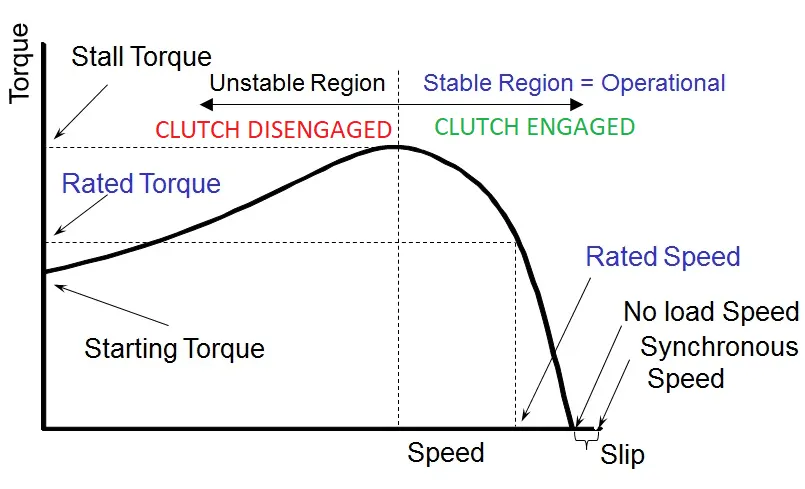
The motor draws a high current during the starting time.thats why the starting torque in electrical machine is high.
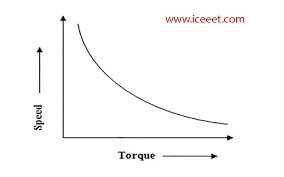
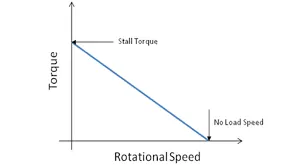
We can observe that in the below plot. These are the torque speed plots for different machines.
Another thing is the torque is inversly proportional to speed of the motor. T∝1/s.
That means the motor achive high torque and low speed when starting time.
when braking is applied :
The speed of the vehicle is very high when we need to brake the vehicle.
The speed is high means it prooduce the less torque as we seen in the motor characteristics.
Thats why the Electric vehicle motor can't produce the high torque (T) simliar to starting torque.
Thats why we use the frictional braking in addition with the regenarative braking.
Types of frictional brakes is electrical vehicle :
Friction brakes help stop a moving vehicle...... a car with disc brakes, force is applied to the outside of a disc located in the middle of the wheel. This force slows the wheel until it comes to a stop. Pressing the brake pedal harder creates more friction and pressure against the wheel, thus stopping it faster.
The two main types of friction brake are drum brake and disc brake
In both types a fixed (non-rotating) shoe or pad rubs against a moving drum or disc.
To increase the friction between the rubbing surfaces, a special friction material is attached to the fixed part. Earlier this friction material had a high content of asbestos, but its dust is injurious to health so that a safe asbestos free friction material is nowadays used.
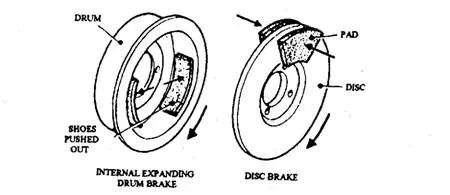
Drum brakes :
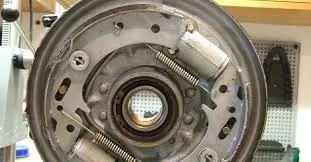
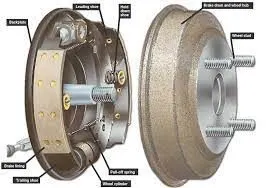
This internal expanding type of brake contains two shoes that are attached to a back-plate and are fixed to a stub axle or axle tube. The section of each shoe is of “T” shape.
A friction lining is riveted or bonded to the outer face of the shoe. A drive is fitted at one end of the shoe so that the shoe expands when the brake pedal is applied. In a simple brake a cam is used as a shoe expander, but modern systems for cars use hydraulically operated pistons for shoe expansion.
Disc brakes :
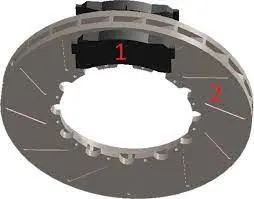
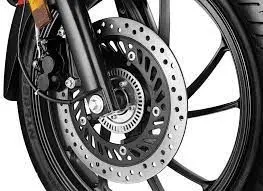
The hydraulic pressure forces the friction pads against the rotating cast iron disc. Consequently, the disc motion is retarded and heat generated from the energy of motion is conducted to the disc.
Since a large part of the disc is exposed to the air, heat is easily dissipated, so that the brake can be used continuously for long periods before serious fade occurs.
Electric and mechanical brakes are coordination :
The electric and mechanical brakes are coordinated in two ways, 1.series operation & 2.parallel operation.
1.series operation :
In this type of coordination the brakes are operated one after another i.e, intially the regenarative braking is appilied after that frictional brakes are applied .
2.parallel operation :
In this type of coordination the two types brakes are applied at simultaneously.
Electric driven intelligent brake :
This type of braking is used in the vehicles of Nissan leaf model.
EVs and hybrid vehicles use regenerative braking, which utilizes the motor to convert the kinetic energy during deceleration into electrical energy. With energy regeneration, an EV is able to run on less electricity and a hybrid vehicle on less fuel.
The EDIB (Electric Driven Intelligent Brake) allows and controls optimization of the regenerative brake and regular friction brake (hydraulic brake).
The plot tells us the how the braking is working
During high speeds of the vehicle the motor produce light torque so mostly the vehicle is braked by friction brake which we see intially.
During low speeds the torque of the machine is high so the most amount of the braking covered by regenerative braking.
At that time less amount of friction brakes are used.
3.MATLAB program which plots contour of given motor speed, torque and efficiency :
contour (z) creates a contour plot containing the isolines of matrix Z, where Z contains height values on the x-y plane. MATLAB® automatically selects the contour lines to display. The column and row indices of Z are the x and y coordinates in the plane, respectively.
The .mat code plots contour of given motor speed, torque and efficiency
Intially we giving the different speeds and toques using the linspace variable.
After that connstants for losses are declared and then losses are calculated.
diffrent formules are computed like input , output ,effficiency
After that for diffrent efficiency an linspace variable is used.
matlab code :
clc
w=linspace(0,1000); %speed array
T=linspace(0,500); %torque array
%losses in machine
kc=0.18;
ki=0.006;
kw=0.000015;
K=20;
[x,y]=meshgrid(w,T);
CL=(y.^2)*kc; %copper losses
IL=x*ki; %iron losses
WL=(x.^3)*kw; %windage losses
outputpower=x.*y; % output power
inputpower=outputpower+CL+IL+WL+K; % input power
efficiency=outputpower./inputpower; % efficiency
n=linspace(0.8,0.95,10); % no of efficiency plots
contour(x,y,efficiency,n);
title('effficiency contour')
xlabel('speed rad/sec')
ylabel('torque Nm')
grid on
contour plot for the given speed ,torque , and efficiency :
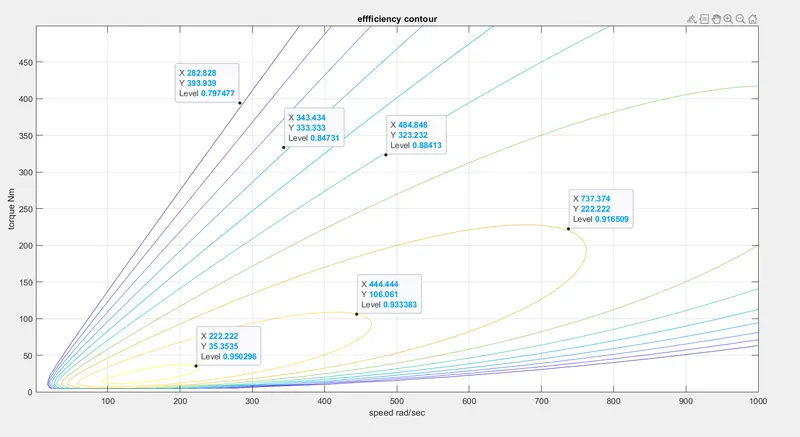
from the above plot we can say that the efficiency is max 95% with speed 222 rad/sec and torque 35.3Nm .
The efficiency is 93% at speed 444.4 rad/sec and torque 106.06Nm .
The efficiency is 91% at speed 737.3rad/sec and torque 222.2Nm .
The efficiency is low 79.7% at speed 282.8rad/sec and torque 393.3Nm .