Week-11 Challenge: Braking
#ANSWER 1:
Consider a vehicle with Kerb weight =800kg and payload = 200kg
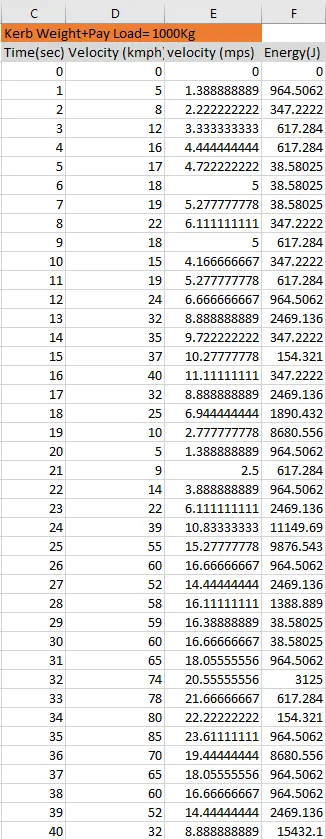
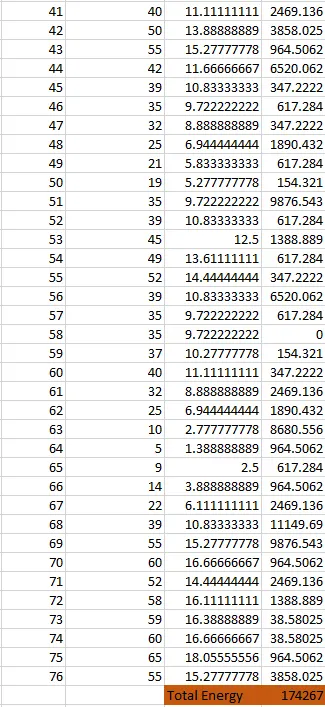
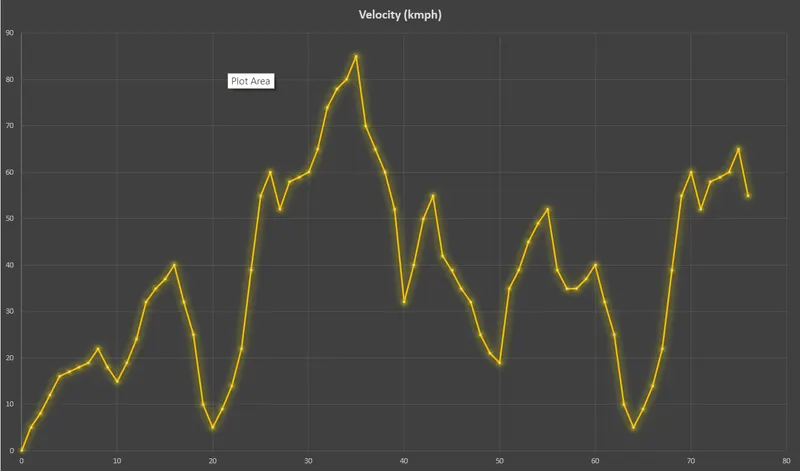
we constructed a driving cycle using Microsoft Excel and
we found the energy for each second.
let V1 be the initial velocity and V2 be the final velocity in m/s.
and m be the total weight of the vehicle that includes kerb weight and payload.
then the energy can be calculated for this transition is
KE(joules) =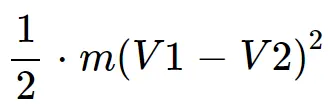
the energy required to move the velocity from V1 to V2 and V2 to V1 are equal since we are squaring the difference of velocities.
#ANSWER 2:
* Electric Motor braking is referred as Regenerative braking, in regenrative braking when vehicle decelerates the motor generates negative torque to slowdown the vehicle.
* the current direction becomes reverse hence motor delivers current to the input if the inverter contains a bidirectional connection.
* The back EMF of the motor is greater than the supply voltage during such periods.
*At higher rpm's when the motor apply breaks the current which flows in opposite direction have reduced value which inturn produces the weak flux and thus generated torque is low.
* At low speeds, the torque is high , after reaching the rated speed the torque falls down from the rated torque.
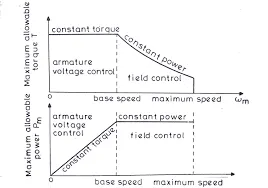
the top curve shows the relation between Torque vs speed and below curve shows relation between power vs speed .
here from above we can observe that upto rated speed the torque produced is constant and power is increasing.
and after rated speed the torque falls down and power is maintained at constant value.
at such high speeds the torque is very much lower than the rated torque.
coordination between electrical & mechanical breaks:
Nowadays we use electrical and mechanical break coordination to achieve effective breaking of the vehicle. in electrical aspect we use regenerative breaking, in which the current and torque becomes negative thus slowdowns the vehicle.
in mechanical breaking , these are the classical breaks using friction and hydraulic cylindrical system. the distribution of the break force must be uniform.
when regeneration breaking happens , if it exceeds the regeneration capacity or the charging capacity then we need to coordinate mechanical breaking system to achieve smooth breaking operation. In reality we will apply both breaks.
there are some methods to control the breaking , which are
1. series combination of breaking
2. parallel combination of breaking
1. in series combination of breaking , mechanical breaks and regenerative braking are connected one to another . we can control from either regenerative or mechanical braking.
2. in parallel combination of breaking , the both breaks are connected in parallel. we need to apply the both breaks at a time.
Electric Driven Intelligent Brake (EDIB) ( By Nissan)
EDIB is the combination of both regenrative breaking along with mechanical Hydraulic breaks also.
which are connected in parallel.
#ANSWER 3:
close all;
clc;
Torque = linspace(1,500);
Speed = linspace(1,1500);
[W,T]= meshgrid (Speed,Torque);
Kc = 0.8;
Ki = 0.08;
Kw = 0.00005;
C = 18;
outP = W.*T;
A = Kc*(T.^2);
B = Ki*W;
L = Kw*(W.^3);
inP = outP+A+B+C+L;
eff = outP./inP;
contour(Speed,Torque,eff)
title('speed- torque chars')
xlabel('speed(rpm)')
ylabel('Torque')
here Kc,Ki,Kw are cu and iron and windage losse coefficients respectively.
C is the constant loss . A,B,C,L are the corresponding lossses.
efficiency is denoted by eff.
eff = (output power /input power)
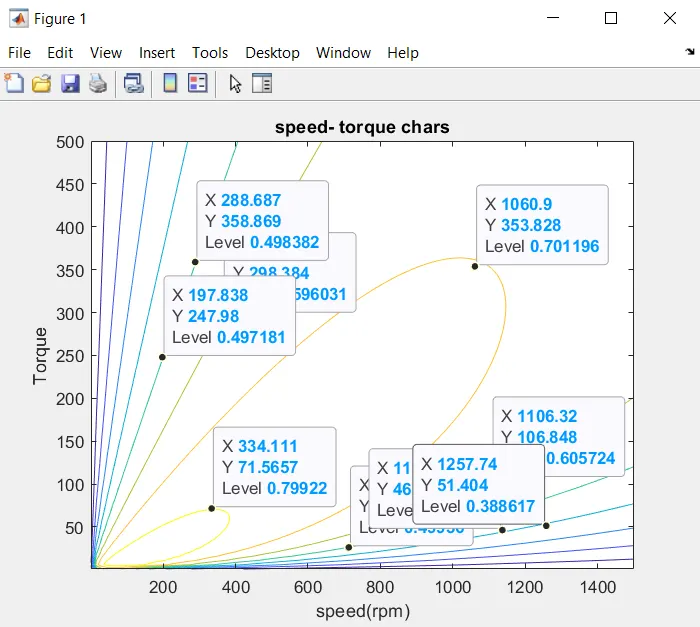
observations :
1. here speed values are on X- axis and Torque is on Y- axis .
2.at speed of 334 rpm torque at 71 N-m we can get the efficiency of 79.9% .
that efficiency is same along that line , which constitutes multiple speed and torque values.
3. we can understand that to achieve 79.9 % efficiency the speed is limited to 400 rpm and torque is limited to around 70 N-m.
4. the points located in the curve gives information about the speed torque and efficiency.
5. the second contour line gives the 70.1% efficiency line .
as we move farthest the efficiency decreses.