Week-4 Challenge WOT Condition Part-2
#ANSWER 1:
MAPPED MODEL OF ENGINE:
In Mapped Models the data used for the operation and simulation are to be entered in a form of Lookup Table which would be then configured with the operational parts and the analysis would be formed.
If the detailed specifications/Lookup Table data is available with us the simulation becomes easier and it gives the results on the basis of data interpreted. Also known as Global Based Model.
The drawback of this model is more data has to be collated and some assumptions might also have to be taken.
(i)Engine:
Engine Performance could be simulated with the Array of data interpreted in the system. Whereas all conditions such as Engine Operations, Power, Efficiency could be measured accordingly.
(ii)Motor:
Motor Specifications such as rpm, maximum efficiency, Heat, and such specifications are to be entered for simulating the results
(iii)Generator:
Specifications for Battery Torque, Battery Current, Motor Torque and others are to be enetered for simulation.
DYNAMIC MODEL OF ENGINE:
In Dynamic Model it understands the behavior of the part/element and then it behaves accordingly. It gives detailed analysis for the variations entered by us in the Specifications whereas it simulates according to real and dynamic operations.
It operates dynamically depending on the situation of operation detailed data and specifications are not required and the simulation gives the detailed analysis of the components simulated.
It is also known as Real-Time Based Model.
The drawback of this model it could not simulate as per our customized specifications.
(i)Engine:
Engine performance will be simulated as per the original/real engine specifications of the designated vehicle chosen for simulation. All results would be obtained with real-time details.
(ii) Motor:
actual details for the same would be considered and the results would be obtained.
(ii) Generator:
All the details and specifications would be considered as per the actual and dynamic state the results of the same would be obtained then.
consider electric vehicle reference Application
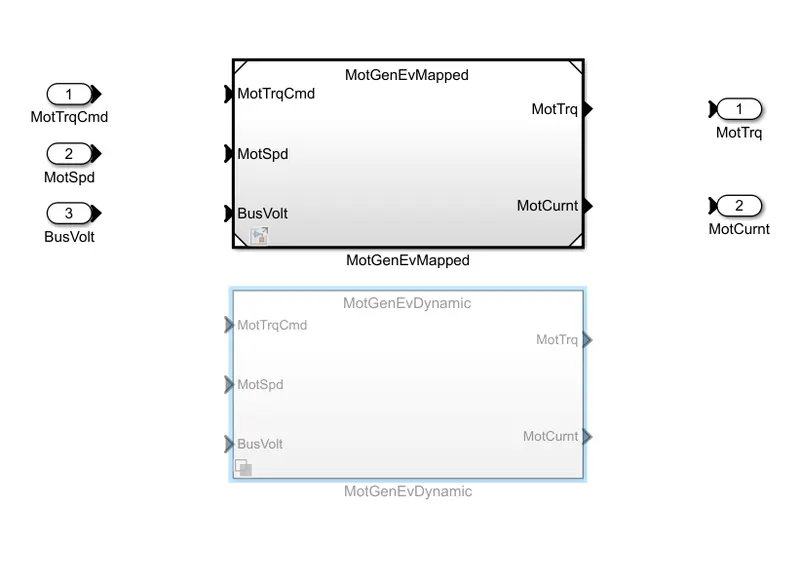
to change the model from mapped to dynamic
convert the dynamic model to varient subsystem,
and select varient subsystem and select which model you want to enable
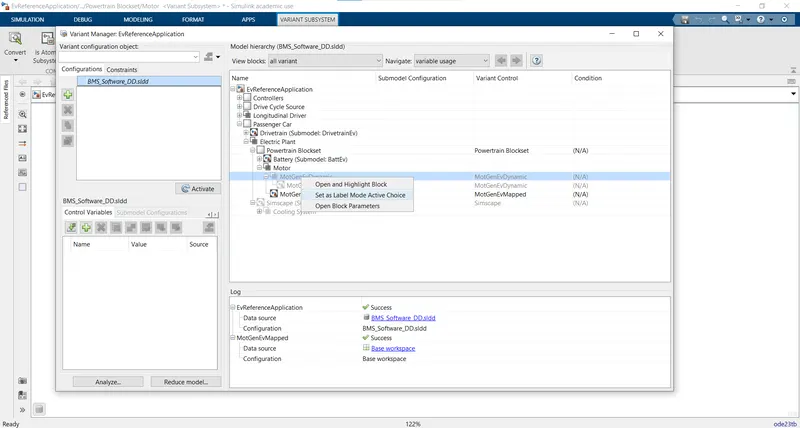
choose "set as label mode active choice".
then the model is changed to dynamic.
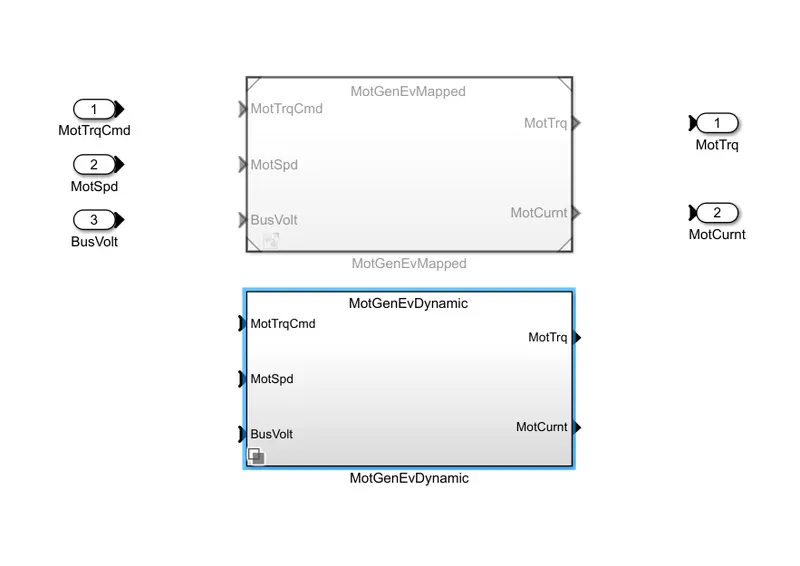
#ANSWER 2:
the factors considered for fuel flow are
1. vehicle speed
2. battery power
3. flow of fuel.
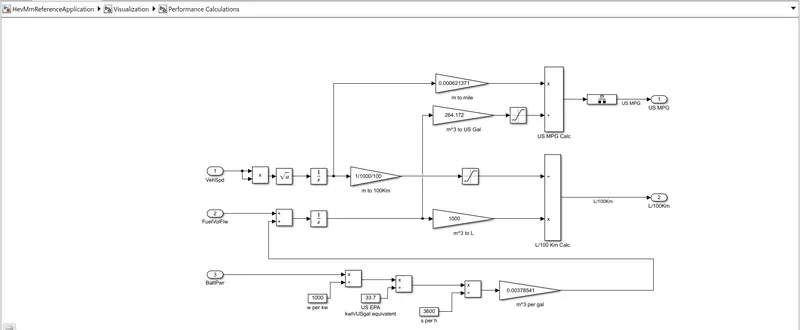
miles per gallon means , How much distance the vehicle can travel with one gallon of fuel
we considered the hybrid electric vehicle model since it contains the both the sources battery and fuel.
we know that 264.172 US Gallons = 1000 L.
The input for the running of battery and fuel flow are converted into Gallons by multiplying 264.172.
and we get the distance covered from the vehicle speed , and multiply by 0.000621 to convert into miles.
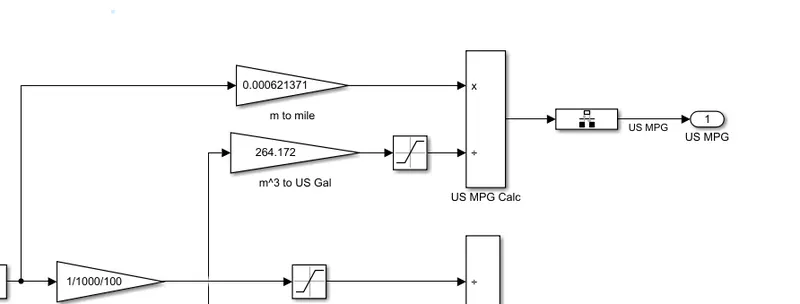
we convert into the respective units by doing appropriate calculations.
with the use of miles and gallons we can easily calculate the miles /gallon.
# ANSWER 3:
we applied WOT condition for the hevmm application
and we changed the parameters as shown below.
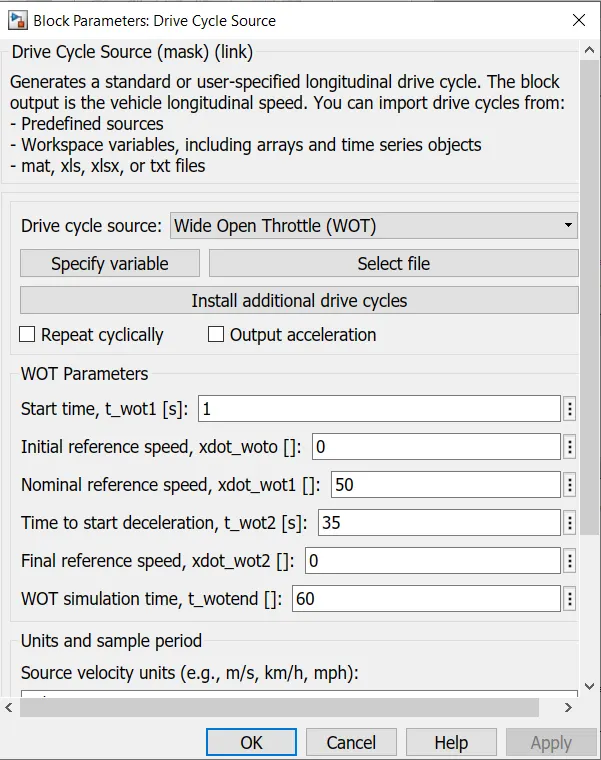
and click on OK and then run the simulation
the results obtained are :
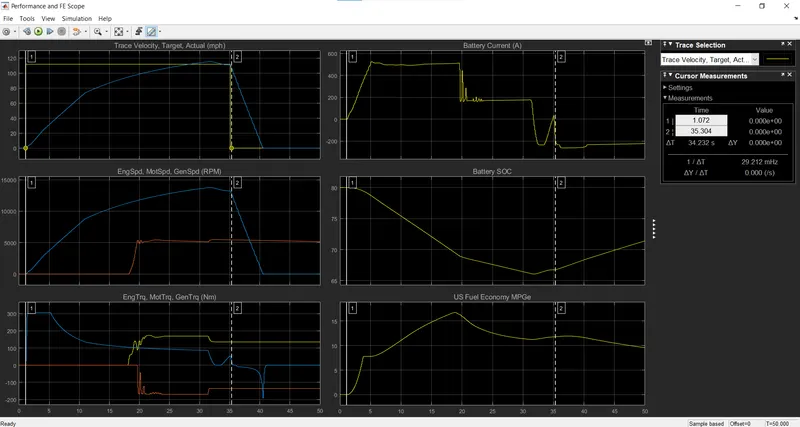
OBSERVATIONS:
1. TRACE VELOCITY ACTUAL Vs ACTUAL:
Here we can observe that the actual speed meets the desired speed at 28 seconds. the desired speed is nearly 110 mph.
and then decelration starts from 35 seconds.
2. MOTOR AND GENERATOR SPEEDS:
in the second plot of the results we can see the moment of engine speed and generator speeds .
3. ENGINE TORQUE AND GENERATOR TORQUE:
In the 3rd plot we can observe the moments of torques of generator and motor .
4.BATTERY CURRENT Vs TIME:
in the 4th plot we can see the changes in the battery current with the time ,
while it is charging it is taking current and while it is discharging it is delivering current. that is why the current is negative in charging mode that is decelaration.
5. BATTERY SOC Vs TIME:
We can see the percentage of charge decresed with time . here in the 5th plot it was shown the percentage falls from 80 to 67 and then again charges to 72 nearly.
6.US Fuel Economy MpGe:
it is the fuel efficiency tells that miles per gallon equvivalent of the vehicle. we can observe this in the 6th plot .
now we changed the grade and wind velocity in the environmental block.
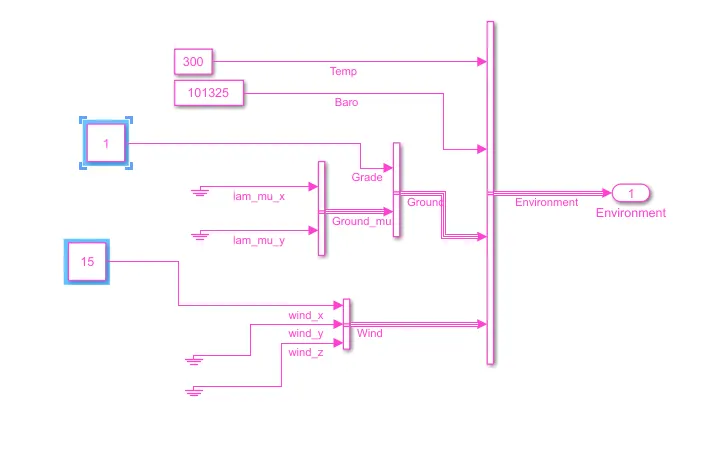
and now click on Run . to get the simulation results.
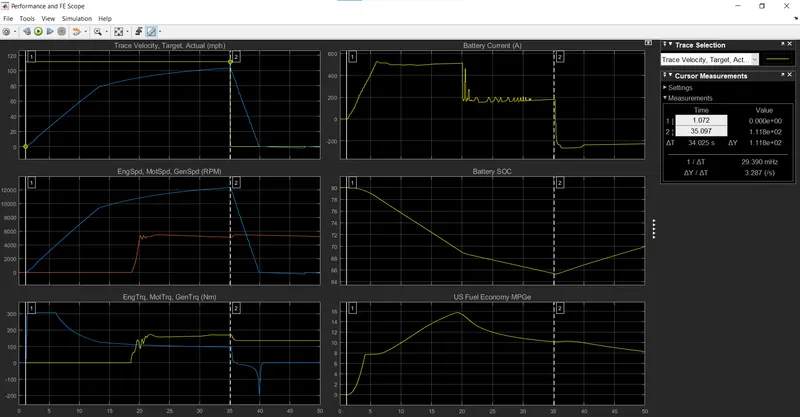
OBSERVATIONS:
1. TRACE VELOCITY ACTUAL Vs ACTUAL:
Here we can observe that the actual speed doesnot meet the desired speed. and starts decelrate after35 seconds.
2. MOTOR AND GENERATOR SPEEDS:
in the second plot of the results we can see the moment of engine speed , the engine speed is reduced because of the grade chage.
3. ENGINE TORQUE AND GENERATOR TORQUE:
In the 3rd plot we can observe the moments of torques of generator and motor .
there is no much difference with the previous result with the present one.
4.BATTERY CURRENT Vs TIME:
in the 4th plot we can see the changes in the battery current with the time ,
while it is charging it is taking current and while it is discharging it is delivering current. that is why the current is negative in charging mode that is decelaration. current has fluctuations from 20 th second to 30th second.
5. BATTERY SOC Vs TIME:
We can see the percentage of charge decresed with time . here in the 5th plot it was shown the percentage falls from 80 to 66 and then again charges to 70nearly. which is similar to the previous result.
6.US Fuel Economy MpGe:
it is the fuel efficiency tells that miles per gallon equvivalent of the vehicle. we can observe this in the 6th plot .
there is no much difference in the fuel efficiency.
#ANSWER 4:
we changed the parameters of grade and wind velocity and wot drive cycle for the ev also same as hev which is in the ANSWER 3.
the results of ev reference application
with the same parameters of hev with changes in grade and wind velocity are:
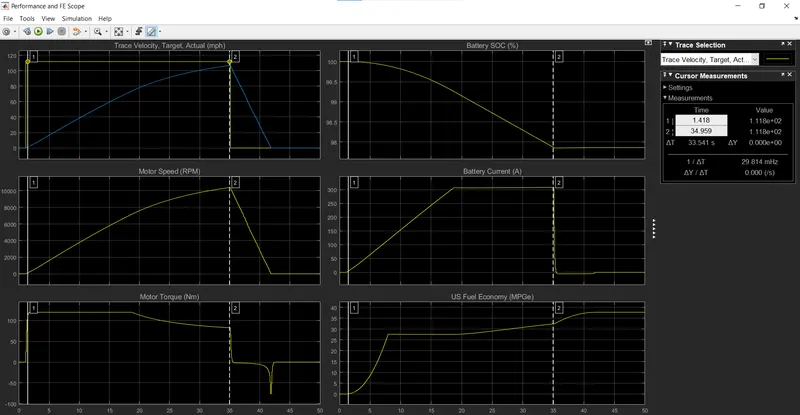
conclusions:
1. both ev and hev are not able to meet the desired velocity with in time.
2.and ev doesnot have ic engine while hev have both battery and IC engine.
3. ev battery dont charge while decelerating but hev can, because of having engine .
4. fuel efficiency is very much impressive for EV compared to HEV.
5. and the decrease in soc is also very good in EV compared to Hev.